What SkillBridge is, precisely
SkillBridge is an authorized industry training or internship in your final months of service. You work at a civilian employer, full time, while still on active duty at full military pay and benefits, in a permissive TDY status. The employer gets a long interview; you get civilian experience and, often, a job offer before your DD-214 prints.
Two things it is not:
- Not an entitlement. Commanders may deny or modify applications — reduce the length, change the dates, or decline outright — based on mission needs. The regulation says so explicitly.
- Not paid by the employer. You may not accept compensation from the provider. Ordinary perks offered to all employees (a parking stipend, a gym membership) are allowed only where expressly identified in the provider's SkillBridge DoD MOU.
Eligibility — four gates
| Gate | Requirement |
|---|---|
| Time in service | At least 180 continuous days on active duty. |
| Time remaining | Expect to be discharged or released within 180 days of starting the program. |
| Characterization | Expected to separate with general (under honorable conditions) or higher. |
| TAP first | Initial counseling and pre-separation counseling complete before you submit the application. |
That last one is the sequencing error people actually make. TAP Initial Counseling has its own hard deadline at 365 days out — but if you intend to do SkillBridge, IC isn't a 365-day task, it's a prerequisite that has to clear months earlier so the application can move. Treat IC as an 11-month item at the latest.
The 180-day box — the constraint that breaks plans
Here is the rule that quietly determines your entire final year: you are prohibited from starting a SkillBridge program and associated leave more than 180 days before your date of separation. That is the Air Force’s wording (AFI 36-2671 ¶6.4.4.1; the Space Force’s SPFI 36-2672 ¶6.4.4.1 says the same), and the Coast Guard’s participation statement binds leave the same way (COMDTINST 1040.7, Enclosure (1)). The other three services draw the box differently — see below.
On the Air Force, Space Force and Coast Guard reading, everything shares that space:
- SkillBridge PTDY (the training itself)
- PTDY for relocation and house hunting — which can be used consecutively with SkillBridge PTDY
- Terminal leave, whose last day coincides with your last day of active duty and comes at the end of the overall SkillBridge program dates
So a 180-day SkillBridge and 60 days of terminal leave do not both fit. If you want a long program and to burn a large leave balance, one of them has to give — which usually means selling leave back instead. Our terminal leave vs. sell-back guide covers what that trade actually costs.
How the Army, Navy and Marine Corps draw it. The DoD rule itself binds the program’s start (DoDI 1322.29). The Navy reaches the same box by order: SkillBridge must come before any terminal leave or PTDY, so the block starts when SkillBridge does (NAVADMIN 064/23 ¶4). The Marine Corps counts PTAD and leave used with SkillBridge against your category limit — 120 or 90 days, tighter than 180 (MARADMIN 280/24 ¶3.b). The Army binds the start of your CSP or SkillBridge (AR 600-81 ¶5-4c(3)) and will not move your separation date to make room for the program, or for terminal leave after it (¶5-4c(4); AR 600-8-10 ¶5-12c(14)(g)). None of these rules limits terminal leave on its own — the box exists because of SkillBridge.
One more hard edge: you cannot separate or retire while in a PTDY status. The program has to end before your date, not on it.
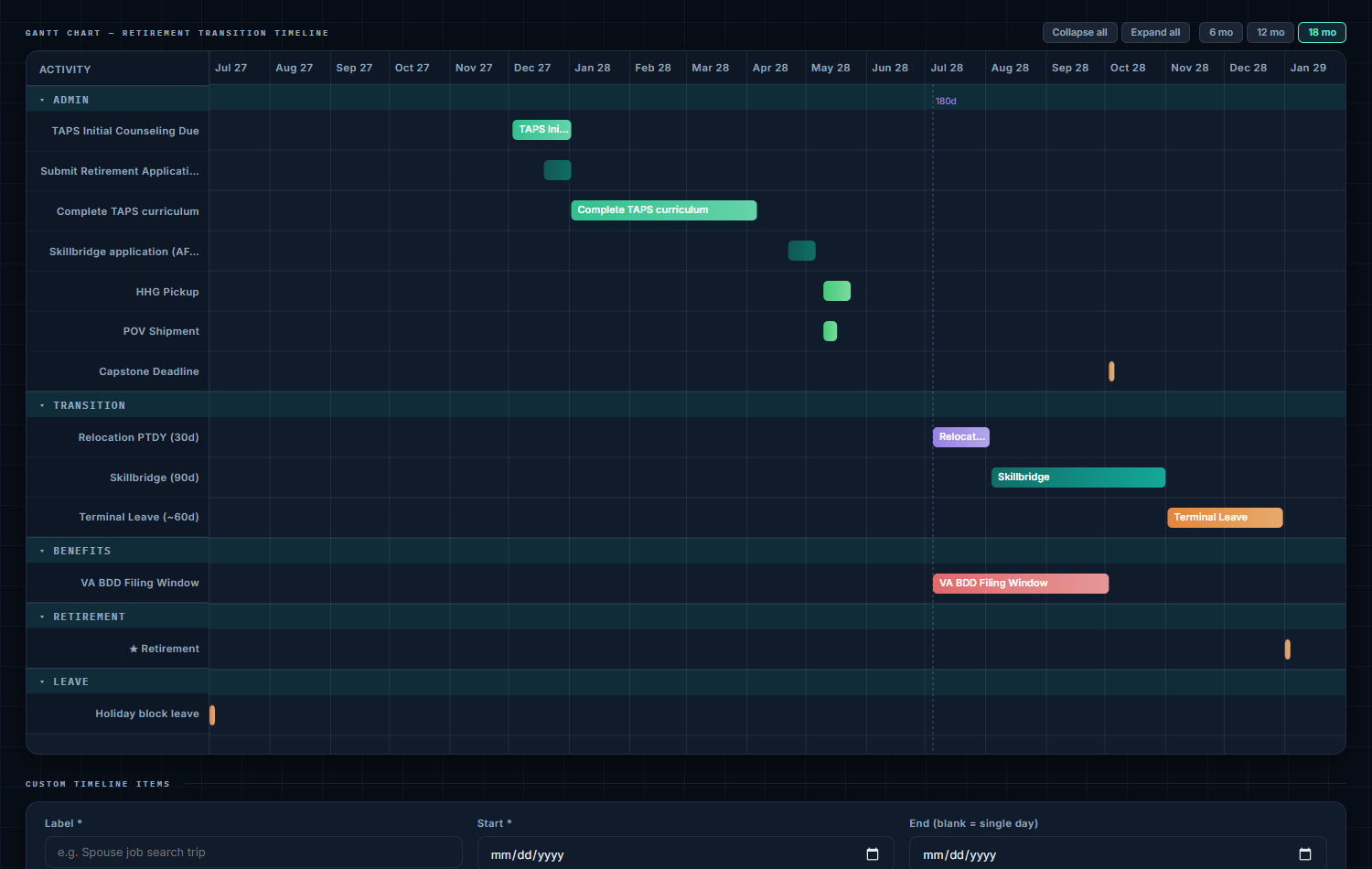
WheelsUp lays SkillBridge, relocation PTDY, and terminal leave on one timeline — so you can see where your SkillBridge start falls against the 180-day window, measured the way your service measures it, before you commit to a program length rather than after.
How long you actually get
The DoD ceiling is 180 days — no program may exceed it, no exception. But your service sets shorter limits by grade: the Air Force publishes them as a rank-based table, with senior grades restricted and O-6 exceptions requiring coordination above the approval authority. Check your branch's table before you scope a program, because a plan built around 180 days when your grade rates fewer is a plan you rewrite.
Exceptions to policy (ETPs) exist. They apply to any rank and may exceed the grade-length restrictions — but never the 180-day ceiling — where the program supports OSD or congressional priorities identified in the SkillBridge program guidance. ETPs are denied only where releasing you would impact critical readiness.
Reserve members: terminal leave days count toward the total SkillBridge training days requested, and the combined total can't exceed your allowable participation days. The leave doesn't sit alongside the program; it's inside it.
Pending a medical board? Members meeting a full MEB have no official separation date. You submit an ETP to establish an expected date, with estimated timelines set within 180 days of the MEB notification, documented on the Form Letter 4 with medical codes redacted.
The application sequence
- Complete TAP initial + pre-separation counseling. Gate, not formality.
- Complete DoD Ethics Training — and review gifts, conflicts of interest, and post-government employment rules with an ethics official. This matters more than it sounds: the post-government employment restrictions bind you after you leave, and the provider you train with is frequently a defense contractor.
- Find a provider with an approved DoD MOU. No MOU, no program. The MOU covers the training duration and defines what the provider may and may not give you.
- Build the training plan with the provider. This is the document your commander approves — vagueness here is what gets applications returned.
- Submit with every date included: SkillBridge PTDY training, relocation/house-hunting PTDY if eligible, and terminal leave based on your projected remaining ordinary leave. The application is where the 180-day box gets checked.
- Allow real time for command approval, then monitor the request and respond to system notifications.
- File the approved authorization as your PTDY source document in your service's leave system. This is the piece people forget, and it's what makes your status legal.
Start the provider search around 9–10 months out. The chain — IC → ethics → provider → training plan → command approval — takes longer than any single step suggests.
Branch differences worth knowing
- Air Force / Space Force: applications run through AFVEC, and the approved application is filed in LeaveWeb as the PTDY source document. Grade-length restrictions live in AFI 36-2671's Table 1.
- Army: delivered as the Career Skills Program (CSP); initial counseling must be complete before a CSP application, and the authorization becomes your PTDY source document.
- Navy: approval runs through your commanding officer — confirm who signs early; the Navy has no separate branded portal.
- Marine Corps: same DoD program, CO approval, coordinated through your career planner and the Transition Readiness Program.
- Coast Guard: participates directly in the DoD program; the same 180-day rule applies.
Branch checklists with each service's full deadline set: Air Force · Army · Navy · Marine Corps · Coast Guard.
Sources
- DoDI 1322.29 — the DoD SkillBridge program: PTDY status, no compensation from the provider, not an entitlement, and the 180-day start restriction
- AFI 36-2671 (31 March 2026) — ¶4.1.1–4.1.3 eligibility (180 continuous days; separation within 180 days of starting; general discharge or higher; TAP counseling before application) · ¶4.5.5 ethics review · ¶6.4.4–6.4.4.2 (all dates in the application; the 180-day prohibition; consecutive relocation PTDY; no separating in PTDY status; Reserve terminal-leave inclusion) · ¶7.5.1 (ETPs; program cannot exceed 180 days) · ¶7.6–7.6.1 (MEB members, FL-4) · Table 1 (grade-based length restrictions) · MOU-identified benefits at ¶¶167–180
- DoDI 1332.35 — the TAP initial-counseling requirement that gates the application
- Branch delivery: AR/CSP (Army), MILPERSMAN (Navy), MARCORSEPMAN / TRP (Marine Corps), COMDTINST 1000.4C (Coast Guard) — each branch pack carries its own citations
Spot an error? Tell us — citations are the product here.
One timeline, with the 180-day window measured the way your service measures it. WheelsUp back-plans every deadline from your actual date and branch, with the citation attached to each card.