What BDD actually buys you
Benefits Delivery at Discharge lets you file a VA disability claim before you separate, so the VA can gather evidence and work the claim while you're still on active duty. The point is timing: a decision can land shortly after you get out rather than many months later.
The alternative isn't losing anything — you can always file a standard claim after separation. What you lose is the head start, and for most people that head start is the difference between a rating that arrives during terminal leave and one that arrives after two or three civilian paychecks have already come and gone.
The window: 180 to 90 days
BDD is available when you have between 180 and 90 days remaining on active duty. Both ends matter:
| Days remaining | What you can do |
|---|---|
| More than 180 | Too early. The window hasn't opened. Use this time to gather evidence. |
| 180 to 90 | File BDD. File early in the window, not at the back of it. |
| Fewer than 90 | Too late for BDD — you file a standard claim instead (still fine, just slower). |
The failure mode is almost never filing too early. It's arriving at 95 days out with records you haven't pulled and an exam you haven't scheduled, and then watching the window close. Treat the 180-day mark as a filing date, not an opening date.
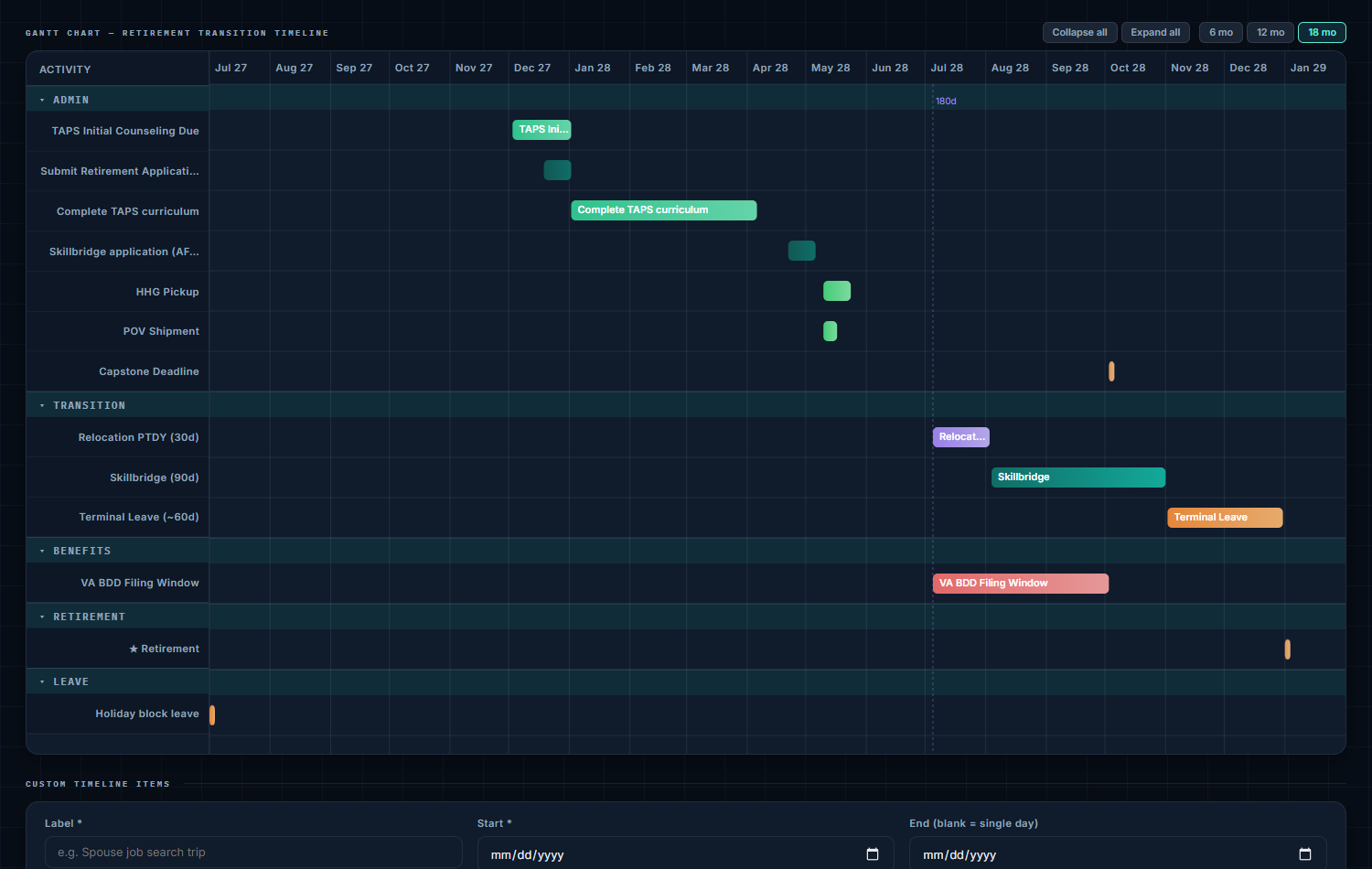
WheelsUp puts both edges of the BDD window on your timeline — computed from your actual separation date, alongside the SHPE scheduling milestone that feeds it.
One exam, two purposes
Your Separation History and Physical Exam / Separation Health Assessment is required as part of transition regardless — it documents your conditions at separation and feeds your clearance. It can also serve as your BDD exam, giving the VA the medical evidence it needs without a second round of appointments.
There's a real trap in how you route it. If you have the exam done through the VA as a BDD exam, the results must reach DoD in time — and if they don't, the military treatment facility has to complete its own. That's a re-do you'll discover late.
Practical rule: if your timeline has any slack, the VA route is efficient. If your timeline is tight, don't bank solely on it — coordinate with your MTF early so you know which path you're on and who's responsible for the paperwork arriving where.
What to have ready before the window opens
Everything below is work you do at 12–8 months out, so the filing itself is short:
- Your complete service treatment records. Request them early; retrieval is the slowest step in this entire process.
- A written list of every condition you intend to claim, with the approximate date it started and where it was documented. Conditions treated but never documented are the ones that cost people ratings.
- Private medical records for anything treated off-base.
- Buddy statements for conditions that were real but under-documented — incidents, exposures, injuries treated in the field.
- Your separation date confirmed in writing, since the entire window is computed from it and a date change moves both edges.
Then, when you file: be available for exams before you separate. Availability is the practical condition on the whole program — a claim filed inside the window still needs you reachable and examinable while you're still in.
What happens to the rating afterward
A rating decision is the start of several other calculations, not the end of one:
- Combined ratings don't add. 50% and 30% is not 80%. The VA combines them with a specific table under 38 CFR §4.25 — see our guide to the combined-ratings math.
- If you're retiring, VA compensation normally offsets retired pay dollar for dollar. CRDP removes that offset at a 50% or higher rating — our CRDP guide covers who qualifies.
- If you took involuntary separation pay, VA compensation is generally used to recoup it — see the ISP guide.
- VA disability compensation is not taxable (38 U.S.C. §5301), unlike retired pay.
Sources
- VA Benefits Delivery at Discharge program — the 180-to-90-day filing window and pre-discharge claim processing (va.gov)
- DoD Separation Health Assessment policy; DoDI 6040.46 — the SHPE/SHA requirement and its use as the BDD exam
- 38 U.S.C. §5301 — VA compensation is not taxable income
- 38 CFR §4.25 (combined ratings table) · 10 U.S.C. §1414 (CRDP) · DoDI 1332.29 (ISP recoupment) — for what happens after the rating
Every branch pack in WheelsUp carries this window with its own branch's SHPE scheduling guidance attached. Spot an error? Tell us — citations are the product here.
Both edges of the window, on your calendar. WheelsUp back-plans every deadline from your actual date and branch, with the citation attached to each card.