180 days of TRICARE, at no premium
The Transitional Assistance Management Program is 10 U.S.C. §1145(a) doing something unusually generous: qualifying separated members and their dependents receive medical and dental care under §1076 in the same manner as a dependent, plus health benefits contracted under §1079(a), for 180 days beginning on the date of separation from active service.
No premium. No enrollment fee. Six months of coverage while you find civilian insurance — which is exactly the window in which most separating families are most exposed.
The catch is that it doesn't apply to everyone, and the people it doesn't apply to are the ones who most often assume it does.
Who qualifies — the list is specific
§1145(a)(2) enumerates the covered categories:
- (A) A member involuntarily separated from active duty. The main category.
- (B) A Reserve member separated from active duty called or ordered under §12304b or a provision referenced in §101(a)(13)(B), where the active duty exceeded 30 days.
- (C) A member separated from active duty for which they were involuntarily retained under §12305 in support of a contingency operation — stop-loss.
- (D) A member separated from active duty served under a voluntary agreement to remain on active duty for less than one year in support of a contingency operation.
- (E) A member receiving a sole survivorship discharge (as defined in §1174(i)).
- (F) A member separated from active duty who agrees to become a member of the Selected Reserve of the Ready Reserve.
- (G) A National Guard member separated from full-time National Guard duty under 32 U.S.C. §502(f) for more than 30 days, performing federally funded duties responding to a declared national emergency.
⚠ An ordinary voluntary separation at the end of your obligated service is not on that list. Neither is retirement — retirees get retiree TRICARE instead, which is better. If you're separating voluntarily and not joining the Selected Reserve, plan on buying coverage.
Category (F) is the one worth noticing. Agreeing to become a member of the Selected Reserve qualifies you for TAMP. If you were already weighing a Reserve affiliation, this is a real and frequently overlooked part of its value.
One refinement: for members under (B) or (G), the dental entitlement is the active-duty dental care under §1074 rather than the dependent-style care, per §1145(a)(3).
When the 180 days start
The clock starts on the date you separate from active service — not on your terminal-leave start date, and not when your DD-214 is issued.
A specific rule covers extensions: for members under (B), (C), (D) or (G) who, without a break in service, are extended on active service for any reason, the 180-day period begins on the date of separation from that extended active service. So an extension moves your window rather than consuming it.
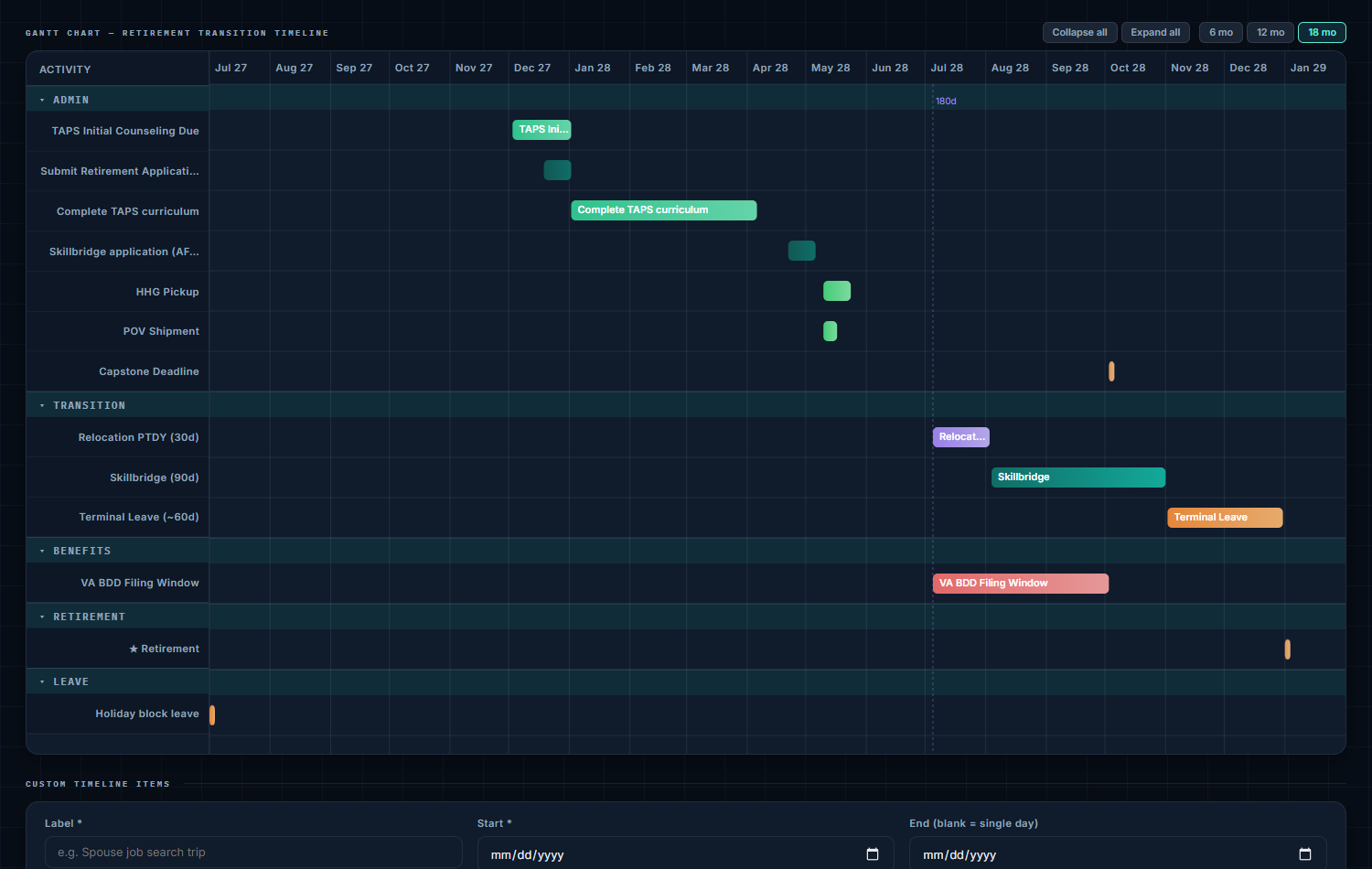
WheelsUp puts your TAMP window and your civilian-coverage start date on the same timeline — so the gap between them is something you close deliberately, not discover.
The extension nobody talks about
This is the provision that makes TAMP worth reading the statute for. §1145(a)(7)(A):
A member with a medical condition relating to active service that warrants further medical care and that is identified during the 180-day transition period — where a DoD physician determines the condition can be resolved within 180 days — is entitled to medical and dental care for that condition, and that condition only, as if still on active service, for 180 days following the diagnosis.
Read that timing: the condition must be identified during your transition period, and the new 180 days run from the diagnosis. A condition found in month five of TAMP can extend care for that condition well past your original window.
§1145(a)(7)(B) requires the Secretary concerned to keep DEERS continually updated to reflect that continuing entitlement — which is your practical lever if a provider tells you your eligibility has lapsed.
The actionable implication: get seen early. Conditions identified inside the window carry protection that conditions identified after it do not. If something has been bothering you, the first month of TAMP is a much better time to raise it than the seventh.
The separation exam is required — and it now asks about burn pits
§1145(a)(5)(A) requires members scheduled for separation in these categories to undergo a physical examination and a mental health assessment (conducted pursuant to §1074n) immediately before separation.
Three details:
- The physical can be waived if you've had one within 12 months before your scheduled separation — but only with your consent and your unit commander's concurrence (§1145(a)(5)(B)). Don't let it be waived reflexively; that exam is evidence for your VA claim.
- It must assess burn-pit and airborne-hazard exposure — §1145(a)(5)(C) requires the exam to include an assessment of whether you were based or stationed where an open burn pit was used, or exposed to toxic airborne chemicals or other contaminants, including information recorded in the VA's registry. Make sure your deployments are actually captured.
- Referrals come with obligations. §1145(a)(6) requires DoD, in consultation with the VA, to ensure members who receive a referral for follow-up treatment get information and referrals for VA care — including counseling and treatment for PTSD and other mental health conditions — information on private-sector treatment in their community, and assistance enrolling in the VA health care system.
This exam is also the natural companion to a BDD claim — see our BDD timeline guide.
After the 180 days — the conversion policy
§1145(b) requires DoD to inform you before your discharge of the availability for purchase of a conversion health policy for you and your dependents, providing coverage for not less than 18 months. This is the statutory basis for what most people know as CHCBP.
Two things make it more than a footnote:
- Pre-existing conditions. If you purchase a conversion policy during the applicable period, the Secretary provides or pays for care during the 18-month period and for a condition existing at the start (including pregnancy) that the policy won't cover solely because it's pre-existing (§1145(b)(2)).
- Price is capped by statute. If DoD can't contract with a private insurer at a rate not exceeding the 5 U.S.C. §8905a(d)(1)(A) benchmark, it must offer the policy itself, and the amount you pay may not exceed that benchmark for comparable coverage (§1145(b)(4)–(5)).
Purchase it during the applicable period — or within a reasonable time after, as prescribed. Practically: treat the enrollment deadline as short and act inside TAMP, not at the end of it.
The short checklist
- Determine whether you're in a §1145(a)(2) category — don't assume. If you're separating voluntarily, you probably aren't, unless you're joining the Selected Reserve.
- Don't waive the separation physical unless you have a reason; make sure exposures are documented.
- Get seen early in the 180 days for anything unresolved — the (a)(7) extension only reaches conditions identified during the window.
- Decide on the conversion policy inside the window, not at the end of it.
- File your VA claim; enroll in VA health care with the assistance §1145(a)(6) requires be offered to you.
Sources
- 10 U.S.C. §1145 — (a)(1) entitlement to §1076 care and §1079(a) contracted benefits for the member and dependents; (a)(2)(A)–(G) the covered categories; (a)(3) active-duty dental for (B) and (G) members; (a)(4) the 180-day period and the extended-active-service rule; (a)(5)(A)–(D) the required physical and §1074n mental health assessment, the 12-month waiver with member consent and commander concurrence, and the burn-pit / airborne-hazard assessment; (a)(6) follow-up referral assistance including VA enrollment; (a)(7)(A)–(B) the 180-day extension for conditions identified during the transition period and the DEERS updating requirement; (b)(1)–(6) conversion health policies of not less than 18 months, pre-existing condition coverage, and the 5 U.S.C. §8905a(d)(1)(A) price ceiling; (c) hardship care for members not otherwise eligible
- 10 U.S.C. §1076, §1079 — the care and benefit authorities TAMP points to · §1074, §1074n — active-duty dental and the mental health assessment
- 10 U.S.C. §1174(i) — sole survivorship discharge · §12304b, §12305, 32 U.S.C. §502(f) — the mobilization authorities in the covered categories
Spot an error? Tell us — citations are the product here.
The coverage gap, closed deliberately. WheelsUp back-plans every deadline from your actual date and branch, with the citation attached to each card.