Who actually qualifies
Involuntary Separation Pay is narrower than its reputation. Under DoDI 1332.29, full ISP requires all of the following:
| Requirement | Detail |
|---|---|
| Years of service | At least 6 years, but fewer than 20, of active duty / active service. For Reserve members, 6 years of continuous AD/AS immediately preceding separation — continuous meaning no break exceeding 30 days. |
| Involuntary | You are being separated. Choosing to leave does not qualify you. |
| Characterization | Fully honorable. |
| Ready Reserve agreement | A written agreement to serve at least 3 years in the Ready Reserve (Selected Reserve or IRR) following separation — in addition to any other service obligation. |
That last row surprises people, and it is not a formality. A member who declines to enter into the Ready Reserve agreement is not eligible — the DoDI lists declining as a disqualifying condition outright. Some services state this even more bluntly: Navy policy provides that ISP will not be paid without a signed Reserve contract or a Reserve enlistment denial letter, with no exceptions.
So if you are being involuntarily separated and intend to claim ISP, line up the Reserve agreement before your separation date. Discovering the requirement afterward is discovering it too late.
The formula
Full separation pay is 10 percent of the product of your years of active service and 12 times your monthly basic pay at the time of discharge or release:
ISP = 0.10 × years of active service × 12 × monthly basic pay
The DoDI's own worked example, for an E-5 separated after 8 years of active service:
0.1 × (12 × $2,989.80 × 8) = $28,702.08
One accounting detail that costs people money: periods for which you previously received separation pay, severance pay, or readjustment pay may be counted for eligibility — to get you over the 6-year minimum — but may not be used in the multiplier for a subsequent separation. You can use those years to qualify; you can't be paid for them twice.
Note also that "half ISP" exists as a separate, reduced category in policy for certain circumstances. Confirm which you're being offered — the difference is the entire second half.
The recoupment — this is the part to plan around
ISP is not a windfall. It's an advance against benefits you may later receive, and the government takes it back.
If you later become entitled to retired or retainer pay, the amount is recouped from each payment of retired or retainer pay until the total deducted equals the total ISP received. The DoDI's illustration: a retiree with $1,800.00 gross monthly retired pay and a 50.8% recoupment rate has $914.40 deducted monthly — and the recoupment rate is recomputed whenever gross retired pay increases for COLAs.
There's a tax nuance in that same example worth catching: only the difference between the recoupment and gross retired pay ($885.60) is taxable. You are not taxed on money that never reaches you.
VA disability compensation recoupment follows the same principle: ISP received is recovered from later VA compensation. You sign a recoupment disclosure acknowledging this as a condition of payment — which means nobody can honestly say they weren't told, and also means a lot of people sign it during the worst week of their career and don't absorb it.
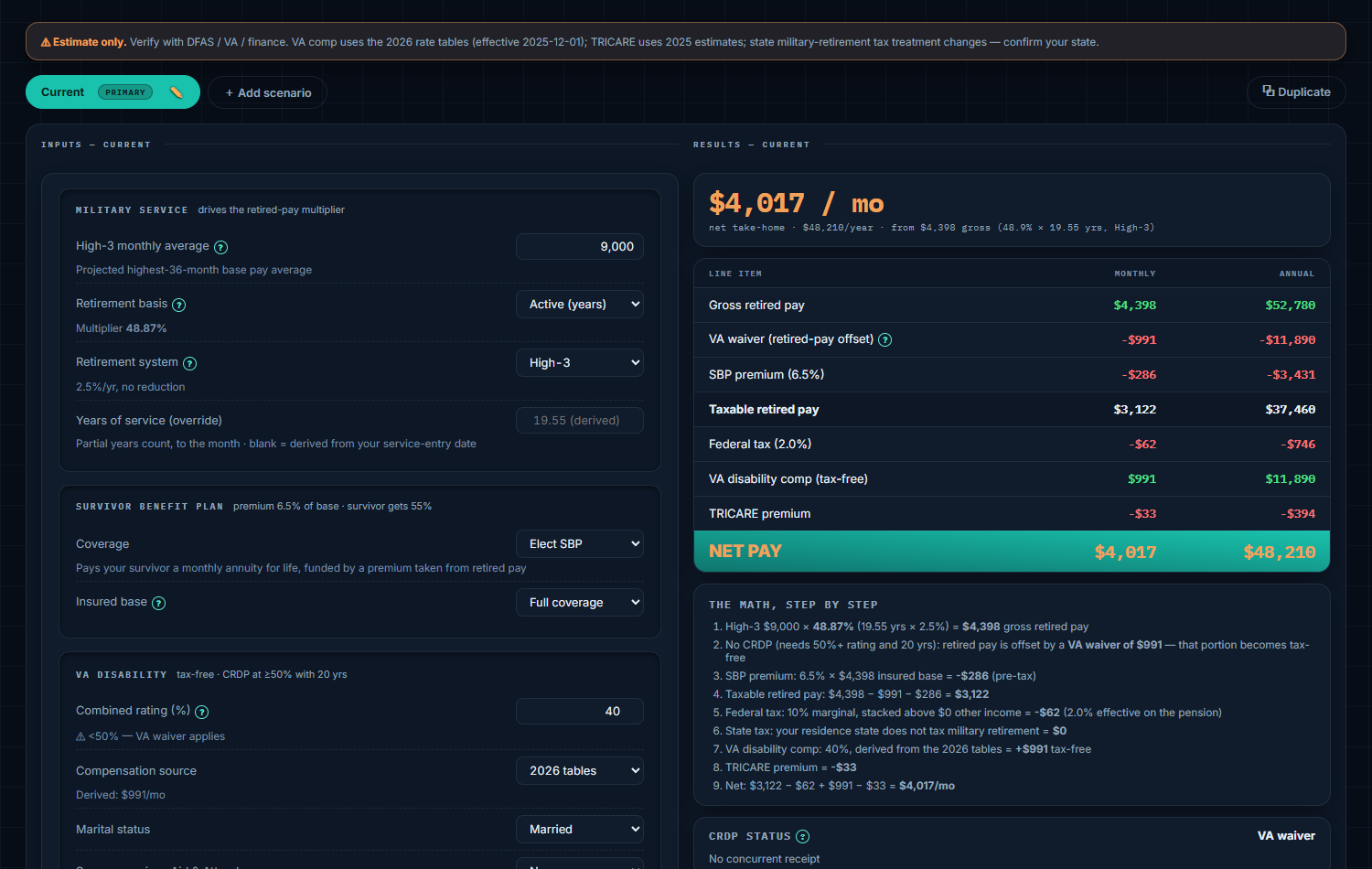
WheelsUp models separation pay and its recoupment against your projected retired pay and VA compensation — so the number you plan around is the one you'll actually keep.
How to think about it
The honest framing: ISP is liquidity now in exchange for reduced benefits later, and whether that's good depends entirely on your situation.
- If you will never draw retired pay and never receive VA compensation, ISP is simply money — recoupment has nothing to attach to.
- If you have a service-connected condition and expect a rating, expect the recoupment. Budget the lump sum as a bridge, not as savings.
- If the Ready Reserve obligation puts you back in a position to reach 20 years, the calculus changes entirely — and so does the recoupment, since retired pay becomes the thing it's collected from.
- The three-year Ready Reserve obligation is a real commitment, with drill or IRR obligations that follow you into whatever civilian life you're building. Weigh it as part of the price, not as paperwork.
The most common mistake is spending ISP as though it were a bonus, then meeting the recoupment two years later against a VA check you were counting on.
What else comes with an involuntary separation
- TAMP — 180 days of transitional TRICARE. Involuntary separation is the primary qualifying category under 10 U.S.C. §1145. Voluntary separations are not covered. See our TAMP guide, including the extension for a condition identified during those 180 days.
- A conversion health policy is available for purchase, covering not less than 18 months (§1145(b)) — the statutory basis for CHCBP. Enroll promptly; the window is short.
- File your VA claim. The BDD window (180–90 days before separation) applies to you the same as to a retiree — see our BDD guide. Yes, a rating triggers recoupment; it also establishes service connection permanently, which is worth far more over a lifetime than the recouped amount.
- Verify your DD-214 line by line. The separation code and characterization drive both ISP eligibility and much else downstream.
Sources
- DoDI 1332.29, Involuntary Separation Pay (Non-Disability) — ¶3.1 eligibility (6 to fewer than 20 years of AD/AS; the Reserve continuity rule and the 30-day break definition; fully honorable characterization; the written 3-year Ready Reserve agreement); ¶3.1.c the Ready Reserve obligation as an additional obligation; ¶3.2 the full-ISP formula (0.10 × years × 12 × monthly basic pay) and its E-5 worked example; the previously-received-separation-pay counting rule (eligibility yes, multiplier no); the declining-Reserve-service disqualification; and the recoupment provisions with the worked $1,800.00 / 50.8% / $914.40 example, COLA recomputation, and the taxability of only the net amount
- 10 U.S.C. §1174 — the underlying separation pay authority
- 10 U.S.C. §1145 — TAMP transitional health care for involuntarily separated members, and (b) conversion health policies of not less than 18 months
- Service implementations, e.g. MILPERSMAN 1910-050 (Navy — signed Reserve contract or enlistment denial letter required, no exceptions) · MARCORSEPMAN Ch 13
⚠ Pay figures in the DoDI example are illustrative and tied to the pay table in effect at publication. Verify your own amount with your personnel office and finance.
Spot an error? Tell us — citations are the product here.
The lump sum, and what you actually keep. WheelsUp back-plans every deadline from your actual date and branch, with the citation attached to each card.