One process, two very different endings
The Integrated Disability Evaluation System produces one of three outcomes: fit for duty, medical separation, or medical retirement. The gap between the last two is enormous, and it's decided by a rule you can state in one line.
| Medical retirement (Ch 61) | Medical separation | |
|---|---|---|
| Trigger | Rated ≥30% for the unfitting condition — or 20+ years of service | <30% and under 20 years |
| Statute | 10 U.S.C. §1201 | 10 U.S.C. §1203, severance under §1212 |
| Pay | Chapter 61 retired pay, monthly, for life | One-time disability severance pay |
| SBP | Eligible | Not eligible |
| Health care | Retiree TRICARE | 180 days of TAMP, then buy coverage |
30% versus 20% is not a 10-point difference in a rating. It's the difference between a pension with lifetime health care and a lump sum with six months of transitional coverage. Everything else in this guide follows from that.
The IDES timeline — and what the goals actually mean
IDES is a joint DoD–VA process. Its published targets:
| Milestone | Target from referral |
|---|---|
| MEB referral — the clock starts | Day 0 |
| NARSUM (medical narrative summary) drafted | ~30 days |
| VA C&P exams complete | ~45 days |
| MEB case file complete, forwarded to the PEB | ~100 days |
| Informal PEB fitness determination | ~130 days |
| Election window after the PEBLO brief | ~140 days |
| Formal PEB (only if you appeal) | ~165 days |
| Final disposition | ~180 days |
These are goals, not entitlements. The DoD model targets completing the MEB portion of active-component cases in roughly 100 days and reaching disposition within roughly 180 days of referral. Real cases run faster and, more often, slower. Plan on the process taking longer than the model and be pleasantly surprised.
The one genuinely efficient part: IDES uses a single set of VA Compensation & Pension exams to drive both the military fitness determination and your VA disability rating. You do not sit two parallel exam processes.
The election window — the deadline that defaults against you
After the Informal PEB issues findings, your PEBLO briefs you. You then have a limited window to accept the IPEB findings or demand a Formal PEB.
Missing that window can default to acceptance. That is the single most consequential deadline in the entire process, it is short, and it lands at a moment when you are managing a medical condition and an uncertain future simultaneously.
Practical guidance:
- Know the date the moment you're briefed. Write it down at the brief, not afterward.
- Review the NARSUM with your PEBLO before it goes forward. The narrative summary is the document the boards actually read; errors and omissions in it are far cheaper to fix at draft stage than to appeal later.
- You may appear with counsel at a Formal PEB. Use that.
- There is usually a further review above the FPEB — the service-level board or council that handles final administrative appeals before disposition locks.
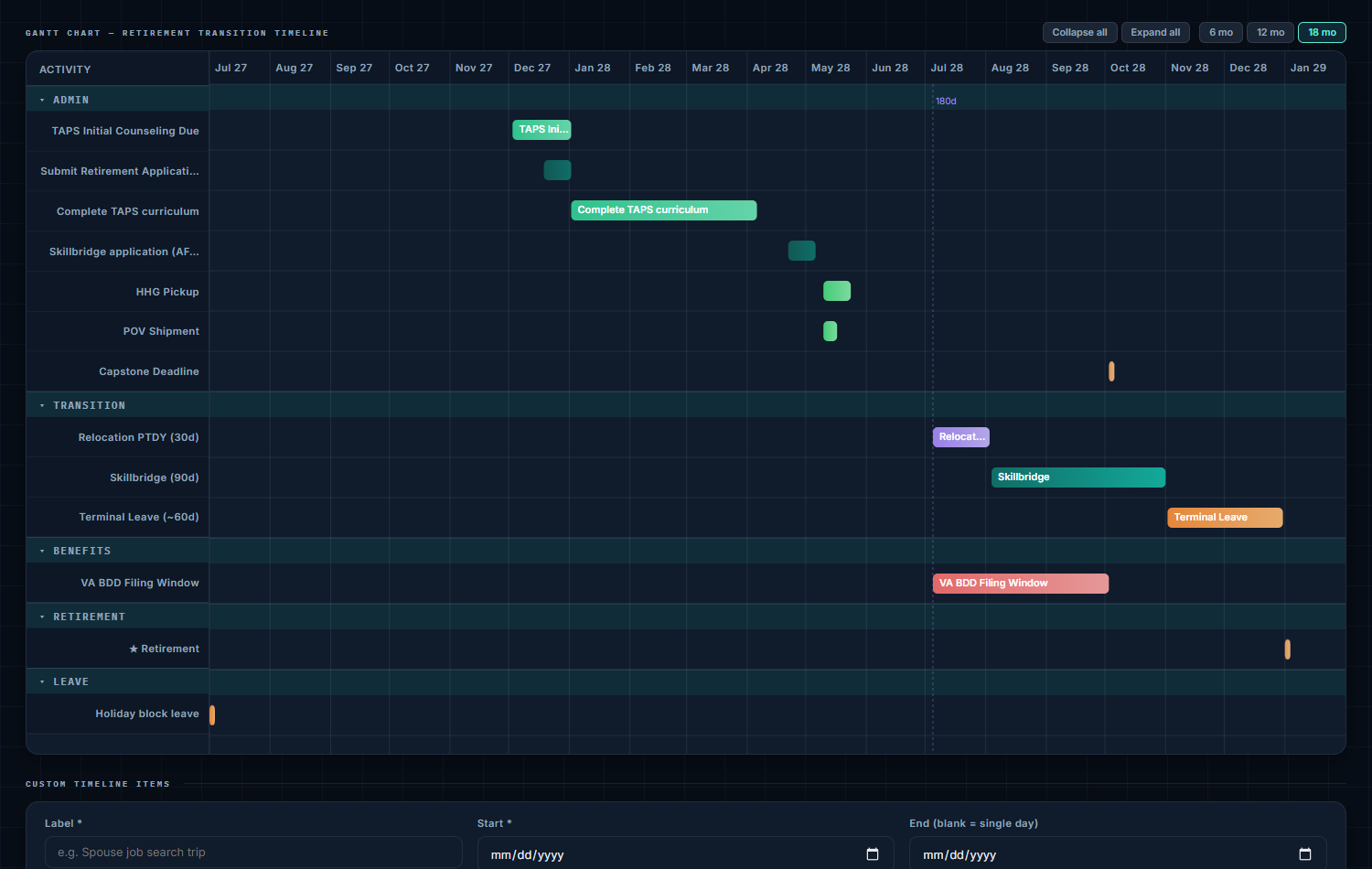
WheelsUp models the medical track as its own timeline — MEB referral, C&P exams, the IPEB, the election window, and disposition, with the outcome branching on your rating and years of service.
Disability severance pay — and the recoupment
Under 10 U.S.C. §1212(a), severance is computed by multiplying your years of service (as computed under §1208) by twice the amount of monthly basic pay — using the highest of several grade bases the statute enumerates, including a higher temporary grade served satisfactorily or a grade you would have been promoted to but for the disability.
Two boundaries in §1212(c): a minimum years-of-service floor applies (and is higher for combat-related cases), and the maximum is 19 years.
Now the part people don't see coming. §1212(d)(1): severance is deducted from any VA compensation for the same disability. You receive the lump sum, and then your VA compensation is reduced until the severance has been recouped.
The exception matters: §1212(d)(2) — no deduction is made for severance received for a disability incurred in the line of duty in a combat zone, or incurred during performance of duty in combat-related operations as designated by the Secretary of Defense. If your condition is combat-related, whether it is documented as such is worth real money.
If you're retired: how Chapter 61 pay is computed
Chapter 61 retired pay is the greater of two computations: the disability percentage × your retired-pay base, or the ordinary length-of-service formula (2.5% × years × base, or 2.0% under BRS) — capped at 75%.
Two important interactions:
- CRDP still requires 20 years. Chapter 61 retirees must meet the 20-year threshold for full concurrent receipt — see our CRDP guide. A medically retired member at 12 years with a 60% VA rating does not automatically get both checks in full.
- Divorce treats Chapter 61 pay specially. Under 10 U.S.C. §1408(a)(4)(A)(iii), the portion equal to retired pay computed using the disability percentage at retirement is excluded from disposable retired pay — see our USFSPA guide.
The TDRL — retired, provisionally
If your condition isn't stable, you may be placed on the Temporary Disability Retired List under 10 U.S.C. §1210. You're re-examined periodically and re-adjudicated, with a final determination by the three-year mark.
Practically: TDRL is not a decision, it's a deferral. Your final outcome — permanent retirement, separation, or return to duty — is still open, and your obligation to show up for re-examinations is real. Under §1210, the grade and pay computations on removal from the TDRL are made as if you had been reappointed or reenlisted before the retirement, transfer, discharge, or elimination.
The choice some members have
If you are already eligible for a length-of-service retirement at the time of your disability evaluation, you may be able to elect a length-of-service retirement instead of a disability retirement, provided the date falls within the disability-retirement timeframe.
That's a genuine choice with real trade-offs — tax treatment, how CRDP and combat-related programs apply, and how the ratings interact all differ. It is exactly the kind of decision to walk through with your PEBLO rather than decide from an article. Just know the option exists; many members don't.
Whose system are you in?
- Air Force / Space Force: DAFI 36-3212, with the Secretary of the Air Force Personnel Council on final appeals.
- Army: AR 635-40 and DA Pam 635-40.
- Navy and Marine Corps: SECNAVINST 1850.4F — the DON DES and the Navy PEB, which adjudicates Marine cases too.
- Coast Guard: its own — COMDTINST M1850.2D, the CG PDES, with "Fit For Duty" / "Not Fit For Duty" findings and CGPC-adm referral. Not the Navy PEB.
The joint IDES framework (DoDI 1332.18) and the Chapter 61 thresholds are common to all of them; the boards, the forms, and the appeal routes are not.
Sources
- 10 U.S.C. Chapter 61 — §1201 (retirement, ≥30% or 20+ years) · §1203 (separation) · §1206 · §1208 (service computation) · §1210 (TDRL, periodic re-examination, computations on removal) · §1212 (a) severance formula — years of service × twice monthly basic pay at the highest applicable grade basis; (c) minimum and 19-year maximum; (d)(1) deduction from VA compensation for the same disability; (d)(2) the combat-zone / combat-related-operations exception
- DoDI 1332.18 and its Volumes 1–3 — the joint IDES: single VA exam set, the ~100-day MEB and ~180-day disposition goals
- Service implementations: DAFI 36-3212 (Air Force/Space Force) · AR 635-40 and DA Pam 635-40 (Army) · SECNAVINST 1850.4F (Navy and Marine Corps) · COMDTINST M1850.2D (Coast Guard PDES)
- 10 U.S.C. §1145 (TAMP for medical separatees) · §1414 (CRDP and its 20-year floor) · §1408(a)(4)(A)(iii) (Chapter 61 pay excluded from disposable retired pay)
⚠ IDES timelines are goals, not guarantees, and every case is individual. Your PEBLO is the authority on your dates and deadlines.
Spot an error? Tell us — citations are the product here.
The medical track, as its own timeline. WheelsUp back-plans every deadline from your actual date and branch, with the citation attached to each card.