The decision you can't undo
The SBP election is made at retirement and is effectively permanent (10 U.S.C. §1448). Two structural facts frame everything below:
- Married members are enrolled at full spouse coverage by default — electing reduced coverage or declining entirely requires your spouse's written concurrence (10 U.S.C. §1448(a)(3)). This is not a formality; it exists because the annuity is your spouse's protection, not yours.
- There is no later enrollment window you can count on. Congress has occasionally opened one-time open seasons, but they are rare and can't be planned on. Walk into outprocessing with this already decided.
What SBP costs and what it pays
| Feature | The statutory rule |
|---|---|
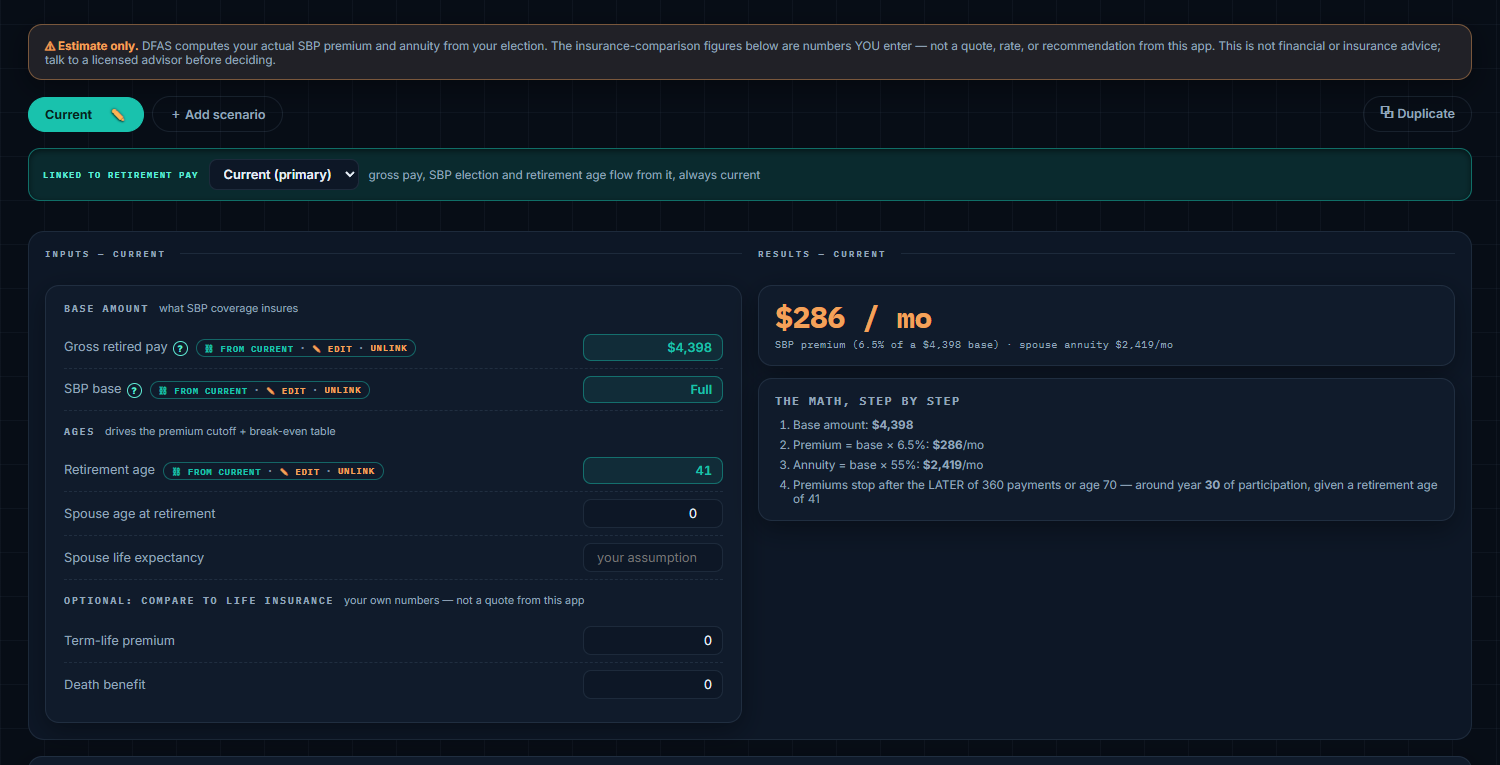
| Premium | 6.5% of your elected base amount, deducted from retired pay (10 U.S.C. §1452(a)). The base can be anywhere from $300/mo up to your full retired pay. |
| Annuity | 55% of the elected base amount to your surviving spouse, for life (10 U.S.C. §1451). |
| Inflation | The annuity tracks retired pay, which receives annual CPI cost-of-living adjustments (10 U.S.C. §1401a) — a survivor benefit that keeps pace with inflation for decades. |
| Premiums end | Coverage is paid-up after the LATER of 360 months of payments and age 70 (10 U.S.C. §1452(j)) — note it's both conditions, not either: retire at 45 and you pay until 75 (360 payments); start at 42 and you pay to 72. |
| Tax treatment | Premiums reduce taxable retired pay (deducted pre-tax); the annuity is taxable to the survivor. |
Read the paid-up rule carefully in your own case — the common shorthand "premiums stop after 30 years" is wrong for anyone who retires young, and the difference is years of premiums.
The "buy term instead" pitch — and what it skips
The standard alternative: decline SBP, buy term life insurance with the premium savings, and self-insure. Sometimes that genuinely wins. But an honest comparison has to price what SBP gives you that a term policy structurally cannot:
- Longevity risk. The SBP annuity pays for your survivor's lifetime. A term policy's lump sum has to be invested and drawn down — and can be outlived. Pricing "55% of retired pay, COLA-adjusted, for life" as an equivalent commercial annuity is the honest comparison, and it's expensive.
- Inflation. A level $500k death benefit is worth far less in 30 years; the SBP annuity COLAs.
- Underwriting and renewal risk. SBP never asks about your health. Term does — at issue and again at every renewal. A condition discovered at 55 can make replacement coverage unaffordable exactly when the term expires.
- Behavior risk. The term strategy only works if the premium difference is actually invested, every month, for decades, and not spent — by whoever survives.
What term has going for it: if your spouse predeceases you or the marriage ends, premiums stop having a purpose under SBP's spouse election, while an insurance policy's beneficiary can be changed; and if you die early, a lump sum can exceed the annuity's discounted value. The point isn't that either side wins — it's that the comparison has real structure, and a one-line sales pitch in either direction is hiding half of it.
Running the break-even
- Fix the protected amount: 55% of your intended base, in today's dollars, COLA-adjusted forward.
- Price the SBP side: 6.5% of base monthly, pre-tax, ending at the §1452(j) paid-up point for your ages.
- Price the term side honestly: quotes for coverage that replicates a lifetime, inflation-adjusted income stream at each renewal age — not just a level 20-year policy — plus the assumed investment return on the difference, and what happens to the plan if that return disappoints.
- Test the tail scenarios: you die at 48; you die at 85; your survivor lives to 95. The strategies diverge hardest in the tails, and the tails are the reason survivor coverage exists.
The WheelsUp SBP planner runs this break-even with your actual retired-pay numbers — premium stream, paid-up point, COLA-adjusted annuity value, side by side with a self-insure track. It's part of the same toolset that models your whole retirement paycheck.
Special cases worth knowing exist
- Former spouses: a divorce decree can require SBP former-spouse coverage, and the former spouse can "deem" the election themselves within the statutory window if you don't file it (10 U.S.C. §1450(f); §1448(b)). If you're divorcing near retirement, this belongs in the settlement conversation, not after it.
- Guard/Reserve: the equivalent decision (RCSBP) arrives much earlier — with your 20-Year Letter (10 U.S.C. §1448; §12731(d)) — not at age-60 retirement. Don't let the active-duty framing make you miss your actual deadline.
- Child and insurable-interest elections exist alongside spouse coverage (10 U.S.C. §1448/§1450) — if your situation isn't "married, spouse coverage," get a counselor to walk the categories.
Sources
- 10 U.S.C. §1448 — participation, elections at retirement, spouse concurrence, former-spouse elections, RCSBP
- 10 U.S.C. §1451 — annuity = 55% of the elected base amount
- 10 U.S.C. §1452(a) — premium = 6.5% of base; §1452(j) — paid-up at the later of 360 payments and age 70
- 10 U.S.C. §1450(f) — former-spouse deemed election · §1401a — retired-pay COLA · §12731(d) — the 20-Year Letter
Spot an error? Tell us — citations are the product here.
One permanent decision deserves real numbers. WheelsUp models SBP against your actual retired pay, alongside every other deadline and dollar in your transition.