What USFSPA actually does — and what it doesn't
The Uniformed Services Former Spouses' Protection Act, codified at 10 U.S.C. §1408, does two separable things that are constantly conflated:
- It permits state courts to treat disposable retired pay as marital property subject to division under state law. It does not create a federal entitlement, does not set a formula, and does not award anyone anything. Your state's law does that.
- It provides a federal payment mechanism — direct payment from the Secretary concerned to a former spouse — subject to strict conditions.
Almost every myth in this area comes from collapsing those two. A court can award a share of retired pay in circumstances where DFAS cannot pay it directly. In that case the obligation still exists; it's just enforced between the parties rather than by the government.
⚠ This is a planning guide, not legal advice, and divorce is genuinely case-specific. Nothing here substitutes for a lawyer who practices in your state and knows military retirement.
The 10/10 rule — what it actually gates
The most persistent myth in military divorce is that a former spouse gets nothing unless the marriage lasted ten years. That is not what §1408 says.
§1408(d)(2): if the former spouse was not married to the member for at least 10 years during which the member performed at least 10 years of creditable service, payments may not be made under this section to the extent they include an amount resulting from the court's treatment of disposable retired pay as property.
Parse that carefully — three things follow:
| Claim | Reality |
|---|---|
| "Under 10 years, no share of the pension" | False. A court may still divide it. 10/10 governs direct payment by the government, not entitlement. |
| "10 years of marriage is enough" | Not by itself. It must be 10 years of marriage overlapping 10 years of creditable service. |
| "The rule blocks all direct payments" | No — the bar is specific to amounts arising from property division. Child support and alimony ordered by the court are handled differently. |
So under 10/10, the practical consequence is enforcement risk and administrative burden, not the loss of the award.
"Disposable" retired pay — the deductions that shrink the pot
Courts divide disposable retired pay, defined in §1408(a)(4)(A) as total monthly retired pay less amounts that are:
- owed to the United States for previous overpayments of retired pay, and recoupments required by law resulting from entitlement to retired pay;
- deducted as a result of court-martial forfeitures, or of a waiver of retired pay required by law to receive compensation under title 5 or title 38 — this is the VA waiver;
- for a Chapter 61 (disability) retiree, equal to the retired pay computed using the disability percentage on the date of retirement (or placement on the TDRL);
- deducted because of a Chapter 73 (SBP) election providing an annuity to a spouse or former spouse to whom a portion of retired pay is being paid under a court order.
The second bullet is where the hardest disputes live. When a retiree waives retired pay to receive VA compensation, the waived amount leaves the divisible pot — which can materially reduce a former spouse's share years after a decree was written. Many decrees are drafted specifically in anticipation of this.
Note the fourth bullet's structure: the SBP premium comes off the top before division, but only where the annuity is for a spouse or former spouse who is receiving a court-ordered portion. SBP and the property division are linked, and the SBP election is separately consequential — see our SBP guide.
The frozen-benefit rule — the biggest change in decades
For divorces finalized before the member's retirement, §1408(a)(4)(B) changes what "total monthly retired pay" means for division purposes. Instead of the pay the member eventually retires on, it is:
- the retired pay the member would have been entitled to using the member's retired pay base and years of service on the date of the decree (computed under §1406 or §1407, as applicable) —
- increased by the cost-of-living adjustments under §1401a(b) that would have occurred between the date of the decree and the member's retirement, using the adjustment provisions applicable on retirement, plus COLAs occurring after retirement.
For a member retiring under non-regular (Reserve) retirement, the parallel rule uses the member's retired pay base and creditable service points on the date of the decree (§1408(a)(4)(B)(ii)).
What this means in practice: the former spouse's share is effectively frozen at the member's rank and service at divorce, then escalated by COLA — rather than riding the member's later promotions and additional years. A divorce at 12 years and O-3 no longer produces a share of an O-5-at-22 pension.
It also means the date of the decree is now a load-bearing fact in your retirement planning, and that older decrees and newer ones behave differently. If your divorce predates the change, don't assume this rule applies to you; if it postdates it, don't assume the old approach does.
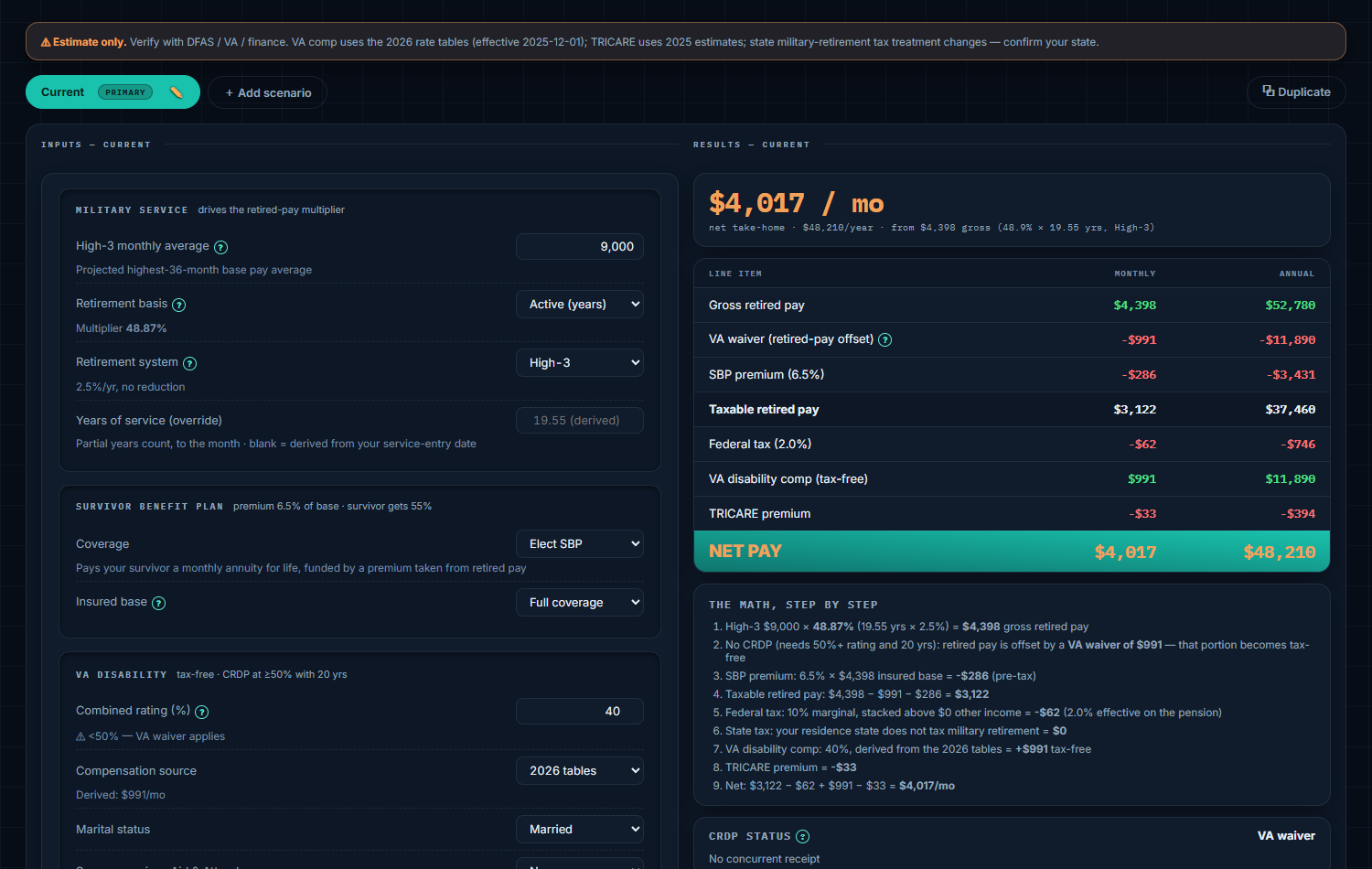
WheelsUp models your retired pay from your actual grade, service, and system — the same computation a frozen-benefit calculation starts from.
Payment limits and mechanics
- 50% cap on property division: §1408(e)(1) — the total disposable retired pay payable under all court orders pursuant to subsection (c) may not exceed 50 percent of disposable retired pay.
- 65% aggregate ceiling: §1408(e)(4)(B) — combined §1408 orders and Social Security Act §459 legal process (support and alimony garnishment) may not exceed 65 percent of the retired pay treated as remuneration for employment.
- First come, first served: where multiple orders and legal process arrive, they're satisfied in order of service, out of what remains within those limits (§1408(e)(4)(A)).
- Service of the order must be effective: §1408(b) requires it be served on the designated agent, be regular on its face, and be accompanied by documents including a certification regarding the member's rights under the Servicemembers Civil Relief Act. A defective order is a delayed order.
- Monthly, not more often: §1408(d)(3) — payments are made no more frequently than once each month.
- "Retired pay" includes retainer pay (§1408(a)(7)), so Fleet Reserve and FMCR members are covered — and "member" includes a former member entitled to retired pay under §12731, so Reserve retirees are too.
What to get right in the decree
Most of the pain in this area is caused by orders that a court signed and the payment agent can't execute. Points worth raising with counsel:
- Is the order regular on its face and does it contain the required certifications? DFAS rejects otherwise-valid orders on this basis routinely.
- Does it address the VA waiver explicitly? A decree silent on what happens if the member later waives retired pay for VA compensation is a decree that will be litigated.
- Does it address SBP? Former-spouse SBP coverage is a separate election with its own deadlines, and a property award of retired pay does not create it. §1408(a)(4)(A)(iv) assumes the two travel together — make sure they do.
- Does it state the award in a form the frozen-benefit rule can compute? Post-change decrees need the member's pay base and service (or points) as of the decree date.
- Is 10/10 satisfied? If not, plan the enforcement mechanism into the decree, because direct payment isn't available for the property share.
Sources
- 10 U.S.C. §1408 — (a)(2) definition of court order; (a)(4)(A) disposable retired pay and its four deductions, including the title 5 / title 38 waiver and the Chapter 61 disability computation; (a)(4)(B)(i)–(ii) the frozen-benefit rule for decrees final before retirement, active and Chapter 1223 versions; (a)(5) "member" includes former members entitled under §12731; (a)(7) "retired pay" includes retainer pay; (b) effective service and "regular on its face" requirements including the SCRA certification; (c) authority for courts to treat disposable retired pay as property; (d)(2) the 10/10 rule; (d)(3) monthly payment; (e)(1) the 50% cap; (e)(4)(A)–(B) first-come-first-served and the 65% aggregate ceiling
- 10 U.S.C. §1406 / §1407 — retired pay base computations referenced by the frozen-benefit rule · §1401a(b) — the COLAs that escalate a frozen award
- DoD FMR Volume 7B, Chapter 29 — former spouse payments, the paying agency's implementation
- DFAS Garnishment / USFSPA guidance, including the NDAA-17 court order requirements — the practical documentation standard for a payable order
- 10 U.S.C. Chapter 73 (SBP) — former-spouse coverage, referenced in the disposable-pay deduction
⚠ Not legal advice. Consult an attorney experienced in military divorce in your jurisdiction; state law governs the division itself.
Spot an error? Tell us — citations are the product here.
The pay computation a division starts from. WheelsUp back-plans every deadline from your actual date and branch, with the citation attached to each card.