Which system are you under? Three questions
Most people get this wrong in one direction: they assume "BRS" because it's the modern one, or "High-3" because they've been in a long time. The statute cares about two dates and one signature.
| If… | You are under |
|---|---|
| You first became a member of a uniformed service on or after 1 Jan 2018, or you opted in during the 2018 election window | BRS — a "full TSP member" under §1409(b)(4) |
| You first became a member after 31 Jul 1986 and elected the $30,000 Career Status Bonus at 15 years | REDUX — §1409(b)(2) reduction applies |
| Anything else (entered on/after 8 Sep 1980, no CSB, not BRS) | High-3 — the plain §1409(b)(1) rule |
Note what makes you REDUX: taking the bonus is the election. There is no separate "I choose REDUX" form. 37 U.S.C. §354 pays $30,000 to a member who has completed 15 years of active duty and agrees to remain on active duty through 20 — and that acceptance is what triggers the reduced multiplier. If you don't remember signing anything, check whether $30,000 ever landed in your account around your 15-year mark.
The three formulas
All three multiply the same thing: your High-3 — the average of your highest 36 months of basic pay — by a percentage.
| System | Multiplier | At 20 years |
|---|---|---|
| High-3 (legacy) | 2.5% × years of creditable service | 50% |
| BRS | 2.0% × years of creditable service | 40% — plus TSP matching you kept along the way |
| REDUX | 2.5% × years, minus 1 point per full year under 30 (and 1/12 point per month) | 40% — plus the $30,000 taken at 15 |
"Years of creditable service" includes 1/12 of a year for each full month, so partial years count — 20 years and 7 months is 20.583 years, not 20.
The 75% cap is not what most people think
Every summary you'll read says military retired pay is capped at 75%. For anyone retiring today, that's wrong — and the error costs long-serving members real money in their planning.
§1409(b)(3) sets a flat 75% only for members who retired before 1 January 2007. For members retiring after that date with more than 30 years of service, the percentage is "the sum of (i) 75 percent; and (ii) 2½ × years of creditable service in excess of 30 years."
Work the algebra: 75% + 2.5 × (years − 30) = 2.5 × years. The sum formula collapses back into the plain rate. There is no ceiling. A 34-year High-3 retiree earns 85%, not 75%. Under BRS the same structure applies with 60% and 2.0 — 60% at exactly 30 years, uncapped beyond.
⚠ One place a 75% cap does still bite: non-regular (Reserve) retired pay is explicitly capped at 75% by §12739(c). Active and reserve computations differ here — see our Guard/Reserve retirement guide.
REDUX: the two penalties, and the one that never ends
REDUX is usually described as "a smaller pension in exchange for $30,000." It's actually two separate reductions, and they behave very differently.
1. The multiplier reduction — recoverable
§1409(b)(2) reduces your percentage by 1 point for every full year your creditable service is under 30. Retire at exactly 20 and that's a 10-point cut: 50% becomes 40%. Retire at 26 and it's 4 points. The reduction applies only while you have less than 30 years and are under age 62 at retirement.
At 62, §1410 recomputes your retired pay once — retrospectively — as if the §1409(b)(2) reduction had never been applied and as if every past COLA had been the full one. Effective the first day of the first month after you turn 62.
2. The COLA reduction — permanent
This is the part that gets stated wrong almost everywhere, including in places that should know better. REDUX retirees receive an annual COLA of CPI minus 1 percentage point under §1401a(b)(3) instead of the full increase.
The age-62 recomputation does not restore your future COLA. Read §1410's verb tense: it recomputes what your pay "would be… if increases… had been computed" under the full paragraph. Past perfect. It rebuilds the base amount, once. It contains no language changing which COLA paragraph applies to you going forward — and §1401a(b)(3)'s trigger is two permanent historical facts (when you joined, and that you took the bonus) with no age condition and no sunset.
So a REDUX retiree stays on CPI-minus-1 for life, including after 62. Over a 35-year retirement, one point of compounding annually is a far larger number than $30,000.
One small mercy: the 1-point reduction only operates when the full COLA exceeds 1%. In a low-inflation year it doesn't apply, and it never produces a negative adjustment.
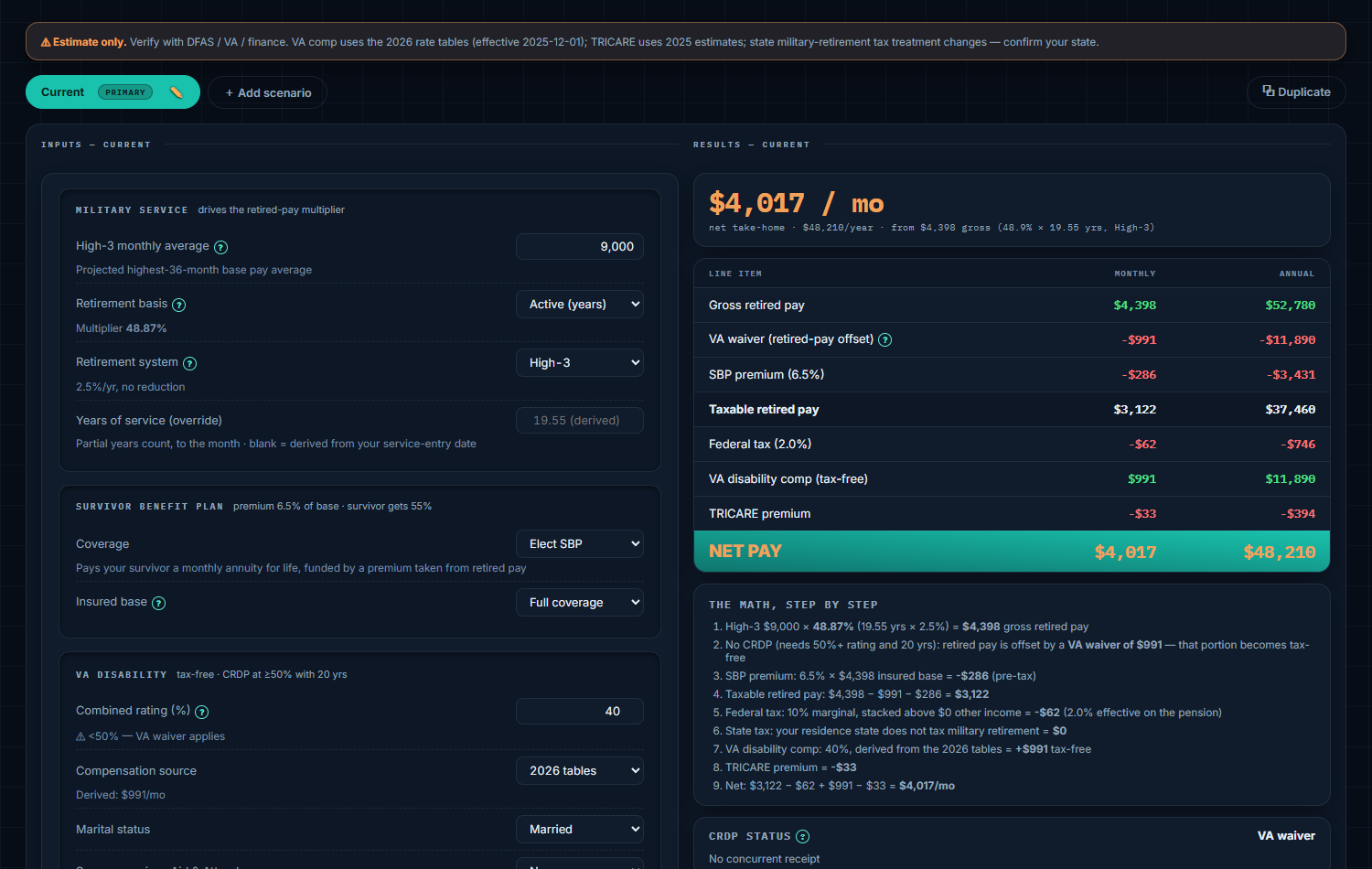
WheelsUp models all three systems side by side against your actual grade, entry date, and planned retirement date — including the age-62 recomputation and the lifetime COLA divergence, year by year.
So is REDUX ever worth it?
The honest answer: rarely, and only under conditions you have to actually commit to.
- It's least bad if you retire at exactly 20 and invest the full $30,000 immediately at a return that beats the compounding value of a point of COLA and 10 multiplier points for the years before 62.
- It gets worse the longer you serve past 20 in one sense (you gave up the bonus's best use case) and better in another (the multiplier penalty shrinks toward zero at 30) — but the COLA penalty is indifferent to your years of service. It follows you regardless.
- The bonus is taxable in the year received, so $30,000 is not $30,000.
- If you elected BRS instead, note §354(f)(2): a person who elects BRS repays any bonus received. The two are mutually exclusive.
If you already took it, this isn't a decision anymore — it's a planning input. Model your actual COLA path rather than assuming the standard one, and know that your 62nd birthday brings a step up in the base but not a return to full inflation protection.
Sources
- 10 U.S.C. §1409 — retired pay multiplier: (b)(1) High-3 2½% rule · (b)(2) REDUX reduction (1 point per year under 30, 1/12 per month; under 62 at retirement) · (b)(3) the pre-2007 75% flat rate and the post-2006 sum formula · (b)(4) BRS "full TSP member" substitutions (2 for 2½, 60% for 75%) · (c) years of creditable service including 1/12 per full month
- 37 U.S.C. §354 — Career Status Bonus: $30,000 (subsection (d)(1)); available at 15 years of active duty with an agreement to serve to 20; repayment on a BRS election (subsection (f)(2))
- 10 U.S.C. §1410 — one-time age-62 recomputation (effective the first day of the first month after attaining 62)
- 10 U.S.C. §1401a(b)(2) and (b)(3) — full COLA vs. the CPI-minus-1 reduced COLA, and the "greater than 1 percent" condition
- 10 U.S.C. §12739(c) — the 75% cap that does apply, to non-regular (Reserve) retired pay
Spot an error? Tell us — citations are the product here.
Three systems, one answer for your record. WheelsUp back-plans every deadline from your actual date and branch, with the citation attached to each card.