The match, and the two windows that close
If you're under BRS, the government contributes on two tracks under 5 U.S.C. §8432(c), extended to uniformed service members by §8440e:
| Contribution | Formula | Window |
|---|---|---|
| Automatic 1% | 1% of basic pay regardless of what you contribute | Starts the pay period beginning on or after 60 days after you first enter a uniformed service |
| Matching | Dollar for dollar on the first 3%; 50 cents on the dollar for the next 2% | Starts the pay period beginning on or after 2 years and 1 day after you first enter — i.e. the start of your third year |
Contribute 5% and you receive the full 5% from the government (1% automatic + 4% matched). Contribute less and the match shrinks proportionally. Contribute nothing and you still receive the automatic 1%. The combined employer amount is capped at 5% of basic pay per pay period.
Both tracks end at 26 years of service. §8440e runs the automatic and matching contributions through the pay period ending on the day the member completes 26 years. If you're serving past 26, the government's contributions have already stopped — a fact worth knowing before you assume your final years are still being matched.
⚠ Contributing less than 5% while eligible is the most expensive mistake in this entire guide. It isn't a "missed opportunity" — it's declining part of your compensation.
Vesting: two years, and only on the government's money
You are always 100% vested in your own contributions and their earnings, regardless of service length. That money is yours from the first pay period.
The government's money is different. You become vested in the Service Automatic (1%) contributions, any matching contributions, and their earnings after completing 2 years of service. Separate before then and you forfeit the automatic and matching amounts.
This only bites people separating early — which is precisely the population least likely to have read about it. If you're leaving inside the two-year mark, know that your TSP balance statement is showing you money that isn't all going with you.
The 2026 contribution limits
| Limit | 2026 amount | Who |
|---|---|---|
| Elective deferral (IRC §402(g)) | $24,500 | Everyone — traditional and Roth combined |
| Age-50 catch-up (IRC §414(v)) | $8,000 | Age 50 or older by the end of the calendar year |
| Enhanced catch-up (SECURE 2.0 §109) | $11,250 | Participants who turn 60, 61, 62, or 63 during the year — replaces, not adds to, the $8,000 |
Two traps in a separation year specifically:
- The limit is annual, but your pay isn't. If you separate in June and front-load contributions to hit the cap, you can max out early and then receive no match for the remaining pay periods — because the match is computed per pay period, not per year. Spread contributions across the periods you'll actually be paid for.
- Traditional and Roth share one limit. $24,500 is the total across both, not each.
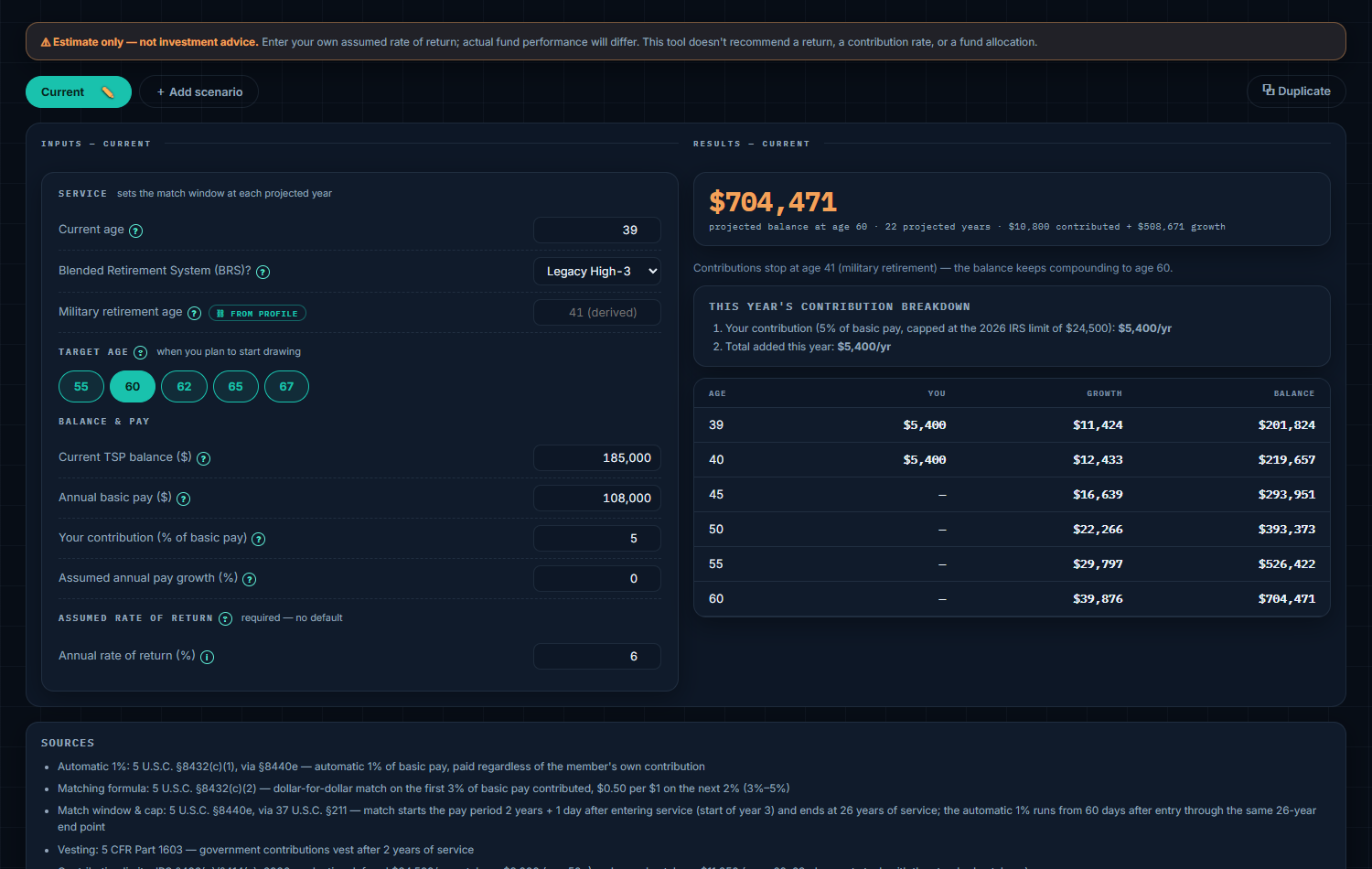
WheelsUp's TSP projection models your balance forward from your actual contribution rate and separation date — including the match you're leaving on the table if you're under 5%.
What happens after you separate
- Your account stays. You can leave the balance in the TSP indefinitely and keep its expense ratios, which remain among the lowest available anywhere. There is no requirement to roll it out, and "roll it to an IRA" advice frequently costs more than it gains.
- You can no longer contribute from military pay — the payroll relationship is what enabled it. Contributions after separation come via rollovers in, not deferrals.
- Loans must be resolved. An outstanding TSP loan at separation has consequences you want to understand before your final pay, not after.
- Update your beneficiaries. TSP beneficiary designations are governed by the form on file, and they don't automatically follow a will or a divorce decree. Do this in the same week you do your SBP election.
- Combat-zone (tax-exempt) contributions keep their character and complicate rollovers. If you have them, verify the treatment before moving money.
Required minimum distributions — 73 or 75
SECURE 2.0 moved the RMD start age twice: from 72 to 73 beginning 1 January 2023, and further to 75 beginning 1 January 2033.
The practical mapping: someone who reaches age 73 before 2033 has an RMD start age of 73; someone who reaches 73 in 2033 or later has a start age of 75. By birth year, that lands as roughly born before 1960 → 73; born 1960 or later → 75.
That's four decades out for most people reading this, which is exactly why it belongs in a separation-year guide: the account you're deciding what to do with today is one you may not be required to touch until you're 75.
Roth TSP balances have their own treatment — confirm current rules before assuming your Roth portion is subject to the same requirement.
The separation-year TSP checklist
- 12 months out: confirm you're contributing at least 5% if you're under BRS and inside the match window. If not, fix it this pay period.
- 6 months out: plan your contribution rate across your remaining pay periods so you don't max early and lose the per-period match.
- 3 months out: resolve any outstanding loan; check whether you'll be vested at your separation date.
- 1 month out: update beneficiaries; confirm your address and contact details will survive the transition.
- After: decide deliberately whether to leave the balance in the TSP. Default to leaving it unless you have a concrete reason not to.
Sources
- 5 U.S.C. §8432(c) — (c)(1) the automatic 1% agency contribution; (c)(2) the two-tier match (dollar-for-dollar to 3%, 50% on the next 2%)
- 5 U.S.C. §8440e — uniformed-services application under BRS: automatic contributions starting 60 days after entry, matching starting 2 years and 1 day after entry, both ending at 26 years of service, and the 5%-of-basic-pay per-pay-period cap
- 5 CFR Part 1603 / TSP Bulletin 15-1 — the 2-year vesting requirement on automatic and matching contributions; member contributions 100% vested regardless of service length
- IRC §402(g) and §414(v), 2026 amounts — $24,500 elective deferral (traditional and Roth combined), $8,000 age-50 catch-up; SECURE 2.0 §109 — $11,250 enhanced catch-up for ages 60–63
- SECURE 2.0 RMD provisions — start age 72 → 73 from 1 Jan 2023, → 75 from 1 Jan 2033
⚠ Planning guide, not tax or investment advice. Contribution limits are adjusted annually — verify current-year figures at tsp.gov before acting.
Spot an error? Tell us — citations are the product here.
Your balance, projected from your real contribution rate. WheelsUp back-plans every deadline from your actual date and branch, with the citation attached to each card.