How this timeline works
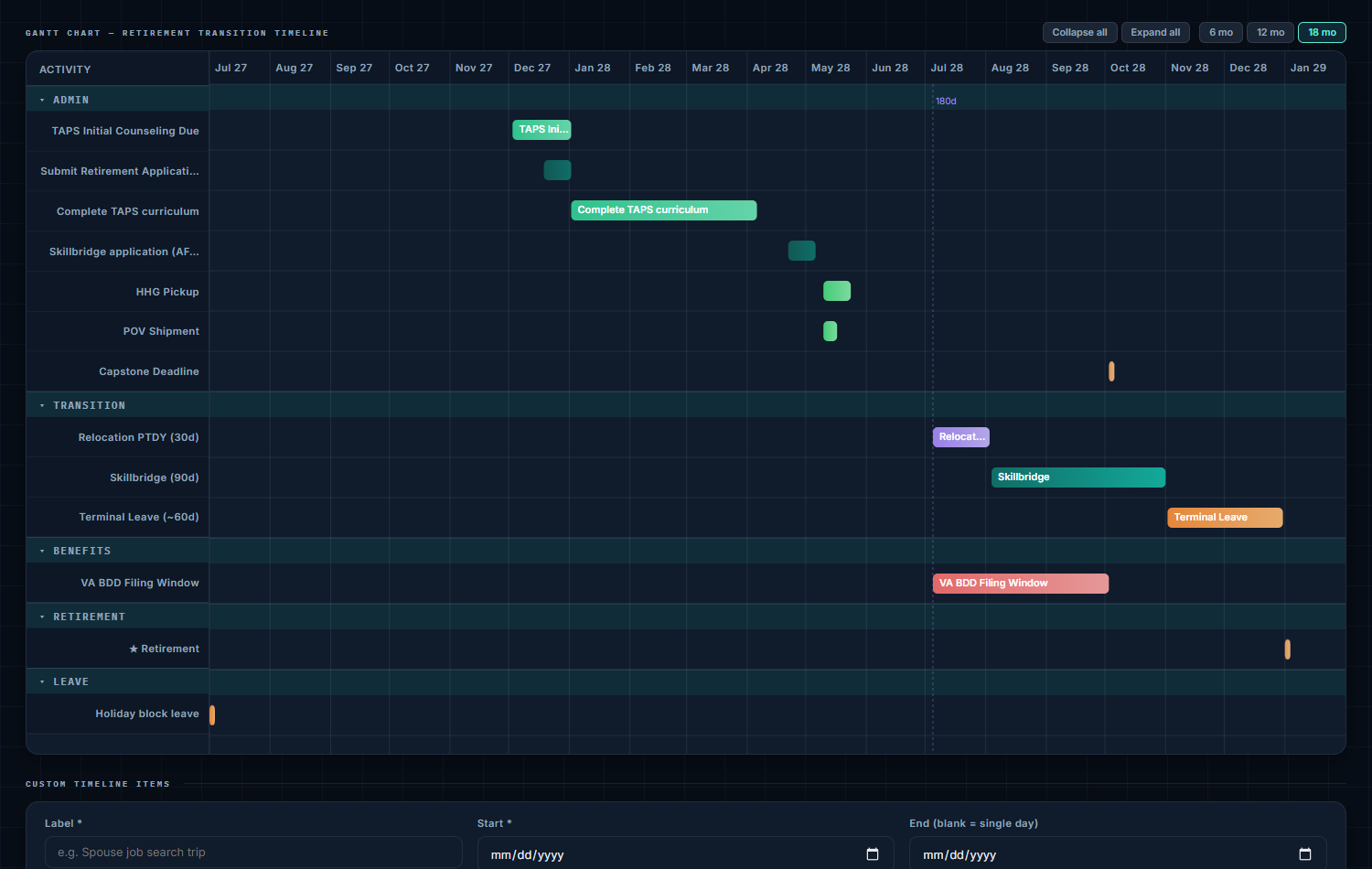
Military retirement is not an event — it is an 18-to-24-month project with hard legal deadlines scattered through it. The dates below are back-planned from your retirement date: DoD policy tells you the latest each step may happen, and working backward from your date tells you when it must happen for you.
Two things to keep straight as you read:
- Federal floors vs. branch rules. DoD-level rules (TAP, SkillBridge, SBP, retired pay law) apply to everyone. The mechanics — which system you apply in, the exact application window, physical-exam scheduling — come from your branch's own regulation (DAFI 36-3203 for the Air Force, AR 600-8-24 for Army officers, MILPERSMAN for the Navy, MCO 1900.16 for the Marine Corps, and so on). Where this guide uses a branch-specific number, it says so.
- "No later than" is not "plan for." Most deadlines below are legal floors. Hitting them exactly leaves zero slack for a slow approval, a rescheduled exam, or a lost form. Plan early; the floor is your safety net, not your target.
T−24 to T−18 months
Decide, and start the money picture
- Set (or bracket) your retirement date. Everything else back-plans from it. If you're weighing dates, run the numbers for each — a date that crosses a fiscal year or a pay raise can change your High-3 average.
- Start transition assistance early — you're allowed to. DoD policy says pre-separation counseling for retirees "will begin as soon as possible during the 24-month period preceding an anticipated retirement date" (DoDI 1332.35 §7.2.a). The 365-day mark is the legal floor, not the intended start.
- Understand your retired-pay formula. Your retired-pay base is the average of your highest 36 months of basic pay (10 U.S.C. §1407), multiplied by 2.5% per year of service under High-3 (10 U.S.C. §1409(b)(1)) or 2.0% under BRS (§1409(b)(4)). Twenty years under High-3 is 50% of your High-36 average — knowing this number early anchors every other financial decision.
- Start the spouse/family conversation — retirement location, the Survivor Benefit Plan question (it arrives with a hard deadline later), and what the post-service budget looks like.
- Watch your leave balance. Leave above the 60-day fiscal-year carry-over cap is forfeited at the end of the fiscal year (branch leave regs; DAFI 36-3003 for the Air Force). A big terminal-leave plan starts with not losing days now.
T−18 to T−12 months
The first hard deadline: TAP initial counseling
- NLT 365 days out: complete TAP pre-separation counseling (DD Form 2648). This is a statutory requirement — transition assistance "must begin no later than 365 days before separation, retirement, or release from active duty" (DoDI 1332.35 §7.2). Book the initial counseling well before the one-year mark; it is the gate to every later TAP component.
- Submit your retirement application when your branch's window opens. Air Force example: the application window runs from 12 months to 4 months before your date, and an approved application is effectively final (DAFI 36-3203 ¶3.11). Other branches differ — check your branch's reg, and file early inside the window.
- Officers: ask about retired grade before you pin on. A promotion close to retirement can interact with service-in-grade rules — Air Force officers need roughly three years in grade to retire in it (DAFI 36-3203 ¶8.2.5). Ask your personnel section before accepting a late promotion or picking a date.
- If you want SkillBridge, start now. The program places you with a civilian employer for up to the last 180 days of service, but the lead time is real: prerequisites, an employer with a DoD-approved MoU, a training plan, and a commander approval that can take 30–90 days (AFI 36-2671 for the Air Force). The people who get SkillBridge are the ones who started a year out.
This is the part spreadsheets get wrong. WheelsUp back-plans every one of these deadlines from your actual date — and shows you what's in the window, what's coming, and what's about to slam shut.
T−12 to T−9 months
TAP components and the SkillBridge application
- Finish the mandatory TAP curriculum: the DoD Transition Day, the VA Benefits & Services briefing, and a two-day track of your choice — employment, education, vocational, or entrepreneurship (DoDI 1332.35 ¶5.1.a). Retirees with 20+ years may be exempt from the DOL employment day — confirm with your transition office rather than assuming.
- Submit the SkillBridge application in your branch's system (AFVEC for the Air Force) and allow 30–90 days for command approval.
- Start assembling your VA disability claim. The filing window opens later, but the evidence work — treatment records, buddy statements, a complete problem list — takes months. Every condition documented now is a condition you won't be chasing paper for at T−6.
- OCONUS? Start the logistics chain early — household-goods pickup, vehicle shipping, and housing termination all have their own notice periods and stack on top of the transition timeline.
T−9 to T−6 months
Two windows open at T−180
- The separation physical (SHPE) window opens 180 days out. Air Force rule: the Separation History and Physical Examination must be within 180 days of retirement but complete at least 30 days before departure (DAFI 36-3203 ¶6.1.2). Book it the week the window opens — this exam feeds your VA claim.
- T−180 to T−90: the VA BDD window. The VA's Benefits Delivery at Discharge program accepts your disability claim from 180 down to 90 days before separation, so the rating process runs while you're still in uniform. File early in the window — miss the 90-day cutoff and your claim waits for the standard post-separation process.
- SkillBridge approval lands (if you applied on time) — upload the approval memo into your leave system and lock the dates with your unit.
T−6 to T−3 months
Capstone, and the machine starts moving
- NLT 90 days out: TAP Capstone. Your commander verifies you meet the Career Readiness Standards and that your Individual Transition Plan is viable. This is the last mandatory TAP gate — and it cannot happen if the earlier components aren't done.
- SkillBridge begins for most participants somewhere in this window (up to the final 180 days; many run 90).
- Finalize the terminal leave vs. sell-back math. Terminal leave keeps full pay and allowances running to your date; sold leave pays base pay only, and you may sell back a maximum of 60 days in a career (DAFI 36-3003 ¶7.9.2.5 for the Air Force; the pay mechanics live in the DoD Financial Management Regulation). The right split depends on your leave balance, your BAH, and whether a civilian start date is waiting.
- Begin base outprocessing — medical and dental clearance, legal, finance, equipment turn-in. The checklist is longer than you remember from PCSing.
The final 90 days
Terminal leave, and one permanent decision
- The SBP election is due by your retirement date, and it is effectively permanent. The Survivor Benefit Plan pays a surviving spouse 55% of your elected base amount (10 U.S.C. §1451) for a premium of 6.5% of that base (10 U.S.C. §1452); electing less than full spouse coverage requires your spouse's written concurrence (10 U.S.C. §1448). Do not walk into outprocessing undecided — run the break-even math against term life insurance first.
- Terminal leave begins — commonly around 60 days for members who protected their balance. You remain on active duty (pay, allowances, TRICARE) until your date.
- Enroll in a TRICARE retiree plan — coverage doesn't roll over automatically; you have a limited enrollment window around your retirement date (90 days is the figure to plan around).
- Update beneficiaries — TSP, SGLI→VGLI decision, and your will. Confirm your retired-pay calculation with finance/DFAS while you can still walk into the office.
T−0 and after
DD-214 day
- Verify your DD Form 214 line by line before you sign — service dates, awards, separation code. Fixing it later is a federal-records correction process; fixing it now is a pen.
- Expect first retired pay roughly a month after your date — confirm the schedule with DFAS.
- If VA disability is granted at 50%+ and you're a 20-year retiree, concurrent receipt (CRDP) lets retired pay and VA compensation stack rather than offset (10 U.S.C. §1414) — worth understanding before the first VA award letter arrives.
Separating instead of retiring?
The spine is the same — TAP is still required NLT 365 days out (DoDI 1332.35 §7.2.b), the BDD window is still 180–90 days, terminal leave and sell-back work the same way — but the planning window is shorter and two things change:
- No retired pay — which makes the VA claim, the GI Bill decision, and the job search carry more of the load, earlier.
- TAMP: eligible involuntary separators and some others get 180 days of transitional TRICARE (10 U.S.C. §1145) — check whether you qualify before buying interim coverage.
Sources
Dates and rules above are grounded in the following (branch-specific citations are examples from the Air Force implementation; your branch's equivalent reg controls):
- DoDI 1332.35, Transition Assistance Program — §7.2 (counseling timeline: 24-month window, 365-day floor), ¶5.1.a (mandatory components), Capstone/CRS requirements
- DAFI 36-3203, Service Retirements — ¶3.11 (application window), ¶6.1.2 (SHPE timing), ¶8.2.5 (retired grade / service-in-grade)
- DAFI 36-3003, Military Leave Program — 60-day carry-over cap; ¶7.9.2.5 (60-day career sell-back limit)
- AFI 36-2671, DoD SkillBridge Program (AF implementation)
- 10 U.S.C. §1407 (High-36 retired-pay base), §1409 (multiplier), §1448/§1451/§1452 (SBP election, annuity, premium), §1414 (CRDP), §1145 (TAMP)
- VA Benefits Delivery at Discharge program (va.gov) — 180-to-90-day claim window
Regulations change. If you spot a date this guide has wrong, tell us — citations are the product here, and we fix them fast.
This guide is the generic version. Your transition isn't generic. WheelsUp builds this exact timeline around your date, branch, and situation — every deadline above becomes a live countdown with the citation attached, plus the pay, leave, SBP, and VA math to decide with.