What a 0% rating actually is
The catch starts with the number. A 0% rating sounds like a denial. It isn't one: it is an evaluation of a condition, set at the level where the schedule's requirements for payment are not met.
The authority is 38 CFR §4.31, and it is a single sentence:
“In every instance where the schedule does not provide a zero percent evaluation for a diagnostic code, a zero percent evaluation shall be assigned when the requirements for a compensable evaluation are not met.”
So some diagnostic codes print their own 0% step — the mental-disorders formula in §4.130 is one, for a condition that has been formally diagnosed but whose symptoms don't interfere with functioning or require continuous medication — and for every code that doesn't, §4.31 supplies one. Either way, 0% is where a condition lands when the requirements for a compensable evaluation are not met.
VA's own health-care regulation has a name for the people who hold one. 38 CFR §17.36 refers to noncompensable zero percent service-connected veterans, and gives them their own place in its priority subcategories — which, as below, is where a 0% rating does most of its work.
Does it pay? On its own, no — with exceptions worth knowing
VA's 2026 compensation tables (effective December 1, 2025) start at 10%, which pays $180.42 a month. There is no 0% row, so a 0% evaluation by itself adds nothing to the basic monthly rate.
But zero percent and zero dollars are not always the same:
- Special monthly compensation, level K. VA's 2026 special monthly compensation table says that if you qualify for SMC-K, VA adds it — $139.87 a month — to your basic compensation rate for any disability rating from 0% to 100%. The losses that qualify are listed in 38 U.S.C. §1114(k).
- A 0% condition that is nevertheless compensated. 38 CFR §17.36(b)(6) refers to “veterans with 0 percent service-connected disabilities who are nevertheless compensated, including veterans receiving compensation for inactive tuberculosis.” The rule that awards that compensation is outside this guide, but the regulation confirms the case exists.
- Several 0% conditions together. §17.36(b)(3) refers to veterans “receiving compensation at the 10 percent rating level based on multiple noncompensable service-connected disabilities that clearly interfere with normal employability.” If you carry more than one 0% rating and they affect your ability to work, ask VA or an accredited representative about that provision.
How 0% behaves when ratings combine
The second catch runs the other way. People read that 0% doesn't count and assume the combined-ratings regulation says so. It doesn't. 38 CFR §4.25(b) says “All disabilities are then to be combined” and names no exclusion for 0 percent.
What keeps a 0% out of the arithmetic is the table itself. Table I has no row and no column for 0 — its top row runs from 10 to 90 — so a 0% evaluation can't be entered into it and can't change the combined value. A 40% rating and a 0% rating still combine to 40.
The bilateral factor leaves 0% out for a reason it states in writing. 38 CFR §4.26(c) says the factor is not applicable “unless there is partial disability of compensable degree in each of 2 paired extremities, or paired skeletal muscles.” A 0% knee on one side does not pair with a 20% knee on the other.
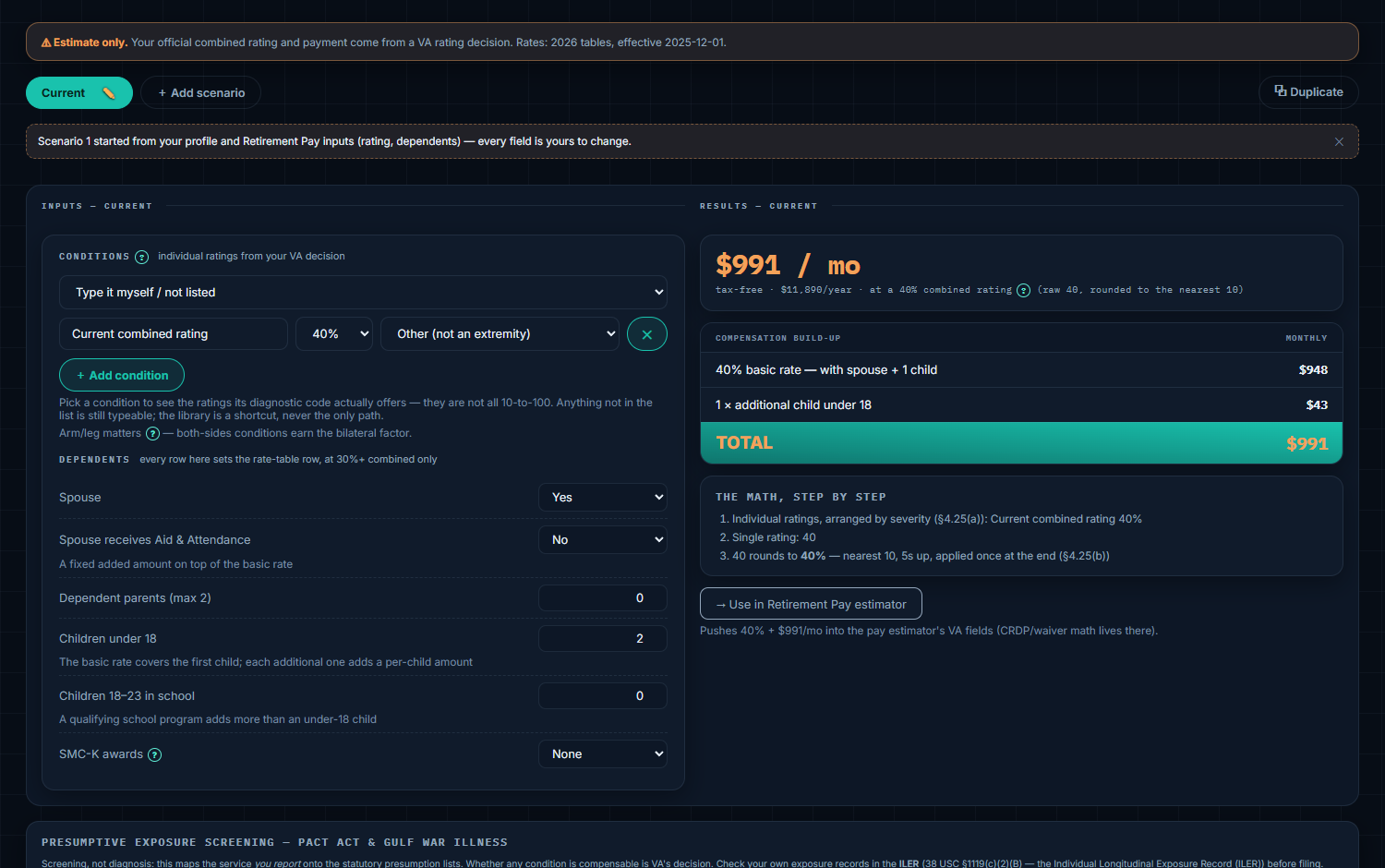
WheelsUp's VA Disability calculator (a Pro tool) offers 0% on every condition, lists each 0% row as service connection without payment, and keeps it out of the §4.25 table and the §4.26 pairing — so the combined figure is right and your record is still complete.
What 0% does for VA health care
The enrollment priority order in 38 U.S.C. §1705(a) sets its rating-based groups at compensable levels — 50% or more for group 1, 30% or 40% for group 2, 10% or 20% for group 3 — so a 0% rating alone doesn't place you in any of them. It matters further down the list:
- It splits categories 7 and 8. Both are for veterans who agree to pay the applicable copayment. 38 CFR §17.36(b)(7) and (b)(8) then divide them into subcategories, and in each matched pair the noncompensable 0% service-connected veteran is listed ahead of the veteran who is not service connected: 7(i) before 7(ii), 7(iii) before 7(iv), 8(i) before 8(iii), 8(ii) before 8(iv), 8(v) before 8(vi).
- Order matters when enrollment tightens. Within categories 7 and 8, §17.36(d)(3)(v) disenrolls and re-enrolls veterans in subcategory order, with subcategory (i) the last to be disenrolled and the first to be re-enrolled.
- It doesn't guarantee enrollment on its own. §17.36(c)(2), unless changed by rulemaking, enrolls every category except subcategories (v) and (vi) of category 8 — and 8(v) is a 0% subcategory. Which 0% subcategory you land in — 8(i), 8(ii) or 8(v) — turns on your enrollment history and on whether your income is no more than ten percent above the income that would permit enrollment in category 5 or 7, whichever is higher.
- Care for the service-connected condition itself. 38 U.S.C. §1710(a)(1)(A) directs VA to furnish needed hospital care and medical services “to any veteran for a service-connected disability” — a clause that names no rating level, and that like the rest of (a)(1) depends on appropriations (§1710(a)(4)). For the 12 months after discharge, §1705(c)(2) has VA provide that care even if you haven't enrolled. How it works after that depends on enrollment rules beyond this guide (§17.36(a)(1) refers to §17.37), so confirm with VA.
The eight groups, and what they do and don't change, are in our priority groups guide.
The home-loan funding fee: read the statute's words
You may hear that any VA rating waives the loan funding fee. The statute is narrower. 38 U.S.C. §3729(c)(1) says the fee may not be collected from a veteran “who is receiving compensation (or who, but for the receipt of retirement pay or active service pay, would be entitled to receive compensation)” — and also not from a surviving spouse of a veteran who died from a service-connected disability, or from an active-duty member who provides evidence of a Purple Heart on or before closing.
The test is compensation, not the existence of a rating. A 0% evaluation that pays nothing is not, by those words alone, receiving compensation. A veteran whose 0% condition is nevertheless compensated, or who also holds a compensable rating, stands differently. §3729(c)(2) adds that a veteran rated eligible to receive compensation through a pre-discharge examination and rating — or a pre-discharge review that results in a memorandum rating — is treated as receiving compensation as of the date of that rating.
The statute never mentions 0% ratings by name, so don't guess: get your waiver status confirmed by VA and your lender before you close. The fee table and the waiver are covered in our funding fee guide.
Why service connection at 0% matters later
Conditions change. A 0% service-connected evaluation means VA has already decided the condition is connected to your service — and the law protects what was decided in your favor:
- The decision has to show its work. A decision notice must identify the findings favorable to you and, where applicable, the criteria that must be satisfied for the next higher level of compensation (38 U.S.C. §5104(b)(4), (7)). For a 0% rating, that second item tells you what a compensable evaluation would need.
- Favorable findings stay found. Under §5104A, a favorable finding “shall be binding on all subsequent adjudicators within the Department, unless clear and convincing evidence is shown to the contrary to rebut such favorable finding.”
- Timing a worsening. For an award of increased compensation, §5110(b)(3) sets the effective date as “the earliest date as of which it is ascertainable that an increase in disability had occurred, if application is received within one year from such date.” Whether a move up from 0% is handled under that paragraph is a question for VA or an accredited representative — but either way, file promptly once the condition worsens, because the one-year limit in that sentence runs from the worsening.
More on how filing dates turn into money is in VA effective dates.
The short checklist
- Keep every 0% rating on your record, and check that your decision letter lists each one.
- Don't expect a 0% rating to move your combined percentage (Table I) or to trigger the bilateral factor (§4.26(c)).
- Ask about SMC-K or the multiple-noncompensable provision if either might fit your situation.
- Apply for VA health care with your 0% rating noted — it decides your subcategory if you land in category 7 or 8.
- Get your funding-fee status confirmed by VA and your lender before closing; the statute's test is compensation.
- File promptly when a 0% condition worsens (§5110(b)(3)).
Sources
- 38 CFR §4.31 — zero percent evaluations · 38 CFR §4.130 — the 0 percent criterion of the General Rating Formula for Mental Disorders
- 38 CFR §4.25 (as of 1 July 2026) — (b) all disabilities combined; Table I's rows and columns · 38 CFR §4.26(c) (as of 1 July 2026) — the bilateral factor requires compensable disability in each paired extremity
- VA disability compensation rates, 2026 (effective December 1, 2025) — the 10% rate · VA special monthly compensation rates, 2026 — SMC-K · 38 U.S.C. §1114(k) — the losses carrying the (k) rate
- 38 U.S.C. §1705 — (a)(1)–(3) the first three priority groups; (c)(2) care for 12 months after discharge without enrollment · 38 CFR §17.36 — (a)(1), (b)(3), (b)(6), (b)(7)(i)–(iv), (b)(8)(i)–(vi), (c)(2), (d)(3)(v)
- 38 U.S.C. §1710(a)(1)(A), (a)(4) — care for a service-connected disability; appropriations
- 38 U.S.C. §3729(c)(1)–(2) — the funding fee waiver and pre-discharge ratings
- 38 U.S.C. §5104(b)(4), (7) — favorable findings and next-level criteria in the decision notice · §5104A — favorable findings binding · §5110(b)(3) — effective date of increased compensation
Spot an error? Tell us — citations are the product here.
Zero percent is still on the record. WheelsUp back-plans every deadline from your actual date and branch, with the citation attached to each card.