What the funding fee is, and why it's larger than people expect
The VA loan's headline feature is no down payment and no mortgage insurance. What replaces mortgage insurance is a one-time funding fee paid to the Secretary, expressed as a percentage of the total loan amount. It may be included in the loan and paid from the proceeds — which is why many buyers never consciously notice paying it, and why it quietly increases the balance they finance.
On a $400,000 zero-down purchase, a 2.15% fee is $8,600. Rolled into the loan at current rates over 30 years, it costs considerably more than that. This is not a rounding error, and for a great many veterans it is entirely avoidable.
The waiver — read the parenthetical
38 U.S.C. §3729(c)(1) says a fee may not be collected from:
- a veteran who is receiving compensation — i.e. any service-connected disability compensation, at any rating;
- a veteran "who, but for the receipt of retirement pay or active service pay, would be entitled to receive compensation";
- a surviving spouse of a veteran who died from a service-connected disability;
- a member on active duty who provides evidence, on or before the date of loan closing, of having been awarded the Purple Heart.
That second bullet is the one that gets missed, and it exists specifically for retirees. If you're a retiree who waived VA compensation against retired pay, you are still entitled to compensation — so the exemption reaches you. The parenthetical was written to prevent the offset mechanics from costing you the waiver.
⚠ Note what the statute does not say: there is no minimum rating. A 10% rating triggers the waiver exactly as a 100% rating does. If you're carrying any service-connected rating and you paid a funding fee, that's worth investigating.
The timing trap — and the provision that fixes it
The classic bad sequence: you separate, you buy a house immediately, your VA rating comes through three months later. Fee already paid, on a claim that was already pending.
§3729(c)(2) addresses exactly this. A veteran rated eligible to receive compensation as the result of a pre-discharge disability examination and rating is treated as receiving compensation as of the date of that rating — without regard to whether an effective date of the award has been established as of that date.
In plain terms: a BDD rating can qualify you for the waiver at closing, even before the award's effective date is formalized. Which turns a VA-claim decision into a home-buying decision:
- File in the BDD window (180 to 90 days before separation) — see our BDD guide. It's the mechanism that gets you a pre-discharge rating in the first place.
- If a rating is pending and you're about to close, say so. Timing a closing a few weeks later can be worth five figures.
- If you already paid and were later rated with an effective date preceding your closing, ask about a refund. This is a known and refundable situation, not an exotic appeal.
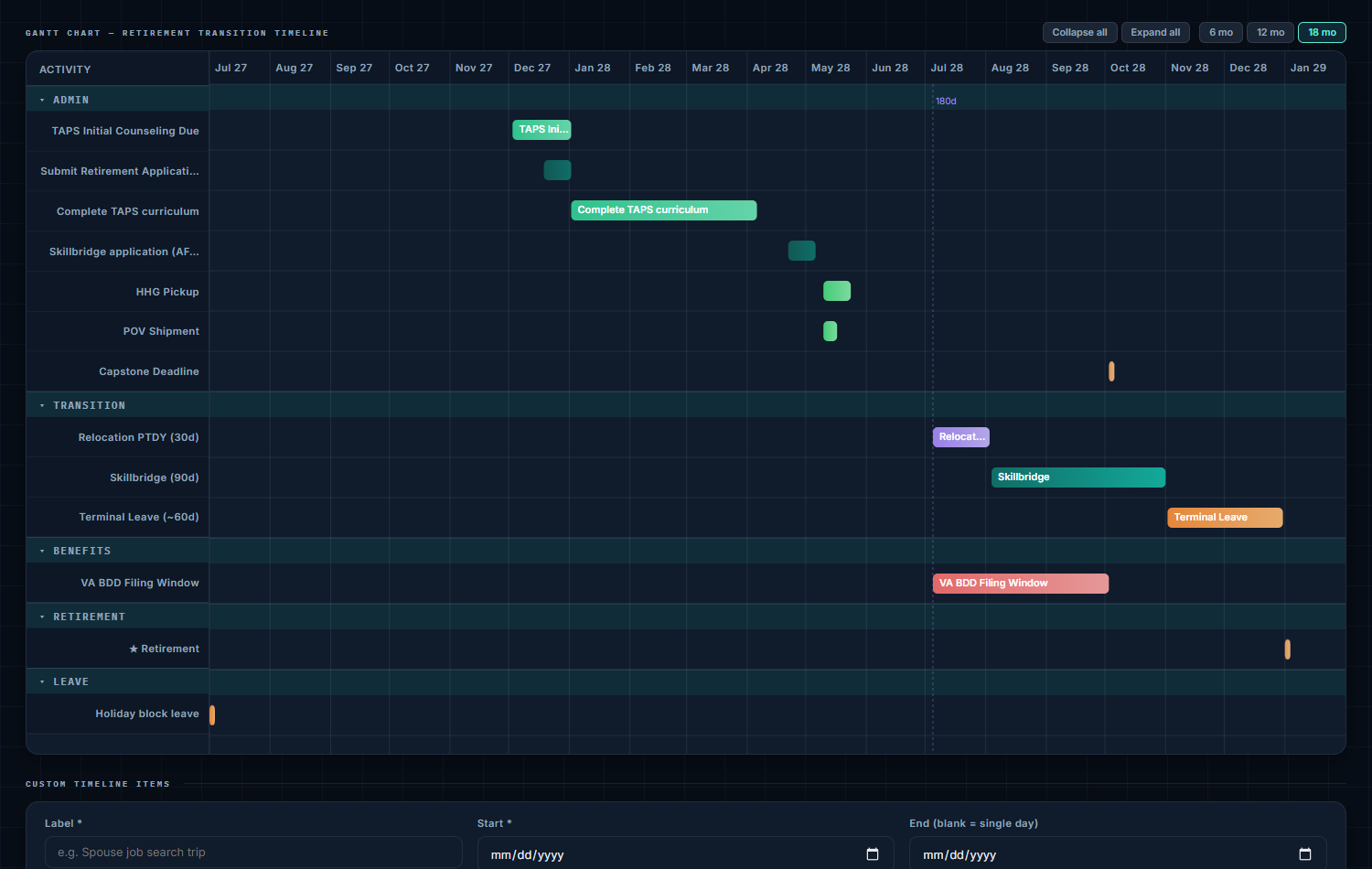
WheelsUp tracks your BDD window and rating timeline alongside your separation date — the same dates that decide whether your first home purchase carries a funding fee.
The fee table, if you do owe it
The statutory table turns on three things: first use vs. subsequent use, down payment tier, and when the loan closes. Rates for loans closing on or after 7 April 2023 and before 9 June 2034:
| Loan type | Down payment | Fee |
|---|---|---|
| Initial purchase/construction loan (§3710(a)) | 0-down (under 5%) | 2.15% |
| 5-down (5% to under 10%) | 1.50% | |
| 10-down (10% or more) | 1.25% | |
| Subsequent purchase/construction loan | 0-down | 3.30% |
| 5-down | 1.50% | |
| 10-down | 1.25% | |
| Interest rate reduction refinancing loan (IRRRL) | — | 0.50% |
| Loan assumption (§3714) | — | 0.50% |
| Direct loan (§3711) · manufactured home (§3712) | — | 1.00% |
| Native American veteran loan (§3762) | — | 1.25% |
Three things to take from that table:
- The first-use discount is large. 2.15% vs. 3.30% on a subsequent zero-down loan — on $400,000 that's a $4,600 difference for using the benefit a second time. Worth knowing before you treat your first VA loan as disposable.
- 5% down is the efficient break point. Going from 0-down to 5-down cuts the fee from 2.15% to 1.50%; going from 5% to 10% only saves another 0.25 points. Most of the fee benefit of a down payment is captured at 5%.
- The rates step down again for loans closing on or after 9 June 2034 (to 1.40% initial / 1.25% subsequent 0-down). Rates are legislated and change — always confirm the current table for your closing date.
⚠ "Active duty veteran" and "Reservist" carried different rates on older loans; for loans closing on or after 1 January 2020 the statute sets the same rate for both. Note also that a "0-down" tier means a down payment of less than 5 percent — including some payment, not necessarily none.
Before you close
- Do you have — or expect — any service-connected rating? If yes, the fee is likely waived entirely. Confirm before signing anything.
- Is a pre-discharge rating pending? §3729(c)(2) may let it qualify you at closing. Ask the lender explicitly.
- Purple Heart on active duty? Provide the evidence on or before the closing date — the statute is specific about that timing.
- Is this a first or subsequent use? It changes the fee by more than a percentage point at zero down.
- Confirm the current fee table for your actual closing date. The table is legislated by closing-date brackets.
Sources
- 38 U.S.C. §3729 — (a) the fee and its inclusion in the loan; (b)(2) the loan fee table with its closing-date brackets and 0-down / 5-down / 10-down tiers; (b)(4)(G)–(I) the down-payment tier definitions; (c)(1) the waiver for veterans receiving compensation, veterans who but for the receipt of retirement pay or active service pay would be entitled to compensation, qualifying surviving spouses, and Purple Heart recipients providing evidence on or before closing; (c)(2) pre-discharge examination and rating treated as receiving compensation as of the rating date
- 38 U.S.C. §3703 — the basic loan guaranty authority · §3710(a), §3711, §3712, §3714, §3762 — the loan types referenced in the fee table
- VA Benefits Delivery at Discharge program — the pre-discharge rating pathway referenced by §3729(c)(2)
⚠ Planning guide, not lending advice. Confirm your fee, waiver status, and entitlement with the VA and your lender before closing.
Spot an error? Tell us — citations are the product here.
A rating date and a closing date, on one calendar. WheelsUp back-plans every deadline from your actual date and branch, with the citation attached to each card.