The 36-month line
Post-9/11 GI Bill entitlement under 38 U.S.C. §3311 turns on aggregate active-duty service commencing on or after 11 September 2001. The headline threshold: an individual who serves an aggregate of at least 36 months on active duty — including service in entry-level and skill training — and then either continues on active duty or is discharged or released as described in §3311(c), is entitled to educational assistance under the chapter.
Below 36 months, entitlement is graduated rather than absent: §3311(b) also covers individuals who served at least 30 continuous days and were discharged for a service-connected disability, among other categories, and the percentage of the maximum benefit scales with aggregate service. Because those tier percentages are set administratively and adjust, confirm the current scale at VA.gov for your exact aggregate service rather than relying on a number in any article — including this one.
What's worth internalizing before you separate: aggregate service is the currency. If you are near a tier boundary, the months between now and your separation date may be worth more in education benefits than they are in pay.
The transfer catch — six years in, four years more
Transferring benefits to a spouse or children is, for many career members, the single most valuable thing the GI Bill does. It also carries a service obligation that has ended more than one person's plan to retire on schedule.
38 U.S.C. §3319(b): an individual is eligible to transfer if, at the time of the approval of the request, they have completed at least six years of service in the Armed Forces and enter into an agreement to serve at least four more years as a member of the uniformed services (or the years of service determined by regulation under §3319(j)).
| The trap | Why it bites |
|---|---|
| The obligation attaches at approval | Requesting transfer at 17 years means committing to 21. If you planned to retire at 20, you've just moved your date — or forfeited the transfer. |
| It's four more years | Not four years total, and not "however long until 20." Four additional years from approval. |
| "Uniformed services," not just your branch | The agreement is to serve as a member of the uniformed services — the obligation follows you. |
The practical rule: if you intend to transfer, request it as early as you are eligible — at six years, not at eighteen. A member who transfers at year six and serves to twenty has satisfied the obligation with fourteen years to spare. A member who first thinks about it at nineteen is choosing between the benefit and their retirement date.
Other statutory boundaries worth knowing:
- Maximum 36 months transferred (§3319(d)) — and the Secretary of Defense may prescribe regulations limiting transfers to no less than 18 months.
- Eligible dependents (§3319(c)) take the meaning of "dependent" under 10 U.S.C. §1072(2)(A), (D) and (I) — spouse and children, per that definition. You may split entitlement across a combination of dependents.
- You designate the dependents and the number of months for each (§3319(e)). Designations can generally be adjusted later, but eligibility to make a transfer at all depends on being in service — which is why "I'll do it at my retirement ceremony" is not a plan.
- The purpose is recruitment and retention (§3319(a)(2)), exercised when authorized by the Secretary of Defense. That framing is why the obligation exists at all, and why the rules can change by policy.
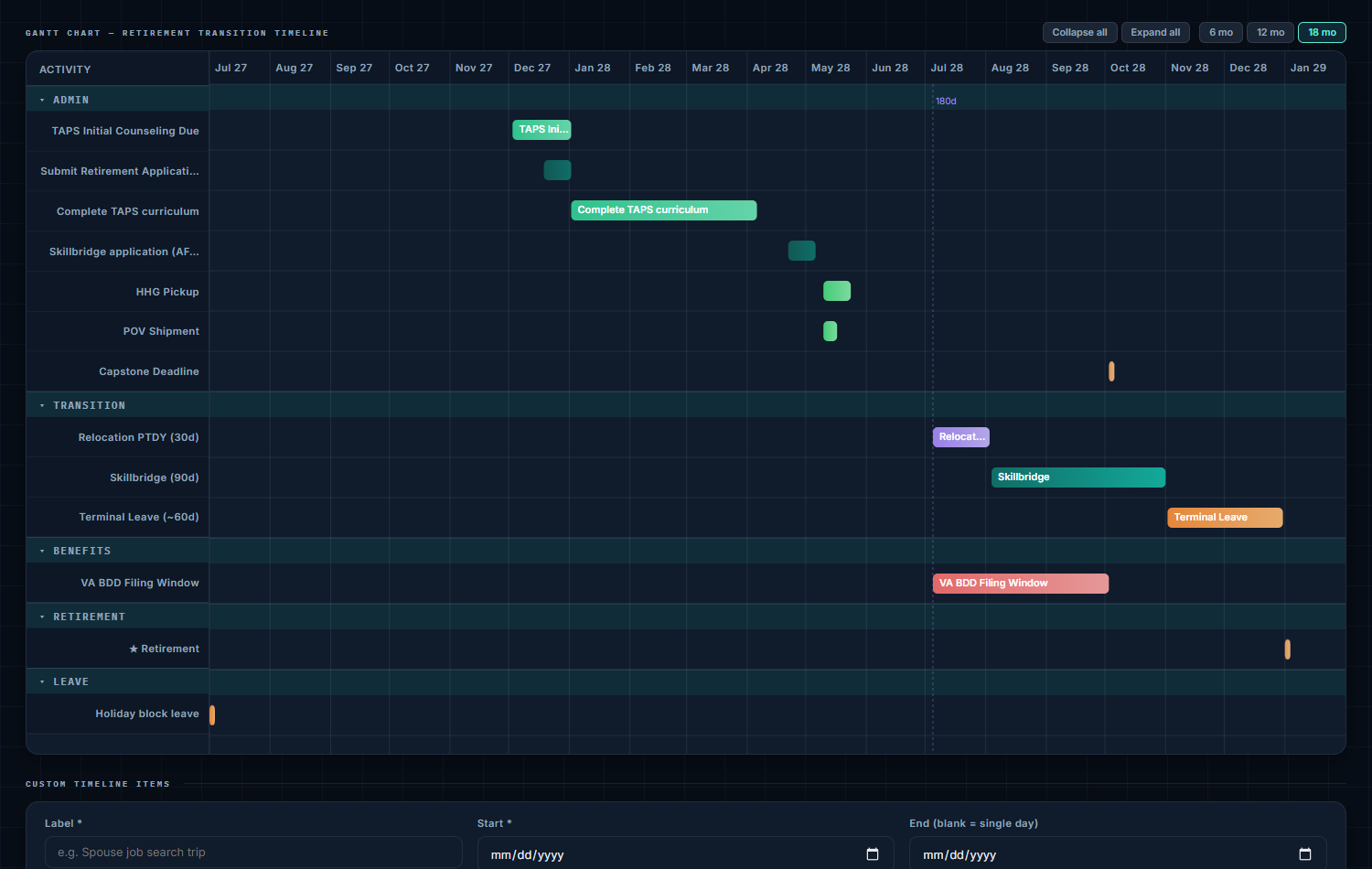
WheelsUp puts the transfer decision on your timeline years before it becomes urgent — alongside the retirement date it can quietly move.
Yellow Ribbon, briefly
The Post-9/11 benefit covers tuition and fees up to statutory limits. The Yellow Ribbon Program (38 U.S.C. §3317) is the public-private mechanism for additional assistance beyond those limits: participating institutions contribute toward the excess and the VA matches that contribution.
Two practical points: participation is by institution and often by program, with limited seats, and it matters most at private and out-of-state schools where costs exceed the standard cap. If a school is on your list, verify its current Yellow Ribbon agreement and seat count directly with the school — this is not something to assume from a directory listing.
What to do in your separation year
- Verify your aggregate creditable service and the benefit tier it produces. Do this before your date is locked — service months are the input you can still influence.
- Make the transfer decision now if it's still available to you. Eligibility to transfer requires being in service; the four-year obligation makes late transfers costly or impossible.
- Confirm existing transfers are correctly designated — right dependents, right months. Errors are much easier to fix while you're still in.
- Check your remaining entitlement if you've already used some. Entitlement is measured in months, and partial use is common and easily forgotten.
- Note the delimiting rules for using the benefit and how they apply to your service dates — they differ by when you separated, and they determine how long you have.
Sources
- 38 U.S.C. §3311 — entitlement for service commencing on or after 11 September 2001: (b)(1)(A) the aggregate 36 months of active duty including entry-level and skill training; (b)(1)(B) continuing on active duty or discharge as described in subsection (c); (b)(2) the 30-continuous-days / service-connected-disability discharge category
- 38 U.S.C. §3319 — transfer of unused benefits: (a)(1)–(2) the authority and its recruitment/retention purpose; (b) eligibility — at least six years of service plus an agreement to serve at least four more, at the time the request is approved; (c) eligible dependents by reference to 10 U.S.C. §1072(2)(A), (D), (I); (d) the 36-month transfer cap and the 18-month regulatory floor; (e) designation of transferees and months
- 38 U.S.C. §3313 — amount and payment of educational assistance · §3317 — the Yellow Ribbon public-private contribution program
⚠ Benefit tier percentages and program rules are administered by the VA and adjust over time — verify current figures at VA.gov before making decisions. This guide cites the statute, not the current rate tables.
Spot an error? Tell us — citations are the product here.
The transfer decision, years before it becomes urgent. WheelsUp back-plans every deadline from your actual date and branch, with the citation attached to each card.