The rule: never earlier than the day VA receives your claim
The catch is which date counts. It's easy to assume VA pays from when the condition started. 38 U.S.C. §5110(a)(1) says otherwise: unless the chapter specifically provides otherwise, the effective date of an award based on an initial or supplemental claim for compensation “shall be fixed in accordance with the facts found, but shall not be earlier than the date of receipt of application therefor.”
Two limits, and the later one wins. The facts found — when the disability actually existed — set one boundary. The day VA received your application sets the other. A condition you've had for years still can't reach back past the day your claim arrived, unless one of the statute's exceptions applies.
For someone leaving the service, one exception matters more than all the others.
The first-year exception: back to the day after discharge
38 U.S.C. §5110(b)(1):
“The effective date of an award of disability compensation to a veteran shall be the day following the date of the veteran’s discharge or release if application therefor is received within one year from such date of discharge or release.”
Inside that year, the award reaches back to the day after you got out. Outside it, you're back to the receipt-date rule. Same condition, same evidence, same rating — a different start date, decided only by when your application arrived.
Worked example (illustrative dates). A member is discharged on June 30, 2026.
- Application received May 14, 2027 — inside the year. Under §5110(b)(1), the effective date is July 1, 2026, the day after discharge.
- Application received August 16, 2027 — outside the year. Under §5110(a)(1), the effective date can be no earlier than August 16, 2027.
Nothing between July 1, 2026 and August 15, 2027 is within the second award's reach — a stretch of more than thirteen months. When payments begin after an effective date is set by rules this guide doesn't cover; the point is that under §5110(a)(1) the second award can't reach back into those months.
Filing before you separate
Don't wait. If you are still in uniform, filing before you separate is covered in our BDD timeline guide.
Whichever route you take, the application's arrival is the event the statute measures, so don't hold a claim back waiting for perfect evidence. Once you are past the first year, every month you wait is a month the award can't reach. VA.gov is explicit that “You can submit evidence at any time.” — with the caveat that evidence sent after the evidence-gathering step sends the claim back to that step for review.
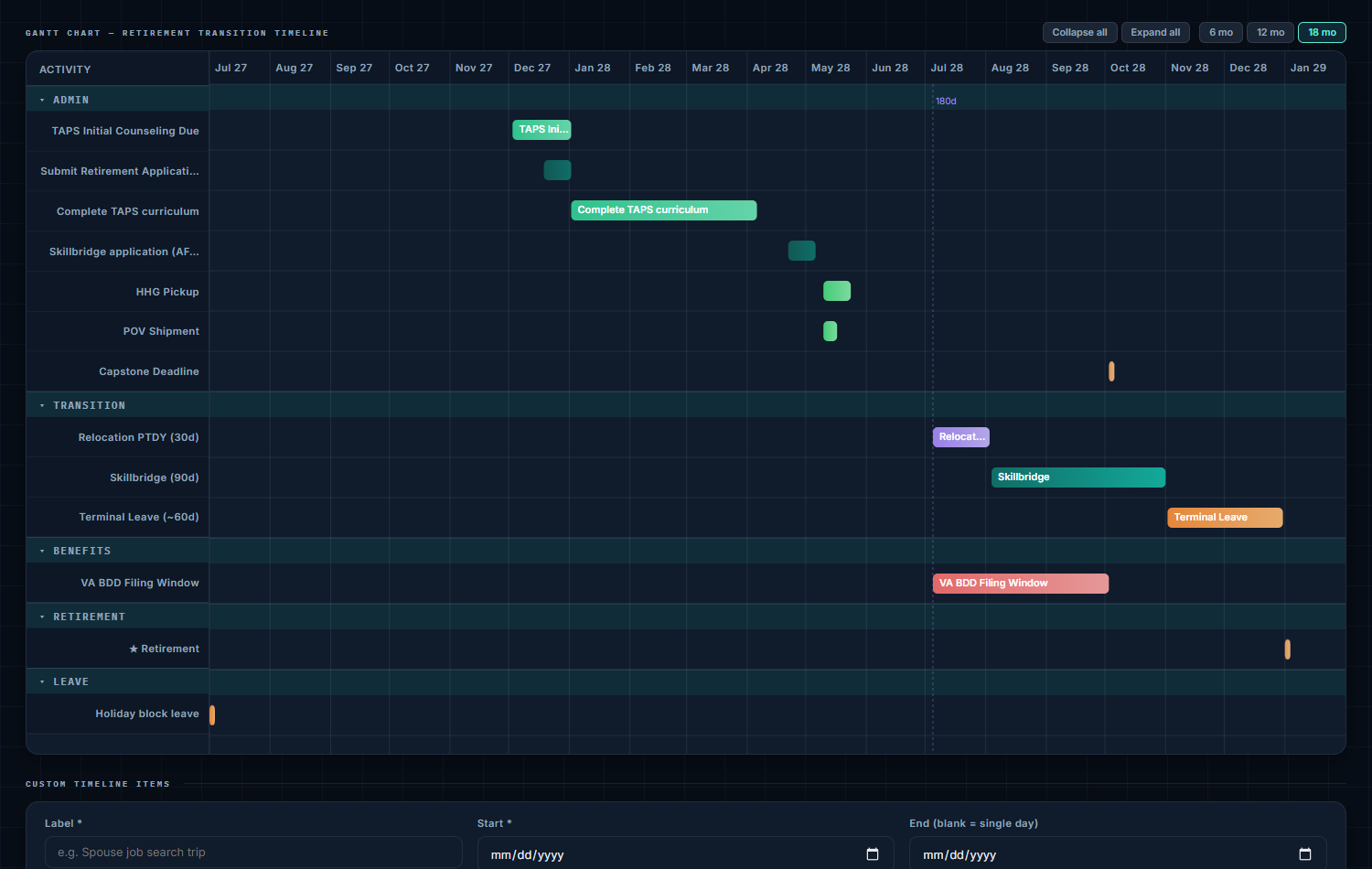
WheelsUp's timeline draws your VA BDD filing window against your separation date and terminal leave — so your claim is planned alongside your separation, not left until after it.
After a decision: continuous pursuit keeps your date
A decision doesn't end the date question. Under §5110(a)(2), the date you filed your initial application stays the date of application as long as the claim is continuously pursued by filing, “either alone or in succession”:
- a request for higher-level review, a supplemental claim, or a notice of disagreement, each within one year after the decision; or
- a supplemental claim within one year after a decision of the Board of Veterans' Appeals or the Court of Appeals for Veterans Claims.
⚠ Let the year pass and the chain breaks. A supplemental claim received more than one year after the original decision or a Board decision takes an effective date no earlier than the day VA receives it (§5110(a)(3)).
The three options and their one-year window come from §5104C, and a supplemental claim stays available after the year under §5104C(b) — just without the earlier date. The lanes are compared in VA decision reviews.
Increases and dependents run on their own clocks
- A worsening condition. For increased compensation, §5110(b)(3) sets the effective date as “the earliest date as of which it is ascertainable that an increase in disability had occurred, if application is received within one year from such date.” That year runs from the worsening, not from your original award.
- Dependents added to a rating. Additional compensation for dependents, based on a rating at the level the law specifies for it, is payable from the rating's effective date — “but only if proof of dependents is received within one year from the date of notification of such rating action” (§5110(f)).
- Marriage, birth or adoption. An award or increase because of one of those events takes effect on the date of the event, if VA receives proof within one year of it (§5110(n)).
- Corrected military records. If a disallowed claim is later allowed on new and relevant evidence that comes from a correction of your military records or a change to your discharge, the effective date is the date you applied for that correction or the date of the disallowed claim, whichever is later — and the award can't be retroactive for more than one year from the readjudication (§5110(i)).
Dependents change the monthly rate only from a 30% rating up — the 2026 figures are in VA disability pay rates.
The clocks side by side:
| Situation | Get it to VA within | Effective date |
|---|---|---|
| First claim after you separate — §5110(b)(1) | One year from discharge or release | The day after discharge or release |
| Any other initial claim — §5110(a)(1) | No window — receipt is the earliest possible date | No earlier than the date of receipt |
| Review after a decision — §5110(a)(2) | One year from the decision | Your original filing date is kept |
| A worsening condition — §5110(b)(3) | One year from the worsening | The earliest date the increase is ascertainable |
| Proof of dependents — §5110(f) | One year from notice of the rating | The rating's effective date |
| Proof of marriage, birth or adoption — §5110(n) | One year from the event | The date of the event |
Make sure it's received — and know when it was
The statute's word is receipt, so know how VA confirms it. VA.gov says that if you file online, “you’ll get an on-screen message from us after you submit the form”. If you mail your application, VA sends a letter to let you know it has your claim, which should arrive “about 1 week, plus mailing time, after we receive your claim.”
Don't assume a postmark rescues a mailed claim. The Board statute spells out a postmark rule for a notice of disagreement (§7105(b)(1)(B)); §5110 speaks of receipt. If the one-year line is close, file in a way that leaves you proof of the date VA received it.
The short checklist
- Get your claim received within one year of discharge — earlier if you can (§5110(b)(1)).
- Don't hold the claim for perfect evidence; evidence can follow.
- Keep whatever confirms VA has your claim — the on-screen message or the acknowledgement letter.
- Act on a decision within its year to keep your original date (§5110(a)(2)).
- File for an increase within a year of the worsening (§5110(b)(3)).
- Send proof of dependents within a year of the rating notice, and of a marriage, birth or adoption within a year of the event (§5110(f), (n)).
Sources
- 38 U.S.C. §5110 — (a)(1) not earlier than the date of receipt; (a)(2) continuous pursuit, (A)–(E); (a)(3) late supplemental claims; (b)(1) the day after discharge for an application received within one year; (b)(3) increased compensation; (f) dependents; (i) corrected military records; (n) marriage, birth or adoption
- 38 U.S.C. §5104C — (a)(1) the three options within one year of a decision; (b) supplemental claims after the year
- 38 U.S.C. §7105(b)(1)(B) (in the staged Title 38 print) — the postmark rule for a notice of disagreement
- VA.gov, The VA claim process after you file your claim (last updated August 4, 2026) — online and mailed claim confirmation; submitting evidence at any time and the return to evidence gathering
- VA, Current Veterans disability compensation rates (2026, effective December 1, 2025) — no higher rate for dependents at a 10% to 20% rating
Spot an error? Tell us — citations are the product here.
The date you file is part of the award. WheelsUp back-plans every deadline from your actual date and branch, with the citation attached to each card.