Three lanes, one year
The catch: people hear appeal and picture the Board of Veterans' Appeals. That is one of three options. 38 U.S.C. §5104C(a)(1) gives you any of these, to be taken “on or before the date that is one year after the date on which the agency of original jurisdiction issues a decision with respect to that claim”:
- a request for higher-level review, under §5104B;
- a supplemental claim, under §5108;
- a notice of disagreement to the Board, under §7105.
VA.gov describes the same thing from the claimant's side: if you disagree with a claim decision received on or after February 19, 2019, you have three decision review options to choose from.
| Lane | What happens | Evidence |
|---|---|---|
| Higher-level review (§5104B) | A higher-level adjudicator within the agency of original jurisdiction reviews the decision de novo | Limited to the evidence of record in the decision reviewed |
| Supplemental claim (§5108) | VA readjudicates the claim if new and relevant evidence is presented or secured | New and relevant evidence; VA's duty to assist applies |
| Board appeal (§7105) | A notice of disagreement filed with the Board | You choose: a hearing, evidence without a hearing, or neither |
After the year runs out, one lane is still open: §5104C(b) lets you file a supplemental claim once more than one year has passed since the decision. What you lose is the other two lanes — and, as below, possibly your original effective date.
Higher-level review: a second look at the same record
Under §5104B, you ask for a review of the decision by a higher-level adjudicator within the agency of original jurisdiction — the part of VA that made the decision. The statute's rules:
- VA shall approve every request (§5104B(a)(2)).
- It must be in writing, in the form VA prescribes, and made within one year of the notice of the decision (§5104B(b)(1)).
- You can ask for a different office. The request may say whether you want the review at the same office or by an adjudicator at a different office, and VA shall not deny a different-office request without good cause (§5104B(b)(2)).
- No new evidence. “The evidentiary record before the higher-level adjudicator shall be limited to the evidence of record in the agency of original jurisdiction decision being reviewed.” (§5104B(d))
- A fresh look. The review is de novo (§5104B(e)), and the decision notice must say whether any evidence was not considered and what your options are to have it considered (§5104B(c)).
VA's duty to help you gather evidence does not apply to higher-level review (§5103A(e)(2)). But if the higher-level adjudicator finds that VA failed that duty before the original decision, the claim goes back for the error to be corrected and readjudicated — unless VA can already award the maximum benefit on the record (§5103A(f)(1)).
Choose this lane when the record was enough and the call on it was wrong.
Supplemental claim: the lane for new evidence
§5108(a) is one sentence: “If new and relevant evidence is presented or secured with respect to a supplemental claim, the Secretary shall readjudicate the claim taking into consideration all of the evidence of record.”
Title 38 defines the second half of that phrase: relevant evidence means “evidence that tends to prove or disprove a matter in issue” (§101(35)). A supplemental claim is where evidence the original decision never saw — a new medical opinion, records you've since found — gets weighed.
- VA's duty to assist applies. If you reasonably identify existing records, whether or not a federal agency holds them, VA shall help you obtain them under §5103A — and that help doesn't wait on a finding that your evidence is new and relevant (§5108(b)).
- It stays open after the year. §5104C(b) allows a supplemental claim more than a year after the decision — but see the effective-date section below before relying on that.
- VA isn't required to readjudicate a disallowed claim without it. §5103A(h) says nothing in the duty-to-assist section requires VA to readjudicate a disallowed claim except when new and relevant evidence is presented or secured.
Board appeal: the notice of disagreement
§7105(a) says appellate review “shall be initiated by the filing of a notice of disagreement in the form prescribed by the Secretary” — and that each appellant is accorded hearing and representation rights. The rules that matter most:
- File within one year of the notice of the decision you are appealing — including a decision made after a higher-level review or a supplemental claim (§7105(b)(1)(A)).
- A postmark counts. A notice of disagreement postmarked before the one-year period expires is accepted as timely (§7105(b)(1)(B)).
- Be specific. The notice must be in writing, identify the specific determination you disagree with, and be filed with the Board (§7105(b)(2)(A), (C)). The Board may dismiss an appeal that fails to identify it (§7105(d)).
- Pick your docket. The notice must say whether you want a hearing before the Board with an opportunity to submit evidence, an opportunity to submit additional evidence without a hearing, or a review with neither (§7105(b)(3)).
- One representative at a time. Not more than one recognized organization, attorney or agent may be recognized at any one time in the prosecution of a claim (§7105(b)(2)(B)).
If no notice of disagreement is filed in time, the decision becomes final and the claim is not readjudicated or allowed, except through a higher-level review requested under §5104B, as §5108 provides, or as regulations provide (§7105(c)). VA's duty to assist doesn't apply to Board review either (§5103A(e)(2)); if the Board finds a duty-to-assist error made before the decision, it remands the claim for correction, unless the maximum benefit can already be awarded (§5103A(f)(2)).
One lane at a time — but you can take them in succession
§5104C(a)(2) sets the traffic rules for a single claim:
- One at a time per issue. Once you take one of the three actions, you can't take another on the same claim or the same issue until the first is decided or withdrawn (§5104C(a)(2)(A)).
- In succession is fine. Nothing in the subsection stops you taking the actions one after another on a claim or an issue (§5104C(a)(2)(B)).
- Different issues, different lanes. You may take different actions on different claims, or on different issues within one claim, at the same time (§5104C(a)(2)(C)).
- Switching lanes midway depends on VA policy: the statute lets VA develop one for claimants who want to withdraw an action before it is decided and take a different one instead (§5104C(a)(2)(D)).
Continuous pursuit keeps your original effective date
This is the money part. 38 U.S.C. §5110(a)(2) treats the date you filed your initial application as the date of application if the claim is continuously pursued by filing any of the following, “either alone or in succession”:
- a higher-level review request within one year after the decision (A);
- a supplemental claim within one year after the decision (B);
- a notice of disagreement within one year after the decision (C);
- a supplemental claim within one year after a Board decision (D);
- a supplemental claim within one year after a Court of Appeals for Veterans Claims decision (E).
⚠ Miss the year and the chain breaks. For a supplemental claim received more than one year after the original decision or a Board decision, the effective date can be no earlier than the date VA receives the supplemental claim (§5110(a)(3)). The lane is still open; the earlier date may not be.
How effective dates work from the start is in VA effective dates.
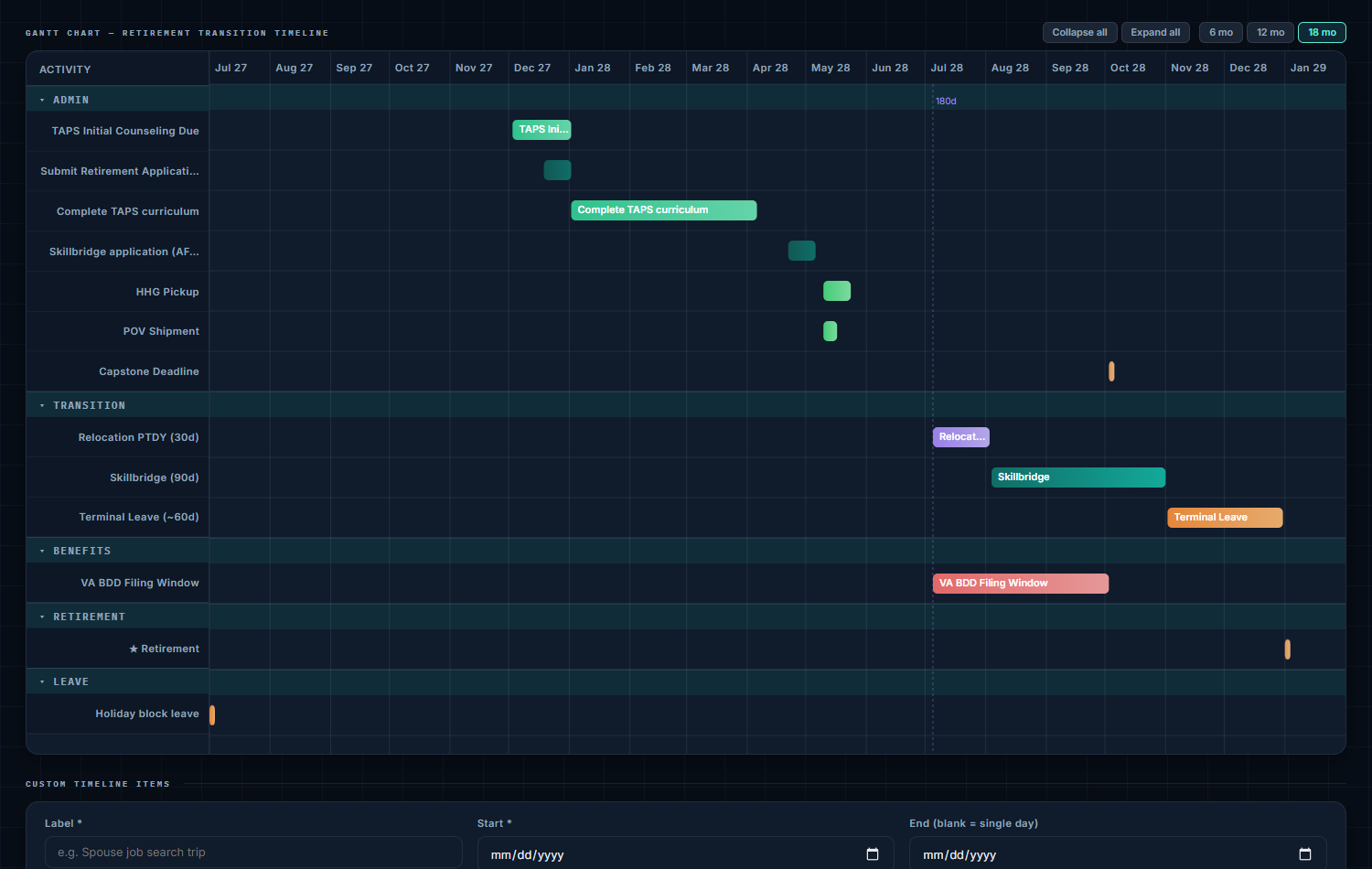
WheelsUp's timeline puts your VA BDD filing window on the same chart as your terminal leave and separation date — so the initial claim that every later review is measured from goes in on time.
Start with the decision letter
Choosing a lane is easier once you read the notice the way the statute writes it. §5104(b) requires every decision notice to include:
- the issues adjudicated;
- a summary of the evidence considered;
- a summary of the applicable laws and regulations;
- the findings favorable to you;
- for a denial, the elements not satisfied that led to it;
- how to obtain or access the evidence used;
- where applicable, the criteria for service connection or the next higher level of compensation.
A denial is not a reset. Under §5104A, a favorable finding “shall be binding on all subsequent adjudicators within the Department, unless clear and convincing evidence is shown to the contrary to rebut such favorable finding.” Whatever lane you take, the favorable findings stand unless VA rebuts them by clear and convincing evidence, so your work is on the elements the letter says were not met.
A practical way to match letter to lane: if the unmet element needs evidence VA hasn't seen, that is supplemental-claim territory, because higher-level review can't consider it. If the evidence was already there and you believe it was misread, higher-level review is built for that. If you want to add evidence or be heard by the Board, the notice of disagreement lets you choose that docket.
The short checklist
- Diary the one-year date the day the notice arrives — counted from the date VA issued the decision, not the day it reached you.
- Read the favorable findings and the unmet elements (§5104(b)(4)–(5)) before choosing.
- New evidence? Supplemental claim. Same record, wrong call? Higher-level review — and consider asking for a different office.
- Board appeal? Pick the docket deliberately and name the specific determination you disagree with.
- One lane per issue at a time; if one fails, take the next inside its year.
- Keep the chain unbroken to keep your original effective date (§5110(a)(2)).
Sources
- 38 U.S.C. §5104C — (a)(1) the three options within one year of the decision; (a)(2)(A)–(D) one action at a time per issue, succession, different issues, and a withdraw-and-switch policy; (b) supplemental claims after the year
- 38 U.S.C. §5104B (in the staged Title 38 print) — (a) higher-level review and its approval; (b) writing, one-year timing, same or different office; (c) notice; (d) record limited to the evidence of record; (e) de novo review
- 38 U.S.C. §7105 (in the staged Title 38 print) — (a) notice of disagreement; (b)(1) one-year filing and postmark rule; (b)(2) form, specificity, representation, filing with the Board; (b)(3) the three dockets; (b)(4) modifying the notice; (c) finality; (d) dismissal
- 38 U.S.C. §5108 — (a) readjudication on new and relevant evidence; (b) duty to assist with supplemental claims · §101(35) — relevant evidence defined
- 38 U.S.C. §5110(a)(2)–(3) — continuous pursuit and late supplemental claims · §5103A(e), (f), (h) — duty to assist and its correction on review
- 38 U.S.C. §5104(b)(1)–(7) — contents of a decision notice · §5104A — favorable findings binding
- VA.gov, The VA claim process after you file your claim (last updated August 4, 2026) — three decision review options for decisions received on or after February 19, 2019
Spot an error? Tell us — citations are the product here.
A year goes fast after a decision. WheelsUp back-plans every deadline from your actual date and branch, with the citation attached to each card.