One formula for PTSD, depression, anxiety and the rest
The first catch: you might expect PTSD to have its own rating criteria, depression its own, anxiety its own. 38 CFR §4.130 doesn't work that way. Its Note 2 settles it in one sentence: “Ratings under diagnostic codes 9201 to 9440 will be evaluated using the General Rating Formula for Mental Disorders.”
That range holds every mental-disorder code in §4.130 except the two eating disorders — among them 9411 posttraumatic stress disorder, 9434 major depressive disorder, 9400 generalized anxiety disorder, 9412 panic disorder and/or agoraphobia, 9432 bipolar disorder, 9440 chronic adjustment disorder — and every one of them reads off the same six steps: 0, 10, 30, 50, 70 and 100 percent. The formula has no 20, 40, 60, 80 or 90.
The diagnosis decides which code VA uses. It doesn't change the criteria. What moves you up or down the ladder is how far the condition impairs your working and social life, described in the formula's own words below.
Two things sit outside that rule. Anorexia nervosa (9520) and bulimia nervosa (9521) are rated on a separate eating-disorders formula with its own steps. And the section's names for conditions follow the American Psychiatric Association's DSM-5, which §4.130 says rating agencies must be thoroughly familiar with.
What each level says, word for word
Every criterion from 10% up leads with an impairment standard; the 0% criterion starts from a formal diagnosis. From 30% up, a list of symptoms follows, introduced by the words “due to such symptoms as” — the 10% and 0% criteria have no list. The ladder at a glance:
| Rating | The impairment standard (summarised) |
|---|---|
| 100% | Total occupational and social impairment |
| 70% | Deficiencies in most areas — work, school, family relations, judgment, thinking, or mood |
| 50% | Reduced reliability and productivity |
| 30% | Occasional decrease in work efficiency and intermittent inability to perform occupational tasks, while generally functioning satisfactorily |
| 10% | Mild or transient symptoms that decrease efficiency only during significant stress — or symptoms controlled by continuous medication |
| 0% | Formally diagnosed, but not severe enough to interfere with functioning or to require continuous medication |
And each step exactly as the regulation prints it:
100 percent
“Total occupational and social impairment, due to such symptoms as: gross impairment in thought processes or communication; persistent delusions or hallucinations; grossly inappropriate behavior; persistent danger of hurting self or others; intermittent inability to perform activities of daily living (including maintenance of minimal personal hygiene); disorientation to time or place; memory loss for names of close relatives, own occupation, or own name.”
70 percent
“Occupational and social impairment, with deficiencies in most areas, such as work, school, family relations, judgment, thinking, or mood, due to such symptoms as: suicidal ideation; obsessional rituals which interfere with routine activities; speech intermittently illogical, obscure, or irrelevant; near-continuous panic or depression affecting the ability to function independently, appropriately and effectively; impaired impulse control (such as unprovoked irritability with periods of violence); spatial disorientation; neglect of personal appearance and hygiene; difficulty in adapting to stressful circumstances (including work or a worklike setting); inability to establish and maintain effective relationships.”
50 percent
“Occupational and social impairment with reduced reliability and productivity due to such symptoms as: flattened affect; circumstantial, circumlocutory, or stereotyped speech; panic attacks more than once a week; difficulty in understanding complex commands; impairment of short- and long-term memory (e.g., retention of only highly learned material, forgetting to complete tasks); impaired judgment; impaired abstract thinking; disturbances of motivation and mood; difficulty in establishing and maintaining effective work and social relationships.”
30 percent
“Occupational and social impairment with occasional decrease in work efficiency and intermittent periods of inability to perform occupational tasks (although generally functioning satisfactorily, with routine behavior, self-care, and conversation normal), due to such symptoms as: depressed mood, anxiety, suspiciousness, panic attacks (weekly or less often), chronic sleep impairment, mild memory loss (such as forgetting names, directions, recent events).”
10 percent
“Occupational and social impairment due to mild or transient symptoms which decrease work efficiency and ability to perform occupational tasks only during periods of significant stress, or symptoms controlled by continuous medication.”
0 percent
“A mental condition has been formally diagnosed, but symptoms are not severe enough either to interfere with occupational and social functioning or to require continuous medication.”
How to read occupational and social impairment
The formula never defines the phrase in a sentence of its own. It grades it — and reading the six standards in order shows what changes from one step to the next:
- 0 to 10: medication is a dividing line. The 0% criterion covers a diagnosed condition whose symptoms are not severe enough either to interfere with functioning or to require continuous medication. The 10% criterion includes “symptoms controlled by continuous medication.”
- 10 to 30: from only under significant stress to occasional. At 10% the decrease in work efficiency appears only during periods of significant stress. At 30% there is an occasional decrease in work efficiency and intermittent periods of inability to perform occupational tasks — while the person is still described as “generally functioning satisfactorily, with routine behavior, self-care, and conversation normal”.
- 30 to 50: reliability and productivity. The 50% standard is “reduced reliability and productivity”. The panic-attack examples show the step: weekly or less often at 30%, more than once a week at 50%.
- 50 to 70: deficiencies in most areas. The 70% standard names the areas — work, school, family relations, judgment, thinking, or mood — and its examples include suicidal ideation and an inability to establish and maintain effective relationships.
- 70 to 100: total. The 100% standard is total occupational and social impairment.
Some symptoms appear on more than one step, in different degrees. Memory is the clearest case: mild memory loss (such as forgetting names, directions, recent events) at 30%; impairment of short- and long-term memory at 50%; memory loss for names of close relatives, own occupation, or own name at 100%.
From 10% up, the impairment standard comes first in each criterion; from 30% up, the symptoms follow it, framed with the words such as. §4.130's opening paragraph also refers rating agencies to the directives in §§4.125 through 4.129. Those sections are outside this guide, so for how VA weighs the evidence in your case, ask an accredited representative.
What evidence speaks to the formula
The 0% criterion begins with a formal diagnosis. Every step above it is about what the symptoms do to working and social life — so the evidence that matters is evidence about how you function, not only the name of the condition.
- Records VA must try to get for you. For a compensation claim, VA's duty to assist includes obtaining, if relevant to the claim, your service medical records, records of treatment at VA facilities or at VA expense if you give enough information to locate them, and other relevant federal records you adequately identify and authorize (38 U.S.C. §5103A(c)(1)).
- Private treatment records. VA must make reasonable efforts to obtain relevant private records you adequately identify — and not less than two requests to the custodian, unless the first makes clear a second would be futile (§5103A(b)(1)–(2)). Name each provider precisely.
- Your own account is part of the record. When VA decides whether an examination is necessary, it takes into consideration “all information and lay or medical evidence (including statements of the claimant)” (§5103A(d)(2)). Describe effects the formula names: problems at work, strain in relationships, how often panic attacks happen, whether you rely on continuous medication.
- The examination. VA must provide a medical examination or obtain a medical opinion when one is necessary to decide the claim — when the record contains competent evidence of a current disability or persistent or recurrent symptoms, indicates they may be associated with your service, and doesn't contain enough medical evidence to decide (§5103A(d)).
- Medication history. Continuous medication appears in both the 0% and the 10% criteria, so a documented prescription history speaks directly to where you sit.
When the decision arrives, the notice must identify, where applicable, the criteria that must be satisfied for the next higher level of compensation (38 U.S.C. §5104(b)(7)). For a mental-health rating, that is the next step of the formula above.
How a mental-health rating fits your combined rating
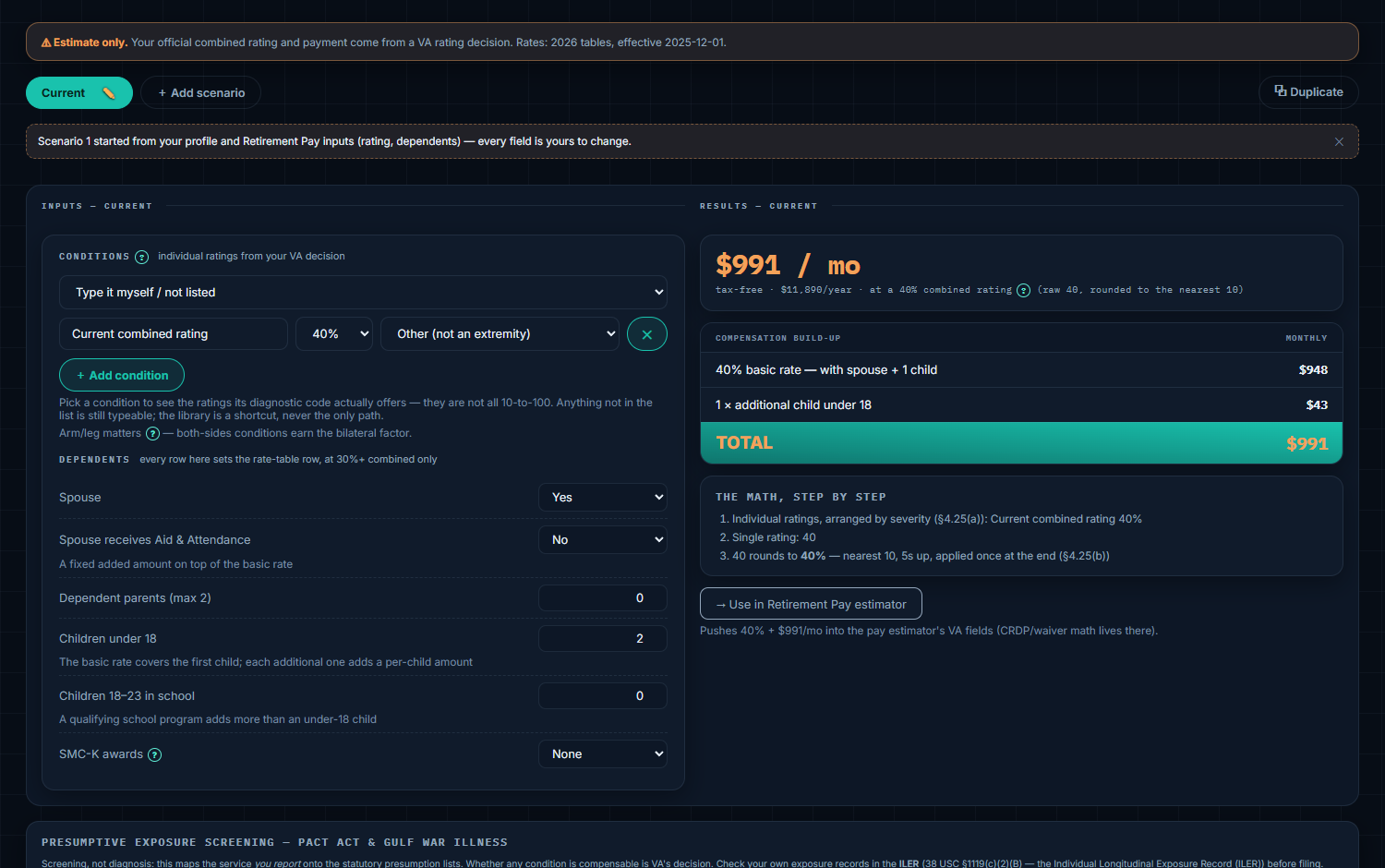
A mental-health evaluation combines with your other ratings the way any rating does: arranged in order of severity, combined through Table I, and converted to the nearest number divisible by 10 only once, as the last step (38 CFR §4.25(a)–(b)). The regulation's own example: a 50% and a 30% disability give a combined value of 65, which converts to 70.
A 0% evaluation is a real evaluation, but Table I has no row or column for 0, so it cannot move the combined number. What a 0% rating still does for you is covered in our 0% rating guide; the full combining procedure is in VA disability math.
WheelsUp's VA Disability calculator (a Pro tool) offers PTSD, major depressive disorder, generalized anxiety disorder and chronic adjustment disorder with only the evaluations this formula contains — each step's criteria shown in the regulation's words beside the rating — and combines the result with your other conditions under §4.25.
If this is heavy reading
Reading rating criteria about your own symptoms can be hard going. You don't have to finish this page, or file anything, today.
If you are in crisis — or simply need to talk to someone now — the Veterans Crisis Line is at the bottom of this page, with the ways to reach it.
The short checklist
- Find your diagnostic code, then set it aside — every code from 9201 to 9440 uses the same formula.
- Read the six criteria yourself and note which impairment standard describes your working and social life.
- Document functioning, not just the diagnosis — effects at work and at home, how often symptoms occur, and your medication history.
- Identify every treating provider precisely, so VA's duty to assist reaches their records.
- Attend the examination VA schedules; §5103A(d) has VA provide one when an examination is necessary to decide the claim.
- Read the decision's next-level criteria (§5104(b)(7)) before choosing what to do next — see VA decision reviews.
Sources
- 38 CFR §4.130 — diagnostic codes 9201–9440 and 9520–9521; the General Rating Formula for Mental Disorders (the 100, 70, 50, 30, 10 and 0 percent criteria, quoted in full); the Rating Formula for Eating Disorders; Note 2 assigning codes to each formula; the opening paragraph on the DSM-5 nomenclature and its reference to the directives in §§4.125–4.129
- 38 CFR §4.25 (as of 1 July 2026) — (a) ordering by severity, Table I, and the 50 and 30 → 65 → 70 example; (b) conversion to the nearest degree divisible by 10 once per rating decision
- 38 U.S.C. §5103A — (b)(1)–(2) private records and the two-request rule; (c)(1) records VA obtains for compensation claims; (d)(1)–(2) when a medical examination or opinion is necessary, including lay evidence and the claimant's statements
- 38 U.S.C. §5104(b)(7) — a decision notice identifies the criteria for the next higher level of compensation, where applicable
Spot an error? Tell us — citations are the product here.
Know which step you're claiming, and why. WheelsUp back-plans every deadline from your actual date and branch, with the citation attached to each card.