The 2026 rates, veteran alone
These are VA's 2026 disability compensation rates, effective December 1, 2025, for a veteran with no dependents. The rating that matters is your combined rating after VA's table and rounding — not the sum of your individual ratings (see VA disability math).
| Combined rating | Monthly payment, veteran alone |
|---|---|
| 10% | $180.42 |
| 20% | $356.66 |
| 30% | $552.47 |
| 40% | $795.84 |
| 50% | $1,132.90 |
| 60% | $1,435.02 |
| 70% | $1,808.45 |
| 80% | $2,102.15 |
| 90% | $2,362.30 |
| 100% | $3,938.58 |
Two things stand out. Payment moves only at the ten-percent steps, so the thresholds you cross matter more than your unrounded value. And the jump from 90% to 100% is by far the largest step on the table.
Dependents change the rate — but only from 30% up
VA's table note is direct: if you have a 10% to 20% disability rating, “you won’t receive a higher rate even if you have a dependent spouse, child, or parent.” From 30% up, the rate depends on exactly who your dependents are.
Read your row; don't build it. VA publishes a separate basic monthly rate for each dependent status. Find the column that describes you and the row for your rating — that cell is your basic rate.
Without children
VA's first group: a dependent spouse or parent, but no children.
| Rating | Veteran alone | With spouse |
|---|---|---|
| 30% | $552.47 | $617.47 |
| 40% | $795.84 | $882.84 |
| 50% | $1,132.90 | $1,241.90 |
| 60% | $1,435.02 | $1,566.02 |
| 70% | $1,808.45 | $1,961.45 |
| 80% | $2,102.15 | $2,277.15 |
| 90% | $2,362.30 | $2,559.30 |
| 100% | $3,938.58 | $4,158.17 |
| Rating | With 1 parent (no spouse) | With 2 parents (no spouse) |
|---|---|---|
| 30% | $604.47 | $656.47 |
| 40% | $865.84 | $935.84 |
| 50% | $1,220.90 | $1,308.90 |
| 60% | $1,540.02 | $1,645.02 |
| 70% | $1,931.45 | $2,054.45 |
| 80% | $2,242.15 | $2,382.15 |
| 90% | $2,520.30 | $2,678.30 |
| 100% | $4,114.82 | $4,291.06 |
| Rating | Spouse and 1 parent | Spouse and 2 parents |
|---|---|---|
| 30% | $669.47 | $721.47 |
| 40% | $952.84 | $1,022.84 |
| 50% | $1,329.90 | $1,417.90 |
| 60% | $1,671.02 | $1,776.02 |
| 70% | $2,084.45 | $2,207.45 |
| 80% | $2,417.15 | $2,557.15 |
| 90% | $2,717.30 | $2,875.30 |
| 100% | $4,334.41 | $4,510.65 |
With a child
VA's second group: dependents including one child. For more than one child, add the amounts in the next section.
| Rating | 1 child only | 1 child and spouse |
|---|---|---|
| 30% | $596.47 | $666.47 |
| 40% | $853.84 | $947.84 |
| 50% | $1,205.90 | $1,322.90 |
| 60% | $1,523.02 | $1,663.02 |
| 70% | $1,910.45 | $2,074.45 |
| 80% | $2,219.15 | $2,406.15 |
| 90% | $2,494.30 | $2,704.30 |
| 100% | $4,085.43 | $4,318.99 |
| Rating | 1 child and 1 parent (no spouse) | 1 child and 2 parents (no spouse) |
|---|---|---|
| 30% | $648.47 | $700.47 |
| 40% | $923.84 | $993.84 |
| 50% | $1,293.90 | $1,381.90 |
| 60% | $1,628.02 | $1,733.02 |
| 70% | $2,033.45 | $2,156.45 |
| 80% | $2,359.15 | $2,499.15 |
| 90% | $2,652.30 | $2,810.30 |
| 100% | $4,261.67 | $4,437.91 |
| Rating | 1 child, spouse and 1 parent | 1 child, spouse and 2 parents |
|---|---|---|
| 30% | $718.47 | $770.47 |
| 40% | $1,017.84 | $1,087.84 |
| 50% | $1,410.90 | $1,498.90 |
| 60% | $1,768.02 | $1,873.02 |
| 70% | $2,197.45 | $2,320.45 |
| 80% | $2,546.15 | $2,686.15 |
| 90% | $2,862.30 | $3,020.30 |
| 100% | $4,495.23 | $4,671.47 |
Added amounts: more children, and a spouse receiving Aid and Attendance
Every basic rate with a child already pays for one child. For each child beyond the first, and for a spouse who receives Aid and Attendance (A&A), VA adds a fixed amount on top of the basic rate. In school below is VA's child over age 18 in a qualifying school program:
| Rating | Each extra child under 18 | Each extra child over 18 in school | Spouse on A&A |
|---|---|---|---|
| 30% | $32.00 | $105.00 | $61.00 |
| 40% | $43.00 | $140.00 | $81.00 |
| 50% | $54.00 | $176.00 | $101.00 |
| 60% | $65.00 | $211.00 | $121.00 |
| 70% | $76.00 | $246.00 | $141.00 |
| 80% | $87.00 | $281.00 | $161.00 |
| 90% | $98.00 | $317.00 | $181.00 |
| 100% | $109.11 | $352.45 | $201.41 |
VA's own worked example shows the method. A veteran rated 70% with a spouse and three children under 18 starts from the basic rate of $2,074.45 for a spouse and one child — “Since your basic rate already provides payment for 1 child” — then adds $76.00 for each of the other two children, and, if the spouse receives Aid and Attendance, $141. VA's total with Aid and Attendance: $2,367.45 a month.
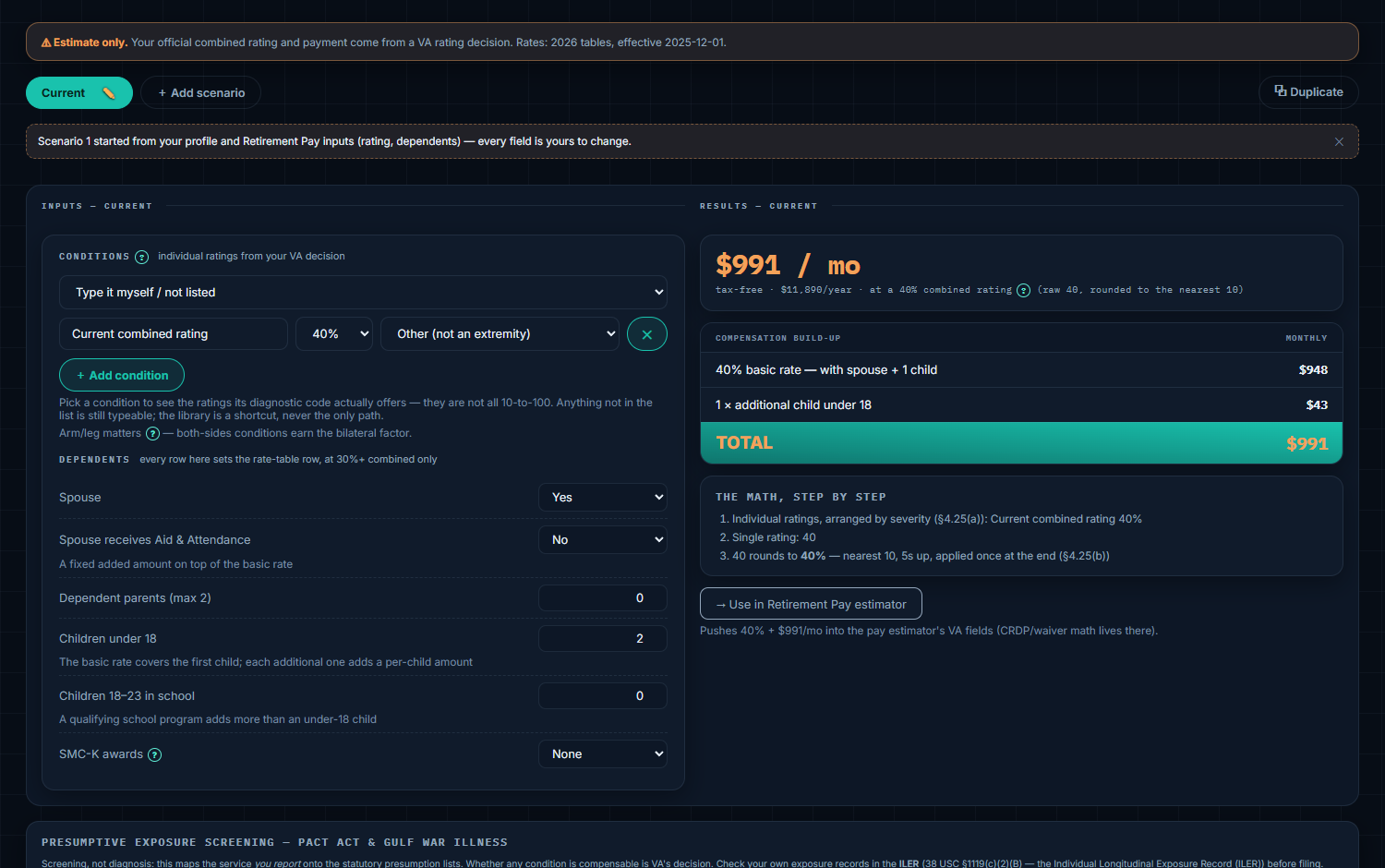
Worked example (illustrative inputs). A veteran rated 50%, with a spouse who is not receiving Aid and Attendance, two children under 18, and no dependent parents.
- Basic rate, 50%, with spouse and 1 child: $1,322.90
- One additional child under 18 at 50%: + $54.00
- Monthly total: $1,376.90
WheelsUp's VA Disability calculator (a Pro tool) looks up your combined rating in these 2026 tables with the dependents you enter — spouse, children under 18, children in school, parents, a spouse receiving Aid and Attendance — and shows the build-up line by line, with up to three SMC-K awards on top.
Where the rates come from: 38 U.S.C. §1114 and an annual increase
The statute behind the table is 38 U.S.C. §1114. It sets a monthly amount “if and while the disability is rated” at each level, from 10 percent in subsection (a) to a disability rated as total in subsection (j); the subsections after that deal with special monthly compensation.
The catch: don't read your payment out of the statute's text. The Code text of §1114 prints $123 for a 10% rating, and its own amendment notes show that figure was written in by a 2009 law, Pub. L. 111–37. VA's 2026 table pays $180.42.
The gap is the annual increase. The notes to §1114 reproduce this cycle's rate-increase law, Pub. L. 119–42 (November 25, 2025). It directed VA to increase, effective December 1, 2025, the dollar amounts in effect on November 30, 2025 — the §1114 amounts, the additional compensation for dependents under §1115(1), and several other amounts including dependency and indemnity compensation — by the same percentage as Social Security benefits increased on that date, and to publish the new amounts in the Federal Register. The notes list similar acts from earlier years.
For 2026 that Social Security increase is 2.8 percent, per SSA. VA's rate page puts the link in one line: “We’re required by law to match the percentage of cost-of-living adjustments made to Social Security benefits.”
Above the table: special monthly compensation
Some disabilities carry more than the basic table pays. VA's 2026 special monthly compensation page, also effective December 1, 2025, sets out letter-designated levels:
- SMC-K — $139.87 a month, added to your basic compensation rate for any rating from 0% to 100%, and to all SMC basic rates except SMC-O, SMC-Q and SMC-R. You may receive 1 to 3 SMC-K awards. The qualifying losses are listed in §1114(k).
- SMC-L through SMC-O — cover specific disabilities and situations, with their own tables by dependent status.
- SMC-R — may apply if you need daily help from another person for basic needs such as dressing, eating and bathing.
- SMC-S — may apply if you can't leave the house because of your service-connected disabilities.
Whether any level applies is VA's decision. If one might, read VA's SMC tables for your level and dependent status rather than the basic table above.
When the table changes next
Every table on this page carries the same date — effective December 1, 2025 — and VA's list of past rates shows the same day for the years before: December 1, 2024, 2023 and 2022. And the Social Security adjustments VA follows have, after 1982, taken effect with benefits payable for December, per SSA.
⚠ Expect these tables to be replaced on December 1, 2026, and treat every figure on this page as a 2026 figure until then.
Two cautions about the next one:
- It depends on the next increase being enacted. This cycle's came from Pub. L. 119–42, and the notes to §1114 list similar acts from earlier years — the increase is not automatic arithmetic in the statute's own text.
- It isn't always a raise. SSA's history shows years with a 0.0% adjustment — January 2010, January 2011 and January 2016 — and SSA says that if there is no increase in its index, there can be no COLA.
What your rating itself is worth also depends on when it starts — see VA effective dates. And if you're retiring, the interaction with retired pay is in our CRDP guide.
The short checklist
- Start from your combined rating, rounded as VA rounds it — not the sum of your ratings.
- At 10% or 20%, skip the dependent columns: dependents don't change the rate.
- From 30% up, find your exact dependent-status column and read the cell.
- Add the added amounts for each child beyond the first and for a spouse receiving Aid and Attendance.
- Ask whether any SMC level applies, especially SMC-K.
- Recheck every figure after December 1, 2026.
Sources
- VA, Current Veterans disability compensation rates — 2026 rates effective December 1, 2025 (page last updated December 2, 2025): the 10%–20% table and its dependent note; basic monthly rates for 30%–60% and 70%–100%, with and without children; the added amounts; the cost-of-living note; VA's worked examples; past rates effective December 1, 2022, 2023 and 2024
- VA, Current special monthly compensation rates — 2026, effective December 1, 2025: SMC-K and its application; the descriptions of levels L through O, R and S
- 38 U.S.C. §1114 — (a)–(j) rates by rating; (k)–(t) special monthly compensation; the amendment notes (Pub. L. 111–37, 2009); the note reproducing Pub. L. 119–42, §§2–3 (November 25, 2025), and listing similar acts
- Social Security Administration, Cost-of-Living Adjustment Information for 2026 — the 2.8 percent COLA; COLAs effective with December benefits after 1982; the history of automatic adjustments, including the 0.0% years
- 38 CFR §4.25 (as of 1 July 2026) — the combined ratings table; combined values converted to the nearest number divisible by 10, with final 5s adjusted upward, once per rating decision
Spot an error? Tell us — citations are the product here.
Your rating, your dependents, this year's table. WheelsUp back-plans every deadline from your actual date and branch, with the citation attached to each card.