Tinnitus: one evaluation, at 10 percent
Diagnostic code 6260 in 38 CFR §4.87 is Tinnitus, recurrent, and the schedule gives it exactly one evaluation: 10 percent. There is no 20% or 30% step to argue for.
The catch is the question almost everyone asks next — I hear it in both ears, so is that two ratings? The regulation answers it directly in Note (2):
“Assign only a single evaluation for recurrent tinnitus, whether the sound is perceived in one ear, both ears, or in the head.”
One ear, both ears, or in the head: one evaluation, 10 percent. Nor does tinnitus pick up the bilateral factor. 38 CFR §4.26 adds 10 percent of the combined value (added, not combined) when a partial disability results from disease or injury of both arms, both legs, or paired skeletal muscles — ears are not on that list, and Note (2) would settle it anyway.
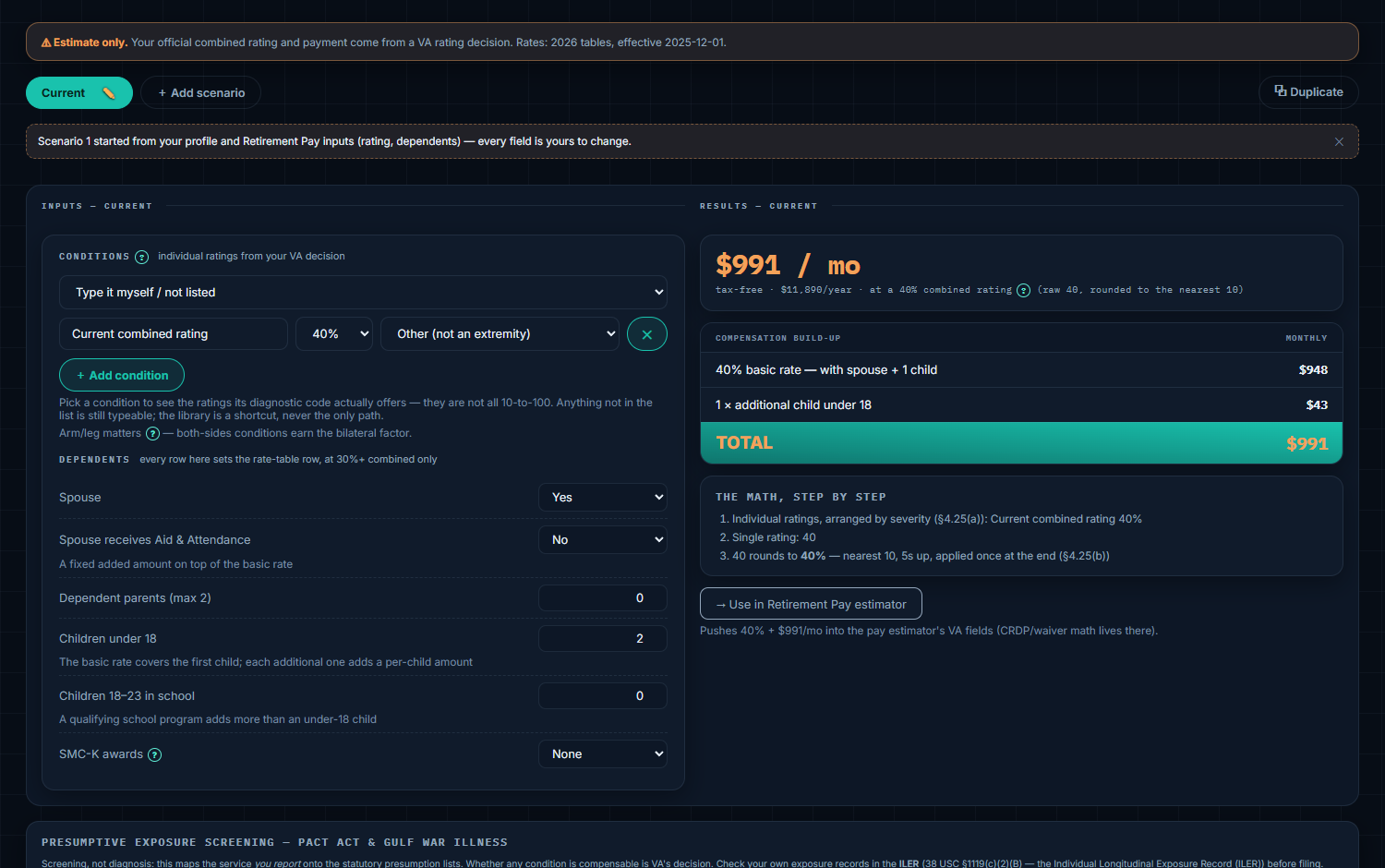
WheelsUp's VA Disability calculator (a Pro tool) offers tinnitus at the one evaluation DC 6260 contains, and for hearing loss it tells you to enter the evaluation from your decision letter or audiogram — because that number comes out of VA's tables, not out of a description you can match yourself to.
The notes that trip people up
DC 6260 carries three notes, and each one answers a real question:
- Note (1) — tinnitus can sit beside other ratings. A separate tinnitus evaluation may be combined with an evaluation under 6100, 6200, 6204 or another diagnostic code — “except when tinnitus supports an evaluation under one of those diagnostic codes.” If tinnitus is already part of what earned another evaluation, it isn't rated twice.
- Note (2) — one evaluation, however it is perceived, as quoted above.
- Note (3) — objective tinnitus is different. Tinnitus that other people can hear, with a definable cause, is not evaluated under 6260 at all; it is evaluated as part of the underlying condition causing it.
Two neighbouring codes carry their own instructions:
- Chronic suppurative otitis media, mastoiditis or cholesteatoma (6200) — its note says to evaluate hearing impairment and complications such as tinnitus separately.
- Meniere's syndrome (6205) — VA evaluates it either under 6205's own criteria or by separately rating vertigo, hearing impairment and tinnitus, whichever results in a higher overall evaluation. What it may not do is both: the note says not to combine an evaluation for hearing impairment, tinnitus or vertigo with an evaluation under 6205.
Hearing loss starts with the exam, not a description
Many diagnostic codes describe what each rating looks like. Hearing loss doesn't. Its evaluation comes out of numbers, and 38 CFR §4.85(a) sets how those numbers are gathered:
- the examination must be conducted by a state-licensed audiologist;
- it must include a controlled speech discrimination test (Maryland CNC) and a puretone audiometry test;
- and “Examinations will be conducted without the use of hearing aids.”
That makes the exam the rating, in practice. Two results come out of it for each ear — a speech discrimination percentage and a set of puretone thresholds — and the tables do the rest.
How the two tables turn an audiogram into a percentage
Step 1 — the puretone threshold average
§4.85(d) defines it: the sum of the puretone thresholds at 1000, 2000, 3000 and 4000 Hertz, divided by four. The same average is used in every case, including those under §4.86.
Worked example (illustrative inputs, not a real audiogram). One ear's thresholds read 20 at 1000 Hertz, 35 at 2000, 50 at 3000 and 65 at 4000.
Sum: 20 + 35 + 50 + 65 = 170. Divided by four: a puretone threshold average of 42.5.
Step 2 — a Roman numeral for each ear
Table VI gives each ear a designation from I through XI, read where that ear's speech discrimination percentage (the rows) meets its puretone threshold average (the columns) (§4.85(b)).
Table VIa does the same from the puretone threshold average alone. It is used when the examiner certifies that the speech discrimination test is not appropriate — because of language difficulties, inconsistent speech discrimination scores and the like — or when §4.86 calls for it (§4.85(c)).
Step 3 — one percentage for both ears
Table VII combines the two designations. Its rows are the ear with the better hearing, its columns the ear with the poorer hearing, and the evaluation sits where they meet (§4.85(e)).
| Input | Output | Rule |
|---|---|---|
| 1. Thresholds at 1000, 2000, 3000, 4000 Hertz | Puretone threshold average | §4.85(d) |
| 2. Average + speech discrimination (or the average alone) | Roman numeral I–XI per ear | §4.85(b), (c) |
| 3. Better ear's numeral + poorer ear's numeral | Percentage evaluation | §4.85(e) |
If only one ear is service connected, the other ear is assigned a designation of I for Table VII, subject to §3.383 (§4.85(f)). Ask VA how §3.383 applies to you before assuming the other ear is ignored.
This guide doesn't reproduce the cells of Tables VI, VIa and VII. Your audiologist's two numbers per ear, read through VA's published tables, are what decide the evaluation — which is why a calculator can't honestly guess it for you.
Putting tinnitus and hearing loss together
Under Note (1) to DC 6260, a separate tinnitus evaluation may be combined with an evaluation under any other diagnostic code — a hearing-loss evaluation included — unless the tinnitus supports that evaluation. When both stand, they combine like any other ratings under 38 CFR §4.25: arranged by severity, combined through Table I, and converted to the nearest number divisible by 10 once, at the end.
A hearing-loss result below a compensable level still counts as an evaluation. Where the schedule doesn't provide a 0% evaluation for a code, 38 CFR §4.31 says “a zero percent evaluation shall be assigned when the requirements for a compensable evaluation are not met.” Table I has no row or column for 0, so a 0% hearing-loss evaluation beside a 10% tinnitus evaluation leaves the combined value at 10.
Being service connected at 0% is not nothing — see Is a 0% VA rating worth anything? — and the combining arithmetic is in VA disability math.
When hearing loss reaches further: special monthly compensation
§4.85(g) tells VA, when evaluating any claim for impaired hearing, to refer to §3.350 to decide whether special monthly compensation may be due for deafness, or for deafness in combination with other specified disabilities.
In the statute, 38 U.S.C. §1114(k) lists “deafness of both ears, having absence of air and bone conduction” among the losses that carry the (k) rate. VA's 2026 special monthly compensation table (effective December 1, 2025) pays SMC-K at $139.87 a month, added to the basic compensation rate for any rating from 0% to 100%, and says you may receive 1 to 3 SMC-K awards. Whether you qualify is VA's determination under the rules §4.85(g) points to.
The short checklist
- Claim tinnitus once. One ear or both, it is one 10% evaluation (DC 6260, Note (2)).
- Check whether your tinnitus is part of another evaluation — if it supports one, it isn't rated separately (Note (1)).
- Treat the audiology exam as the rating event: a state-licensed audiologist, Maryland CNC plus puretone testing, no hearing aids.
- Ask for your numbers — the thresholds at 1000, 2000, 3000 and 4000 Hertz and the speech discrimination score for each ear — so you can follow the tables.
- Keep a 0% hearing-loss rating on the record; it is still service connection.
- If both ears are severely affected, ask about special monthly compensation (§4.85(g)).
Sources
- 38 CFR §4.87 — DC 6260 Tinnitus, recurrent (10 percent) and its Notes (1)–(3); the note to DC 6200; the note to DC 6205 (Meniere's syndrome)
- 38 CFR §4.85 — (a) examination by a state-licensed audiologist with Maryland CNC and puretone testing, without hearing aids; (b) Table VI; (c) Table VIa; (d) puretone threshold average; (e) Table VII; (f) one service-connected ear; (g) special monthly compensation for deafness under §3.350; (h) the numeric tables
- 38 CFR §4.31 — zero percent evaluations · 38 CFR §4.25 (as of 1 July 2026) — combining through Table I and the single final conversion · 38 CFR §4.26 (as of 1 July 2026) — the bilateral factor's scope
- 38 U.S.C. §1114(k) — deafness of both ears among the losses carrying the (k) rate · VA special monthly compensation rates, 2026 (effective December 1, 2025) — SMC-K
- 38 CFR §17.36(b)(7)–(8) — noncompensable zero percent service-connected veterans named in the VA health-care priority subcategories
Spot an error? Tell us — citations are the product here.
Rate what the schedule actually offers. WheelsUp back-plans every deadline from your actual date and branch, with the citation attached to each card.