Eight groups, in the law's order
38 U.S.C. §1705(a) requires VA to run an annual patient enrollment system and to manage enrollment “in accordance with the following priorities, in the order listed” — eight of them. The statute creates the order; 38 CFR §17.36(b) defines who is in each group:
| Group | Who is in it, per 38 CFR §17.36(b) |
|---|---|
| 1 | A singular or combined rating of 50% or more based on service-connected disabilities or unemployability; Medal of Honor recipients |
| 2 | A singular or combined rating of 30% or 40% |
| 3 | Former prisoners of war; Purple Heart recipients; a rating of 10% or 20%; veterans discharged or released for a disability incurred or aggravated in the line of duty; certain veterans receiving, or suspended from, compensation under 38 U.S.C. §1151; veterans whose compensation is suspended because they receive military retired pay; veterans compensated at the 10% level for multiple noncompensable service-connected disabilities that clearly interfere with normal employability |
| 4 | Veterans receiving increased pension for regular aid and attendance or for being permanently housebound; veterans determined to be catastrophically disabled |
| 5 | Veterans not in groups 1–4 who are determined unable to defray the expenses of necessary care under 38 U.S.C. §1722(a) |
| 6 | World War II veterans; veterans solely seeking care for a disorder associated with toxic-substance or radiation exposure, with Southwest Asia theater service in the Gulf War (August 2, 1990 to November 11, 1998), or with combat service after the Gulf War or in hostilities after November 11, 1998, as provided and limited in 38 U.S.C. §1710(e); Camp Lejeune veterans under §17.400; veterans with 0% service-connected disabilities who are nevertheless compensated |
| 7 | Veterans who agree to pay the applicable copayment and whose previous-year income is low income under HUD's geographic limits — four subcategories |
| 8 | Veterans not in groups 4 or 7 who are eligible for care only if they agree to pay the applicable copayment — six subcategories |
Catastrophically disabled has its own definition in §17.36(e): a permanent severely disabling injury, disorder or disease that compromises the activities of daily living so far that you need personal or mechanical assistance to leave home or bed, or constant supervision to avoid physical harm — as found by the Chief of Staff, or equivalent clinical official, at the VA facility where you were examined.
You sit in one group — the highest you qualify for
The catch: veterans who fit several descriptions assume they hold several groups. §17.36(d)(3) places a veteran in the highest priority category for which the veteran qualifies, and in only one — with a single exception. A veteran placed in group 6 based on a specified disorder or illness is also placed in group 7 or 8, as applicable, for all matters group 6 doesn't cover, if the veteran has previously agreed to pay the applicable copayment.
- VA decides. On a completed VA Form 10-10EZ, a VA official accepts you as an enrollee on determining that you are in a category eligible to be enrolled — or informs you that you are not (§17.36(d)(2)).
- You are placed even if your group isn't enrolling. Veterans are placed in priority categories whether or not that category is eligible to be enrolled (§17.36(d)(3)(i)).
- The answer comes in writing. A decision on enrollment status is sent by letter with the reasons, an effective date for any change, and a statement of appeal rights (§17.36(d)(6)).
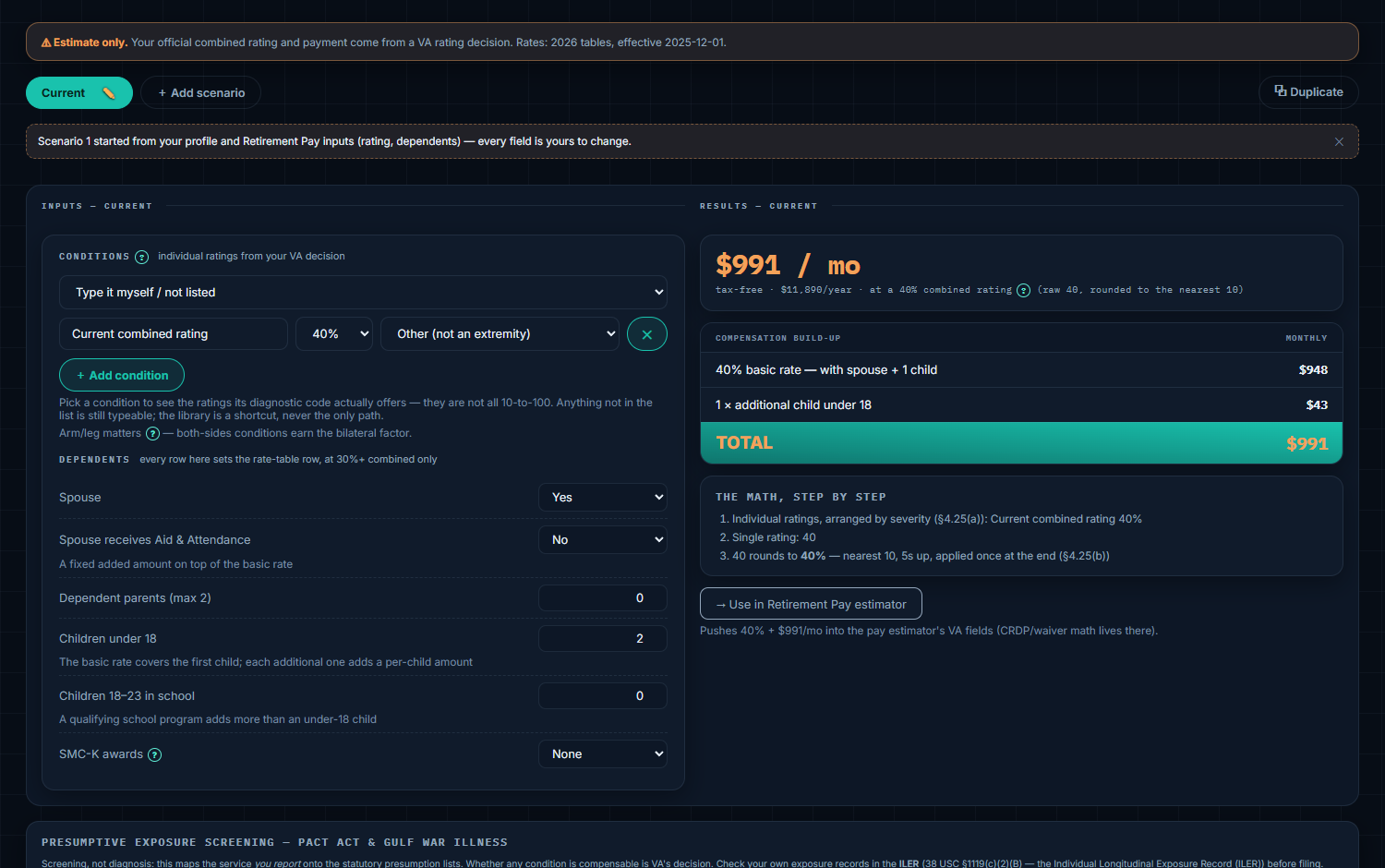
WheelsUp's VA Disability calculator (a Pro tool) works out the combined rating that groups 1 to 3 turn on, keeping 0% conditions on your record as service connection — and the VA Health Care tool (also Pro) reads that rating to show which §17.36(b) category your answers point at, with the clause it comes from. Both are estimates; VA decides.
The care package doesn't change by group
A higher group doesn't mean better care. 38 CFR §17.36(a)(2) makes an enrolled veteran who has agreed to any copayment the law requires eligible for VA hospital and outpatient care as provided in the medical benefits package set forth in §17.38. §17.36(a) names one package and doesn't vary it by priority category. (This guide doesn't describe what the package contains; §17.38 is outside it.)
The one limit §17.36(a) states is in (a)(3): a veteran enrolled on the basis of a §1710(e) disorder — toxic-substance or radiation exposure, Gulf War service, or later combat service — is eligible for the package for the disorder. And a note to (a)(2) adds that a veteran's enrollment status is recognized throughout the United States.
What your group does change
Whether you can enroll right now
VA decides which categories it enrolls, and may revise that (§17.36(c)(1)). The rule in §17.36(c)(2) is that VA enrolls the categories in §17.36(b) beginning June 15, 2009, “except that those veterans in subcategories (v) and (vi) of priority category 8 are not eligible to be enrolled.”
Which subcategory of group 8 you're in turns on your enrollment history — were you enrolled on January 17, 2003, or moved down from a higher category? — and on whether your income is not greater than ten percent more than the income that would permit enrollment in group 5 or group 7, whichever is higher. Within each pair, a veteran with a noncompensable 0% service-connected rating is listed ahead of one who isn't service connected; the 0% side is covered in our 0% rating guide.
Your place in line
Veterans are disenrolled and re-enrolled in category order — group 1 the last to be disenrolled and the first to be re-enrolled — and within groups 7 and 8, in subcategory order (§17.36(d)(3)(v)).
Whether VA must, or may, furnish care
§1705(a)(7) and (8) describe groups 7 and 8 as veterans described in 38 U.S.C. §1710(a)(3) — veterans not described in §1710(a)(1) or (2). For the veterans those two paragraphs describe, VA shall furnish the hospital care and medical services it determines to be needed, effective in any fiscal year only to the extent provided in advance in appropriations Acts (§1710(a)(4)). For §1710(a)(3) veterans, VA “may, to the extent resources and facilities are available and subject to the provisions of subsections (f) and (g), furnish hospital care, medical services, and nursing home care which the Secretary determines to be needed.”
Whether you must agree to copayments
For those §1710(a)(3) veterans:
- VA may not furnish hospital care or nursing home care, except hospice care, unless the veteran agrees to pay the applicable amount (§1710(f)(1));
- VA may not furnish medical services, except hospice care, unless the veteran agrees to pay, for each outpatient visit, the amount VA establishes by regulation (§1710(g)(1));
- for a veteran also described in §1705(a)(7) — group 7 — the hospital-care amount is 20 percent of what the veteran would otherwise owe under §1710(f)(2)(B) and (3)(A) (§1710(f)(4));
- and no payment under (f) or (g) may be required for any days of care beyond 360 in any 365-calendar-day period (§1710(f)(3)(F)).
⚠ Don't read this as free care for groups 1 through 6. The copayment provisions discussed here are §1710(f) and (g), written for §1710(a)(3) veterans, and they don't settle what anyone else pays. Ask VA what copayments apply to you.
Two different income tests — and the 1990 numbers
Two groups turn on income, and they use different tests:
- Group 5 — unable to defray the expenses of necessary care. Under 38 U.S.C. §1722(a), that means you are eligible for medical assistance under a State plan approved under title XIX of the Social Security Act, you receive VA pension under §1521, or your attributable income is not greater than the §1722(b) threshold. VA may refuse the income determination if your estate is large enough that some of it should reasonably be used for your maintenance (§1722(d)), and may deem your income below the threshold to avoid hardship when current projections are substantially lower (§1722(e)).
- Group 7 — low income. §17.36(b)(7) has VA compare your income, including your spouse's and dependents', with the HUD low-income limit for the public housing and section 8 programs in the area where you live — a geographic limit, not a national one. To avoid hardship, VA may use projected current-year income if it is below that limit.
⚠ Don't use the dollar figures printed in §1722. §1722(b)(1) sets the threshold “for the calendar year beginning on January 1, 1990”. Each later year uses the preceding year's amounts as adjusted (§1722(b)(2)), increased every January 1 by the percentage the maximum pension rates rose under §5312(a) during the preceding calendar year (§1722(c)). The printed numbers are a 1990 base, not this year's threshold — get the current figure from VA.
When to enroll — no general deadline, and two time-limited provisions
A note to §17.36(a)(1) is plain: “A veteran may apply to be enrolled at any time.” You apply on VA Form 10-10EZ — at a VA medical facility or by mail, online, or by telephone (§17.36(d)(1)). VA may not provide care under §1710(a)(2) or (3) unless you enroll (§1705(c)(1)).
Two time-limited provisions sit beside that:
- The first 12 months after discharge. For veterans described in §1710(a)(1) — care for a service-connected disability, or a rating of 50% or more — and veterans discharged for a disability incurred or aggravated in the line of duty (§1710(a)(2)(B)), VA provides care for the specified disability for the 12-month period after discharge even if the veteran hasn't enrolled (§1705(c)(2)).
- The combat-veteran route. A veteran who served on active duty in a theater of combat operations during a period of war after the Persian Gulf War, or in combat against a hostile force during hostilities after November 11, 1998, is eligible under §1710(e)(1)(D) for care for any illness, notwithstanding insufficient medical evidence that it is attributable to that service. For a veteran discharged after September 11, 2001, that route runs for “the 10-year period beginning on the date of such discharge or release” (§1710(e)(3)(A)). The limit is on that route, not a deadline for enrolling through any other category.
If you served where the PACT Act presumptions apply, §1710(e) has a separate eligibility route too — see PACT Act presumptive conditions.
The short checklist
- Find your group in §17.36(b) — the highest one you qualify for.
- Don't expect better care from a higher group; expect a different place in line and different copayment terms.
- If you might be group 5 or 7, ignore the §1722 figures — ask VA for the current threshold, and look up your own area's HUD limit.
- If you'd land in group 8, know your subcategory; (v) and (vi) are not currently enrolled.
- Apply on Form 10-10EZ — there's no general deadline, but the combat-veteran route runs 10 years from discharge.
- Ask VA what copayments apply to you, whatever your group.
Sources
- 38 U.S.C. §1705 — (a) the enrollment system and priorities (1)–(8); (c)(1) enrollment required for §1710(a)(2)–(3) care; (c)(2) care for 12 months after discharge
- 38 CFR §17.36 — (a)(1)–(3) and their notes; (b)(1)–(8), including the subcategories of (b)(7) and (b)(8); (c)(1)–(2); (d)(1)–(3) and (d)(6); (e) catastrophically disabled
- 38 U.S.C. §1710 — (a)(1)–(4); (e)(1)(D) and (e)(3)(A), the combat-veteran route; (f)(1), (f)(3)(F) and (f)(4); (g)(1)
- 38 U.S.C. §1722 — (a) inability to defray expenses; (b)(1)–(2) the 1990 base threshold and later years; (c) annual adjustment; (d) corpus of the estate; (e) hardship
Spot an error? Tell us — citations are the product here.
Know your group before you apply. WheelsUp back-plans every deadline from your actual date and branch, with the citation attached to each card.