Start here: you have 90 days, and coverage does not carry over
Retiring is a TRICARE Qualifying Life Event. Your active-duty coverage does not quietly become retiree coverage — you have to enrol, and you have 90 days after your retirement date to do it. Re-enrol inside that window and there is no break in coverage.
Miss it and it is not a cliff, but it is not automatic either: you may request a retroactive enrolment up to 12 months from your retirement date. TRICARE's own wording is "may request" — it is a request, not an entitlement. Outside a Qualifying Life Event, the only other way in is Open Season.
Both halves matter. You have a year is wrong, because coverage breaks after 90 days. Ninety days or you are out is also wrong, because the retroactive path exists.
Group A or Group B — the split that decides your price
Every cost below depends on one thing, and it is not your rank, your years of service or your retirement date. It is when your sponsor first enlisted or was appointed:
| Group | Who you are |
|---|---|
| Group A | Initial enlistment or appointment began before 1 January 2018 |
| Group B | Initial enlistment or appointment began on or after 1 January 2018 |
This is the statutory split in 10 U.S.C. §1075(c) — "originally enlists or is appointed" — not a TRICARE administrative convenience. Someone retiring in 2026 who joined in 2005 is Group A. A medical retirement at ten years for someone who joined in 2019 is Group B. Your date of joining follows you for the rest of your life.
The calendar year 2026 numbers
Annual figures for the retired category. Enrolment fees, deductibles and catastrophic caps all run on the calendar year, not your plan year and not the fiscal year — that is §1075(e).
| Cost | Prime | Select |
|---|---|---|
| Enrolment fee | $381.96 individual $765 family | $186.96 individual $375 family |
| Deductible | $0 | $150 individual $300 family |
| Catastrophic cap | $3,000 / family | $4,381 / family |
| Cost | Prime | Select |
|---|---|---|
| Enrolment fee | $462.96 individual $927 family | $594.96 individual $1,191 family |
| Deductible | $0 | $198 individual (network) $397 family (network) $397 / $794 non-network |
| Catastrophic cap | $4,635 / family | $4,635 / family |
Two exceptions worth knowing. Group A Prime's enrolment fee is waived if you are under 65 and have Medicare Part A and Part B. And medically retired sponsors, their families and survivors pay $0 to enrol and cap at $3,000 — the §1075(e)(3) exemption.
Where the usual advice breaks
The received wisdom is that Select is the cheap plan and Prime is what you pay extra for. Read the two tables again. For Group A that is true — Select costs $186.96 against Prime's $381.96. For Group B it is backwards: Select is $594.96 and Prime is $462.96.
So a Group B retiree who picks Select because Select is the budget option pays $132 more per year as an individual, and $264 more as a family, and also takes on a deductible Prime does not have. There is no version of that sentence that is true for both groups, which is why generic TRICARE advice is worth so little here.
What you still buy with Select is freedom of movement: no primary care manager, no referral for most specialty care, and any TRICARE-authorised provider. That is a real thing to want. It is just not the cheap thing for Group B.
The enrolment fee is not the price
Three numbers decide what a bad year costs you, and only one of them is the enrolment fee.
- The deductible is what you pay before cost-shares start. Prime's is $0 in both groups. Select's is not, and for Group B it doubles out of network.
- Cost-shares are what you pay per visit. Under Select they are a percentage of the allowable charge once out of network — 25% — rather than a flat fee.
- The catastrophic cap is the ceiling. This is the number that matters most and gets quoted least: it is what a genuinely bad year is capped at. Group A Prime caps at $3,000; Group A Select at $4,381. For Group B both plans cap at the same $4,635.
For Group A, the gap between the two caps ($1,381) is larger than the gap between the two enrolment fees ($195). If you are comparing on price alone, compare the worst case, not the subscription.
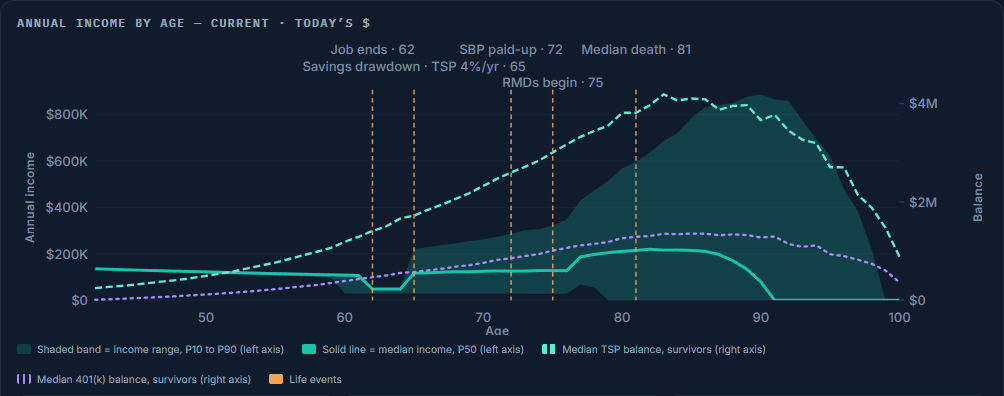
These are annual numbers against a retirement that lasts decades. WheelsUp models your retired pay, VA compensation and TSP drawdown year by year, so a health-care cost you can predict sits beside income you can see.
At 65, everything changes: TRICARE For Life
TRICARE For Life is Medicare-wraparound coverage: Medicare pays first, TFL pays second. Coverage is automatic — there is nothing to enrol in — and starts the first day Medicare Part A and Part B are both in effect. There is no TRICARE enrolment fee at all.
But Part B is not optional, and this is the expensive mistake. 10 U.S.C. §1086(d) is written as a prohibition with an exception, which is why it gets read backwards: a person entitled to Medicare Part A is not eligible for TRICARE under that section — unless they are enrolled in Part B. Part B enrolment is what keeps TRICARE alive at 65. Decline it and you do not have a cheaper plan; you have no TRICARE.
That applies overseas too: Part B is required to stay TRICARE-eligible even where Medicare itself does not cover you.
Your cost for TFL is therefore the Medicare premium. The standard Part B premium for 2026 is $202.90 a month. Higher earners pay more — Medicare adjusts the premium by income — so treat the standard figure as a floor rather than a quote. Part A is premium-free for most people who paid Medicare taxes for at least ten years.
If you are a Guard or Reserve retiree
A grey-area retiree — retired with a 20-Year Letter but not yet drawing retired pay — is not in the retired category above. TRICARE Retired Reserve is a separate premium-based plan with its own costs, and the tables here do not apply to it. The retired-category figures above start when your retired pay does.
Our Guard and Reserve retirement guide covers the points-to-pay calculation and the age at which the pay, and this coverage, begin.
How to choose, in four questions
- Which group am I? Before 1 Jan 2018 is A; on or after is B. Nothing else in this guide means anything until you have answered this.
- Do I want to choose my own doctors, or be assigned one? Select buys freedom of movement. Prime assigns a primary care manager and routes specialty care through referrals.
- What does a bad year cost me? Compare catastrophic caps, not enrolment fees — for Group A the cap gap is seven times the fee gap.
- Am I under 65 with Medicare A and B? If so, Group A Prime's enrolment fee is waived, which changes the arithmetic entirely.
Then enrol inside the 90 days.
Sources
- 10 U.S.C. §1075 — TRICARE Select. (b) the beneficiary categories; (c)(1) and (c)(2)(B) the split by whether the member "originally enlists or is appointed" before or on/after 1 January 2018; (d)(1) the calendar-year-2018 base cost-sharing table; (d)(2) the annual indexing of every fixed dollar amount "to the amount by which retired pay is increased under section 1401a of this title", rounded to the next lower multiple of $1 with the remainder carried forward; (e) enrolment fees, deductibles and catastrophic caps on a calendar-year basis, the $150/$300 base Select enrolment fee and $3,500 base catastrophic cap for the Group B retired category, and (e)(3) the exemption for medically retired members, their families and survivors
- 10 U.S.C. §1075a — TRICARE Prime enrolment fee and cost-sharing, indexed the same way and cross-referencing §1075(b)(1) for the categories
- 10 U.S.C. §1086(d) — TRICARE eligibility and Medicare. (d)(1) bars a person entitled to Part A; (d)(2)(A) restores eligibility for a person "enrolled in the supplementary medical insurance program under part B of such title". Read together, Part B enrolment is what preserves TRICARE at 65
- Defense Health Agency, Compare costs — the published calendar-year 2026 retired-category tables: enrolment fees, deductibles and catastrophic caps for Prime and Select in Groups A and B, the Group A Prime waiver for under-65 beneficiaries with Medicare Part A and B, and the $0 fee / $3,000 cap for medically retired sponsors
- Defense Health Agency, TRICARE For Life — automatic coverage with Part A and Part B, no enrolment fee, coverage beginning the first day both are in effect, and the overseas Part B requirement
- Defense Health Agency, Retiring — retirement as a Qualifying Life Event, the 90-day enrolment window, the requirement to re-enrol within it for unbroken coverage, and the retroactive-enrolment request up to 12 months
- Centers for Medicare & Medicaid Services, Medicare costs — the 2026 standard Part B premium of $202.90 per month, "or higher depending on your income", and premium-free Part A for most people
On the numbers: every dollar figure here is a published calendar-year 2026 amount, not one we computed. The statute indexes its 2018 base amounts by the retired-pay COLA with a carryover rule, which makes that arithmetic path-dependent across every intervening year — so the published tables are the authority for what is actually charged.
Spot an error? Tell us — citations are the product here.
One date drives all of it. WheelsUp back-plans every transition deadline from your real retirement date and branch, with the citation attached to each card.