The 10% rule, and what it is charged on
26 U.S.C. §72(t)(1) says that if a taxpayer receives any amount from a qualified retirement plan (as defined in section 4974(c)), the tax for that year is “increased by an amount equal to 10 percent of the portion of such amount which is includible in gross income.”
Two words carry the weight:
- Increased. This is an additional tax on top of the ordinary income tax on the same money, not a replacement for it.
- Includible. It is charged only on the part you must include in income. IRS Publication 575 puts it plainly: the tax “applies to the part of the distribution that you must include in gross income. It doesn’t apply to any part of a distribution that is tax free, such as amounts that represent a return of your cost or that were rolled over to another retirement plan.”
The age line is exact. §72(t)(2)(A)(i) exempts distributions “made on or after the date on which the employee attains age 59½” — a date, not a calendar year.
A caution about scope. The statute reaches plans defined in §4974(c), and the text of §72(t) never names the Thrift Savings Fund; this guide does not reproduce the provisions that connect the two. WheelsUp's own simulator treats traditional TSP withdrawals before 59½ as subject to the additional tax, and that is the safe way to plan — confirm the treatment of your own account with the TSP or a tax professional.
The age-55 exception turns on when you separated
The statute's wording, §72(t)(2)(A)(v): distributions “made to an employee after separation from service after attainment of age 55”.
The IRS reads that as a calendar-year rule. Publication 575 lists the exception for distributions from a qualified retirement plan “after your separation from service in or after the year you reached age 55”, and then adds: “You can’t separate from service before that year.”
The catch is that the exception attaches to when you separated, not to when you withdraw. The IRS's own example: George left his employer at 49 and took a distribution from his retirement plan in the year he reached 55. “Because he separated from service before he reached age 55, he didn’t meet the requirements”.
Now put military dates on George. A member who leaves the service at 40 or 45 has separated long before the year they reach 55. On the IRS's reading, waiting until 55 to withdraw does not create the exception, because the separation it depends on already happened. If you later work somewhere else, ask the TSP how its rules treat the account your military service built; the sources behind this guide do not answer that.
Two more limits on this exception:
- It does not follow the money into an IRA. §72(t)(3)(A): “Subparagraphs (A)(v) and (C) of paragraph (2) shall not apply to distributions from an individual retirement plan.” Transfer the balance to an IRA and the age-55 route is gone for that money.
- The earlier public-safety age is not earned by military service. §72(t)(10) substitutes age 50 or 25 years of service under the plan, whichever is earlier for age 55 on a distribution from a governmental plan to a qualified public safety employee — defined as state and local employees who provide police protection, firefighting, emergency medical services, or corrections or forensic security services, and federal law enforcement officers, customs and border protection officers, firefighters, air traffic controllers, nuclear materials couriers, Capitol Police, Supreme Court Police and State Department diplomatic security special agents. Military service is not on the list.
Substantially equal periodic payments
The exception that does not depend on your separation age is §72(t)(2)(A)(iv): distributions that are part of a series of substantially equal periodic payments, not less often than annually, made for your life or life expectancy, or the joint lives or life expectancies of you and your designated beneficiary.
Three rules shape it:
- From a plan trust, the series must start after you separate. §72(t)(3)(B) switches the exception off for amounts paid from a §401(a) trust “unless the series of payments begins after the employee separates from service.” Publication 575 repeats the point for qualified retirement plans.
- Changing the series is expensive. Under §72(t)(4), if the payments are modified — other than by death or disability — before the later of five years from the first payment or age 59½, the tax that the exception avoided is added back in the year of the change, plus interest for the deferral period.
- Annuities can count. The statute says periodic payments do not fail to be treated as substantially equal merely because they are received as an annuity.
Do not confuse this with the TSP's installment option. 5 U.S.C. §8433(b)(3) lets a separated participant take 2 or more substantially equal payments to be made not less frequently than annually. The words overlap with §72(t), but the tax exception also requires payments made for your life or life expectancy. Ask a tax professional whether a specific TSP payment choice meets it before you rely on it.
Other exceptions in the statute
§72(t)(2) lists more. The ones most likely to matter to a military family:
- Death — distributions to a beneficiary or the estate on or after the employee's death ((A)(ii)).
- Disability — distributions attributable to the employee being disabled within the meaning of §72(m)(7) ((A)(iii)).
- Medical expenses — up to the amount allowable as a medical-expense deduction under §213 for the year, whether or not you itemize ((B)).
- Divorce — a distribution to an alternate payee under a qualified domestic relations order ((C)); like the age-55 rule, this one does not apply to IRA distributions.
- Reservists called to active duty — a qualified reservist distribution ((G)): made to a reserve component member ordered or called to active duty for more than 179 days or indefinitely, between the date of the order and the end of the active-duty period, from an IRA or from amounts attributable to certain elective deferrals. It can be repaid to an IRA within two years after the active-duty period ends. Whether your TSP contributions fit the definition is a question for the TSP.
- Birth or adoption — a qualified birth or adoption distribution, limited to $5,000 per birth or adoption ((H)).
Each has its own definitions and conditions; the list above is a map, not a checklist to rely on.
Your TSP withdrawal options
5 U.S.C. §8433 sets what the TSP offers. Its text speaks of an employee or Member, and the provision extending it to uniformed-services accounts is not among this guide's sources, so confirm your options on TSP.gov. A participant who separates “is entitled and may elect to withdraw from the Thrift Savings Fund the balance of the employee’s or Member’s account” — may, not must — as:
- an annuity;
- a single payment;
- two or more substantially equal payments made at least annually; or
- a combination, as the Executive Director prescribes by regulation (§8433(b)).
After separation you can also make one or more partial withdrawals of any amount (§8433(c)(1)), or have a withdrawal transferred to an eligible retirement plan (§8433(c)(2)–(3)). Remember the IRA point above before choosing a transfer.
Other rules in the same section:
- No take-backs. You may not return a payment made under an election (§8433(d)(2)).
- Small balances. If your nonforfeitable balance is below an amount set by regulation, the TSP pays it to you in a single payment unless an election under §8432b(h)(2) applies (§8433(f)).
- Before separation only: you can apply for a loan (§8433(g)), or for an in-service withdrawal once you reach 59½ or for financial hardship, the hardship amount limited to your own contributions (§8433(h)); neither can be made unless the requirements of §8435(e) are met.
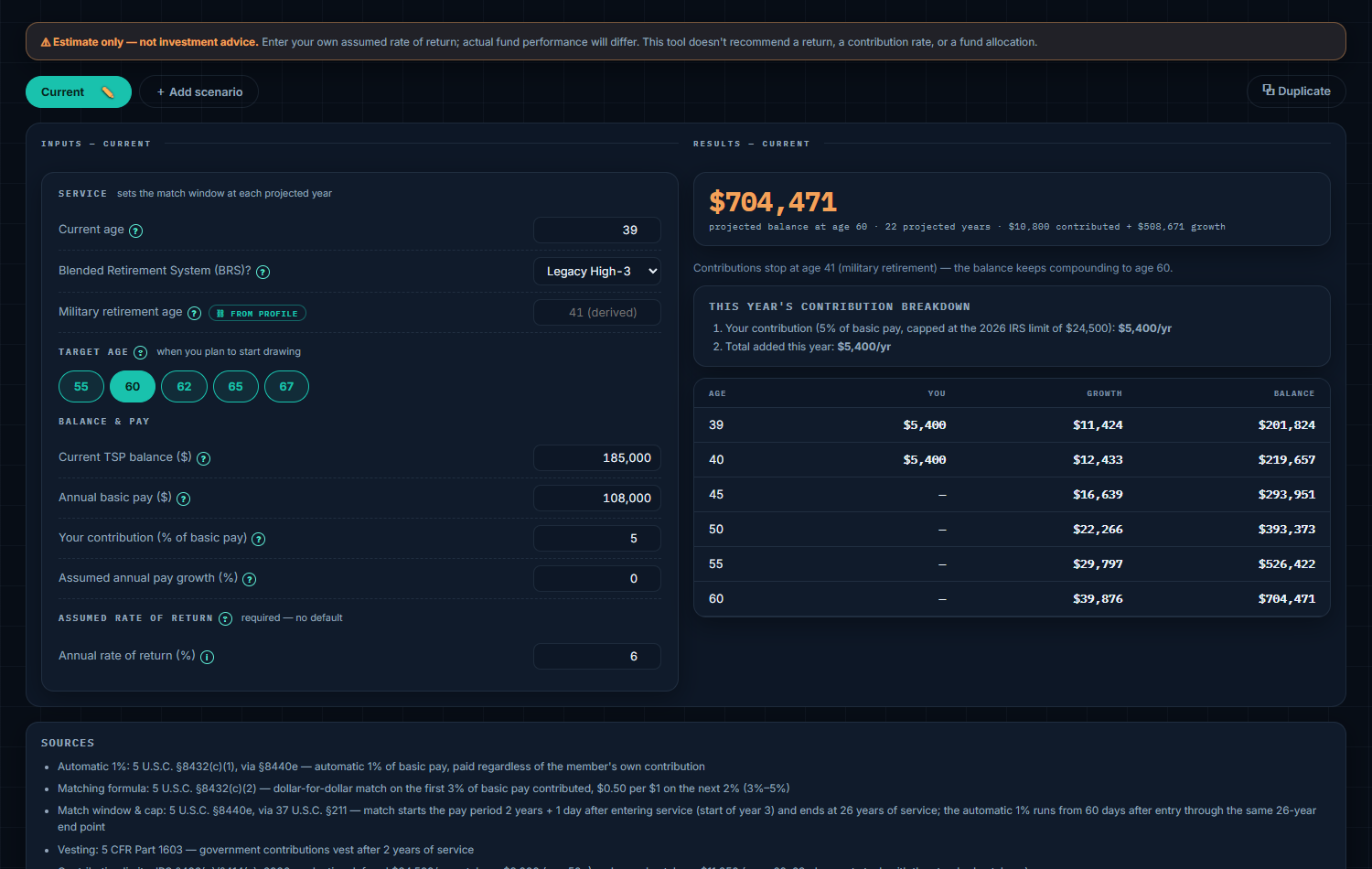
WheelsUp's TSP Growth tool projects your balance year by year to the target age you pick — with the contribution breakdown and the age contributions stop — so you know what an early withdrawal would be drawing down.
At the other end: required minimum distributions
Early withdrawals have a counterpart late in life. TSP Bulletin 23-1 records the SECURE 2.0 changes: the RMD start age rose from 72 to 73 starting January 1, 2023, and rises to 75 starting January 1, 2033 — and “Roth balances will no longer be subject to RMDs prior to the participant's death.”
TSP.gov's RMD age table is by birth year: born before 1960, age 73; born 1960 or later, age 75. And for a federal civilian or uniformed services account, TSP.gov says “your RMD calculation will only include your traditional balance”. A spouse's beneficiary participant account is different: its RMD calculation includes the total balance, traditional and Roth.
WheelsUp's simulator sizes RMDs with the IRS Uniform Lifetime Table (Publication 590-B, Table III): the traditional balance divided by the divisor for your age — 26.5 at 73, 24.6 at 75, 20.2 at 80. That table's own caption limits it to unmarried owners, married owners whose spouses are not more than 10 years younger, and married owners whose spouses are not the sole beneficiaries, so confirm your own figure with the TSP.
Worked example (illustrative birth year and balance; the Uniform Lifetime Table the simulator uses). A retiree born in 1962 reaches 75 with a traditional TSP balance of $400,000 at the end of the prior year.
- RMD age from the TSP.gov table: 75.
- Divisor at 75: 24.6.
- Minimum distribution: $400,000 ÷ 24.6 = $16,260.16 for that year, from the traditional balance only.
What WheelsUp models
Two Pro tools cover this ground, and each says what it leaves out:
- TSP Growth projects your balance to a target age — the BRS automatic and matching contributions, the 2026 IRS contribution limits it enforces, and the year contributions stop. It projects growth only; it does not model withdrawals.
- The Lifetime Monte Carlo draws your TSP down on the plan you set and, with federal tax switched on, charges the additional 10% on the includible part of any discretionary traditional-TSP withdrawal taken at or before age 59 — never on a Roth dollar, because it assumes every Roth withdrawal is a qualified, tax-free distribution (it does not test that, and says so), and never on a required minimum distribution. You can declare that you take early withdrawals as 72(t) payments; it cannot verify that, and says so. Its age-55 declaration applies only to a 401(k)-style account from a later job — it never reaches the TSP, and it does not survive a rollover. It also applies RMDs to the traditional share.
For what happens to the account at separation — the match, vesting and the contribution limits — see our TSP at separation guide.
The short checklist
- Know your 59½ date — the exact date, not the year.
- Assume the additional tax applies to an early traditional withdrawal until the TSP or a tax professional tells you otherwise.
- Check your separation year against 55. If you left service before the year you turned 55, do not plan on the age-55 exception for that account.
- Think twice before moving money to an IRA if an employer-plan exception matters to you.
- If you need income before 59½, get professional help with an equal-payments series — and plan to keep it unchanged for the required period.
- Mark your RMD age from your birth year: 73 if born before 1960, 75 if born in 1960 or later.
Sources
- 26 U.S.C. §72(t) — (1) the additional 10 percent tax; (2)(A)(i)–(v) the 59½, death, disability, equal-payments and separation-after-55 exceptions; (2)(B), (C), (G), (H); (3)(A) IRA limitation; (3)(B) payments must begin after separation; (4) recapture on modification; (10) qualified public safety employees
- IRS Publication 575 (2025), Pension and Annuity Income, Tax on Early Distributions — the 59½ rule and the includible-portion rule; the equal-payments exception; the separation-from-service exception, its calendar-year reading and the IRS example
- 5 U.S.C. §8433 — (a)–(b) entitlement and withdrawal elections; (c) partial withdrawals and transfers; (d)(2) no return of payments; (f) small balances; (g) loans; (h) in-service withdrawals
- TSP.gov, Bulletin 23-1 — RMD start ages and the Roth RMD change; TSP.gov RMD passages and birth-year table; IRS Publication 590-B (2025), Appendix B, Table III (Uniform Lifetime)
Spot an error? Tell us — citations are the product here.
Early money has a price — see it before you pay it. WheelsUp's Pro tools project your TSP and run your drawdown plan through thousands of lifetimes, with the additional tax built in where it applies.