Two different final moves — which one is yours
The catch is that separating and retiring are not two versions of the same move. The Joint Travel Regulations give them different destinations and very different clocks.
In the table, HOR is your home of record and PLEAD is the place from which you were called or ordered to active duty.
| Rule | Separating (par. 051002) | Retiring with a home of selection (par. 051003) |
|---|---|---|
| Who | Separated or released from active duty | Retiring with pay after 8 or more years of continuous active duty; retired for disability or placed on the TDRL; or leaving with severance or separation pay, or involuntarily released with readjustment or separation pay, after 8 or more continuous years |
| Move to | HOR or PLEAD | A home of selection (HOS) |
| Travel must begin | Before the 181st day after separation | Within 3 years of active-duty termination |
| Household goods | 180 days, unless a written request reaches the transportation office by the 180th day | Turned over within 3 years of active-duty termination |
| Storage | To the 180th day after termination | To 1 year after termination |
The 3-year limits apply when your active-duty termination is effective on or after June 24, 2022, and “The 3 year time limitation does not apply retroactively”.
Some retirees do not get a home of selection. Under par. 051003-C, you are limited to the HOR or PLEAD if your order is for retirement without pay; retirement with less than 8 years of continuous active duty immediately before it, for a reason other than physical disability; separation with severance or separation pay after less than 8 continuous years; or involuntary release to inactive duty with readjustment or separation pay. Par. 051003-A separately lists involuntary release from active duty with readjustment or separation pay after at least 8 years of continuous active duty as home-of-selection eligible — if that could be you, get your category in writing from your transportation office. For household goods, those members fall under the separation rules in par. 052012.
Two conditions apply to everyone. A Service member “must actually travel to the appropriate location to be eligible for travel and transportation allowances in this section”. And for separation travel, par. 051002 requires a break in service of at least 1 day.
Where you can move
If you are separating: par. 051002 authorizes your travel from your last permanent duty station to your HOR or PLEAD, and your dependents' travel to the HOR or PLEAD you select. You can go somewhere else, but reimbursement is limited to what the Government would have paid for the trip from your last duty station to the HOR or PLEAD.
If you are retiring with a home of selection: par. 051003-B lets you select:
- any place in the United States;
- your HOR outside the United States, or the place outside the United States from which you were initially called or ordered to active duty; or
- any other place — with reimbursement limited to the allowances for a location in the CONUS that you select, paying you the lesser of the actual cost or that constructed cost.
The choice locks. “Once a home is selected, that selection is irrevocable if transportation in-kind is furnished and used or if travel and transportation allowances are received after travel is completed.”
The three terms, as the JTR defines them:
- Home of record is the place recorded as your home when you were commissioned, appointed, enlisted, inducted or ordered to active duty. You may change it only after a break in service of more than one full day. You may correct it for a bona fide error — to your actual home when you entered the Service, “not a different place selected for the Service member's convenience.”
- PLEAD is where an active component member enlisted, was commissioned or was appointed; it changes if a break in active duty exceeds one full day.
- Home of selection is “the place a Service member selects as the Service member's home upon retirement, separation, or involuntary discharge.”
If you were commissioned from the enlisted ranks and your HOR was recorded as the place you were serving, par. 051002-A and the HOR definition give you routes back to your earlier or actual home of record — ask your transportation office.
The travel clock
Separating: par. 051002-K is blunt — “A Service member and his or her dependent must begin travel to the HOR or PLEAD before the 181st day following separation from Service or release from active duty to receive separation allowances.” A time-limit extension may be authorized through the Secretarial Process when travel inside that window would be a hardship. The request has to describe what prevents travel, state the specific additional time, and acknowledge that the extension is not for personal preference or convenience; it should be for the shortest time appropriate. And “An extension cannot be authorized or approved if it extends travel and transportation allowances for more than 6 years from the date of separation”, except where the Service member's certified, ongoing medical condition prevents the dependent's relocation for longer than 6 years.
Retiring: par. 051003-I gives you and your dependents 3 years from active-duty termination to begin travel to the home of selection, unless more time is authorized through the Secretarial Process. The exceptions it lists:
- Hospitalized on your termination date: travel from the hospital within 3 years after discharge or the end of treatment.
- Hospitalized during the 3 years: the limit is extended by the days spent in the hospital.
- In training or education to qualify for civilian employment on your termination date: travel within 3 years after completing it or 4 years from termination, whichever comes first.
- An unexpected event beyond your control, related to your separation: an extension through the Secretarial Process, if it serves the Service or substantially benefits you and is not costly or adverse to the Service.
Extensions must be requested in writing and may not run more than 6 years from the date of retirement, except for travel to the HOS with a certified, ongoing medical condition.
Dependents going somewhere else: if your dependents travel to a home other than your HOS, their allowances are capped at the cost of travel to your HOS, and they must travel within 1 year after your active-duty termination unless that limit is increased through the Secretarial Process (par. 051003-D).
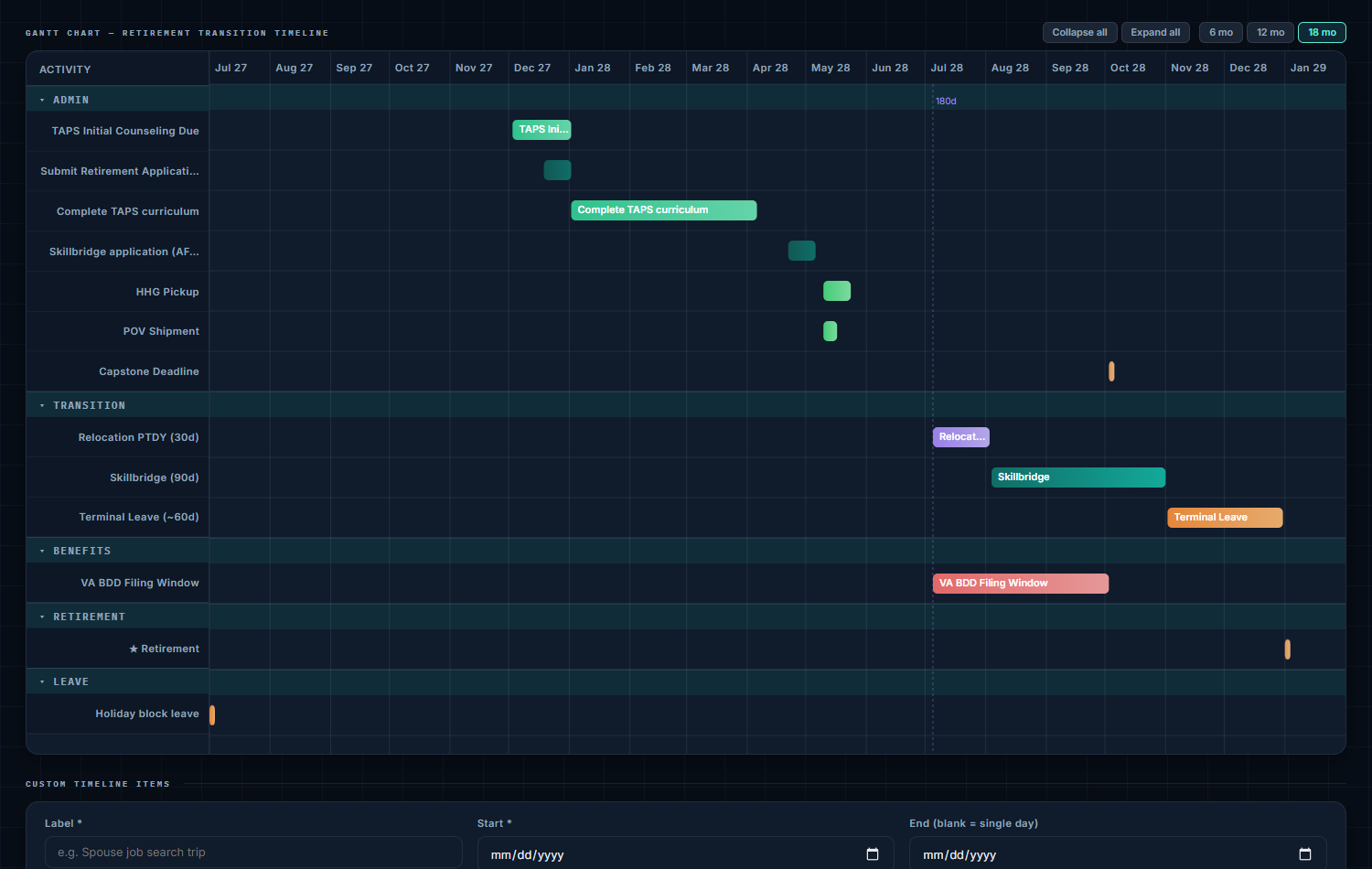
WheelsUp's timeline back-plans your separation from your actual date — relocation PTDY, SkillBridge and terminal leave on one chart, plus household-goods pickup and POV shipment ahead of departure if you are stationed overseas. The JTR's post-separation travel, storage and HHG limits are not built in — add them as your own timeline items.
Household goods and storage
Separating (par. 052012). Household goods move to the HOR or PLEAD you select, up to your authorized PCS weight allowance, from your last or any previous duty station, a designated place, or an authorized storage location. Moving them anywhere else is allowed, but excess costs are yours.
- The deadline: “Authority for HHG transportation is limited to 180 days.” It ends on the 181st day after separation “unless a written request for HHG transportation is submitted to a Transportation Officer or designated representative before the end of the 180th day.” If you apply in time, the goods must be turned over as soon as practicable, and the transportation office judges what is reasonable.
- Storage: non-temporary storage runs from the date your order is issued to the end of the 180th day after your active-duty termination date.
- Extensions: a hardship extension may be granted through the Secretarial Process — but “A time-limit extension for HHG transportation does not extend the Government’s obligation for storage costs” beyond what was authorized. When storage expires, the goods must be moved to the final destination as soon as possible.
Retiring with a home of selection (par. 052013). Household goods can come from your last or any previous duty station, a designated place, anywhere you select (subject to par. 051306), storage, or a combination, to your HOS.
- The deadline: “HHG must be turned over for transportation within 3 years following active duty termination”, with the same June 24, 2022 effective-date rule, and any further extensions granted on an annual basis.
- Storage: Table 5-52 authorizes non-temporary storage from the date your order is issued until 1 year from your active-duty termination date, longer only for hospitalization or medical treatment. Extensions of the move do not extend the Government's storage obligation beyond that year, except for hospitalization or treatment.
- Somewhere other than the HOS, or a split shipment: allowed, if you pay everything above the cost of moving your maximum weight allowance in one lot to the HOS, HOR or PLEAD — whichever saves the Government the most.
- Hospitalization and training: Table 5-53 sets its own shipping limits for these cases. Its training row reads 1 year after completing the training or 2 years after termination, whichever is earlier — different from the travel figures in par. 051003-I. Get the figure that applies to your shipment in writing from your transportation office.
- Other deserving cases: extensions for an unexpected event beyond your control, for the specific time needed, with further extensions possible on a new request — but never more than 6 years from separation, release or retirement, and the delay must be due to your separation.
The details that cost money
- Leaving government quarters early. If you are required to vacate government, government-controlled or privatized housing before you separate or before you choose a home, the JTR authorizes a short-distance move to a local temporary residence within your PCS weight allowance, and the later move from there within the normal limits (Table 5-51, items 6–7; par. 052013-D).
- A POV overseas. For members authorized POV transportation, par. 053001 treats “The HOR, PLEAD, or authorized HOS” as the new permanent duty station for POV transportation upon separation or retirement.
- Leaving before 90% of your first term. Under par. 051002-J, a member who has served less than 90% of the initial enlistment or service commitment gets no per diem, and transportation is limited to the least costly mode — with exceptions that include disability retirement, the TDRL, retirement with pay after 8 or more continuous years, transfer to the Fleet Reserve or Fleet Marine Corps Reserve, separation for a medical condition or a reduction in service time, and hardship discharge.
- Your orders arrive while you are on leave. If you receive your DD214 or separation order on leave taken at personal expense, allowances are paid from your last duty station, not from the leave location (par. 051002-E).
- If a member dies after retiring, before the household goods move. Table 5-55 lets a dependent have household goods moved to the chosen HOS or another dependent-selected home, with the dependent paying costs above the one-lot cost; the par. 051003-I time limits apply.
For the leave side of your last months — terminal leave and what happens to unused days — see terminal leave vs. sell-back.
The short checklist
- Find your category: HOR or PLEAD under par. 051002, or a home of selection under par. 051003 — and check the 8-year continuous active duty condition.
- Confirm your HOR and PLEAD on your records. Fix a bona fide error early; do not assume you can simply change your HOR.
- Separating: put the 180th day after separation on your calendar for both travel and household goods — and submit the written HHG request before it if you cannot ship in time.
- Retiring: note the 3-year travel and HHG limits and the 1-year storage limit; the storage clock runs out first.
- Choose your HOS deliberately — it becomes irrevocable once government-furnished transportation is used, or once you are paid travel allowances after you travel.
- Ask about extensions in writing, before the deadline, with the specific time you need.
Sources
- Joint Travel Regulations, change dated June 1, 2026 — par. 051001 (eligibility; must actually travel); par. 051002 (separation travel to the HOR or PLEAD; A, E, J and K); par. 051003 (A–D home of selection and no-HOS cases; I travel time limits, exceptions and extensions)
- JTR par. 052012 (separation HHG, NTS to the 180th day, Table 5-51, the 180-day limit and written-request rule) and par. 052013 (retirement HHG, Table 5-52 storage, the 3-year limit, Table 5-53, other deserving cases, vacated quarters, Table 5-55)
- JTR par. 053001 (POV transportation points on separation or retirement)
- JTR Appendix A — definitions of home of record, home of selection, and place from which called or ordered to active duty (PLEAD)
Spot an error? Tell us — citations are the product here.
Your last move has a deadline, too. WheelsUp back-plans your separation from your real date and branch, so your leave, your overseas shipments and your other transition deadlines sit on one plan — and you can add your JTR move limits to it.