Two different 60-day caps — do not mix them up
The catch with Special Leave Accrual starts before SLA itself: there are two unrelated limits that both say 60 days.
- The carry-over limit. 10 U.S.C. §701(b): except as provided in subsections (e) and (f), “a member may not accumulate more than 60 days’ leave.” Leave taken during a fiscal year may be charged against leave accumulated in that year without regard to the limit. The Air Force instruction puts the consequence plainly: at the end of the fiscal year, members lose leave in excess of 60 days unless eligible for SLA.
- The career payment limit. 37 U.S.C. §501(b)(3) and (f): the days of leave you are paid for may not exceed sixty, less any days already paid after February 9, 1976 — counted “without regard to any break in service or change in status in the uniformed services.”
SLA is an exception to the first cap. It lets you keep some leave above 60 days across a fiscal year. It does not, by itself, raise the second.
For reference, accrual itself is §701(a): 2½ calendar days for each month of active service, excluding time absent without leave or over leave, confinement under a court-martial sentence, and leave required under §876a.
What the statute allows
§701(e)(1): the Secretary concerned, under uniform regulations prescribed by the Secretary of Defense, may authorize a qualifying member to “retain not more than 30 days of excess leave.” Excess leave, under (e)(4), means leave accrued above the number of days (b) allows you to accumulate.
Under (e)(2), a qualifying member must meet all three conditions:
- (A) the duty: either (i) a continuous period of at least 120 days on active duty for which the member is entitled to special pay under 37 U.S.C. §310(a), or (ii) assignment to a deployable ship or mobile unit, or to other duty designated for this purpose;
- (B) the loss: except for this subsection, the member would lose excess leave at the end of the fiscal year; and
- (C) the approval: the member “receives, from the first officer in a grade above O-6 in the chain of command of such member, written authorization to retain such excess leave.”
Note the verb. The statute says the Secretary may authorize retention. It is not automatic, and each service writes its own procedure.
The section's amendment history includes Pub. L. 117–263 of December 23, 2022, and the Air Force instruction carries a transition rule keyed to leave balances on December 31, 2022. Regulations printed before then may not reflect the current text.
How the services apply it — and why the numbers differ
| Source (date) | What it prints |
|---|---|
| 10 U.S.C. §701(e) (current text) | Not more than 30 days of excess leave, kept until the end of the second fiscal year after the fiscal year the qualifying service ended. Written authorization from the first officer above O-6. |
| DAFI 36-3003 (26 February 2026) — Air Force and Space Force | Up to 90 days total — for example, 60 accrued plus 30 SLA — until the end of the second fiscal year following the fiscal year in which SLA was lost. The first O-7 in the chain is the final approval authority. |
| AR 600-8-10 (3 June 2020) — Army | Up to 120 days total — 60 normal plus up to 60 SLA-protected — until the end of the third fiscal year after the fiscal year the qualifying service ended. Printed before the December 2022 amendment; confirm the current Army rule. |
| MILPERSMAN 1050-010 (CH-42, 29 March 2013) — Navy | Special leave accrual up to 120 days, lost unless used before the end of the third fiscal year after the fiscal year earned. Details are in MILPERSMAN 1050-070, not reproduced here; confirm the current Navy rule. |
The Army regulation itself says “SLA criteria are based on law as established in 10 USC 701.” Where an older printed limit and the current statute disagree, take the question to your finance office rather than planning on the larger number. This guide does not have Marine Corps or Coast Guard SLA text in front of it.
Who qualifies, in the Air Force instruction. DAFI 36-3003 chapter 6 applies SLA to members assigned to hostile fire or imminent danger pay areas for 120 consecutive days, or to operational missions designated by SAF/MR, who could not take leave or bring their balance to 60 days before the fiscal year ended. It also covers some non-hostile-fire deployments on contingency, exercise and deployment orders. And it is strict about what does not count:
- “SLA must not be used as a means to authorize the accumulation of leave in excess of 60 days that is a result of members’ failure to properly manage their leave balance.”
- 120 or more consecutive days supporting an operational mission does not qualify a member automatically.
- The listed disqualifiers include normal PCS moves and TDY, hospitalizations and convalescent leave, details, schools and training not required for the deployment, workload after a deployment, post-deployment recovery time, alert status — and “Pending separations and retirements.”
The Army regulation's list adds hospitalization of 120 or more consecutive days for a line-of-duty injury or illness as a qualifying case, and names its own disqualifiers, including increased workload, training exercises, schools and leave requests that were withdrawn or never submitted.
How long the days last — and how they shrink
The statute's clock, §701(e)(3): retained excess leave “shall be forfeited unless used before the end of the second fiscal year after the end of the fiscal year in which the service or assignment described in paragraph (2)(A) terminated.”
The Air Force instruction adds three rules that change how a protected balance behaves:
- The ceiling only goes down. The maximum carried forward is reduced whenever your balance drops below it, and “If, at any time, the leave balance drops to or goes below 60 days, then there is no longer any SLA protected leave.”
- Only what the duty cost you is protected. Where the qualifying period crosses a fiscal year, only the portion above 60 days that you could not have taken because of the qualifying duty carries over.
- Leave is charged last in, first out, with combat zone tax exclusion leave charged first regardless of when it was earned.
Air Force and Space Force: under DAFI 36-3003 para 6.2.7, a member whose total balance was 90.5 days or more on 31 December 2022 has the portion of SLA days above 30 expiring no later than 30 September 2026 if not used on or before that date.
Worked example (illustrative dates and balance, statute's rule). A member's qualifying deployment ends in August 2026. On 30 September 2026 they hold 85 days, and the first officer above O-6 authorizes retention.
- Excess leave above 60: 25 days — within the 30-day limit, so all 25 can be retained.
- The service ended in the fiscal year that ends on 30 September 2026. The first fiscal year after it ends on 30 September 2027; the second ends on 30 September 2028.
- Any of the 25 days not used before then are forfeited.
Under the Air Force instruction, the same member's protection would also end the moment their balance dropped to 60 days or below.
The one-time enlisted sell-back
SLA days are, in the Army regulation's words, “credited only for use, not for payment.” There is one statutory exception.
37 U.S.C. §501(b)(6): an enlisted member “who would lose accumulated leave in excess of 90 days of leave under section 701(e) of title 10 may elect to be paid in cash or by a check on the Treasurer of the United States for any leave in excess so accumulated for up to 30 days of such leave.” And: “A member may make an election under this paragraph only once.”
The Air Force instruction restates it (para 2.4.3.1) and adds that such a sell-back counts toward the 60-day career cap. The 2020 Army regulation prints the threshold as leave in excess of 120 days, limits payment to 30 days, allows it once, says it counts toward the 60-day maximum — and states that “Officers and warrant officers are not eligible for leave sell back.”
Plan for the interaction: a sell-back you take mid-career uses part of the 60 days you might otherwise sell at separation.
SLA and terminal leave
For a member on the way out, SLA matters in three ways.
- Separation is not a qualifying reason. The Air Force instruction lists pending separations and retirements among the situations where SLA is not authorized. You cannot build an SLA balance because you are leaving.
- Days you already hold still count as leave. §701(d): “Leave taken before discharge is considered to be active service.” Protected days can be taken as leave before your date, like any other leave — which is why the expiration date above matters.
- Ordinary leave at discharge is paid, up to the career limit — and the Army treats protected days differently. §501(b)(1) pays accrued leave at discharge on the basis of the basic pay you were entitled to on the date of discharge, and §501(c) says paid leave is not considered service for any purpose. But the Army regulation says leave above 60 days is credited only for use, so do not count on selling protected days at separation; the one-time enlisted election described above covers leave you would otherwise lose under §701(e), not a payout at discharge.
The service regulations point the same way. The Army regulation says “To prevent loss of leave and to minimize accrued leave payments, requests for terminal leave should normally be granted”, caps terminal leave at the days you will have accrued on your separation date, and lists three options: cash in up to 60 days and take the rest as terminal leave; cash in some; or cash in none. The Navy's separation-leave article lets a commanding officer authorize the leave you will accrue to your date of separation, “including an amount exceeding 60 days.”
For the money side of that choice, see terminal leave vs. sell-back.
WheelsUp's Leave Calculator projects your balance month by month to your date — accrual, planned leave, PTDY, SkillBridge and terminal leave — and compares terminal leave with sell-back under the 60-day career cap. It applies the ordinary 60-day carry-over limit by default (the cap is an editable field) and does not model SLA, so if you hold protected days, read its fiscal-year warnings as conservative.
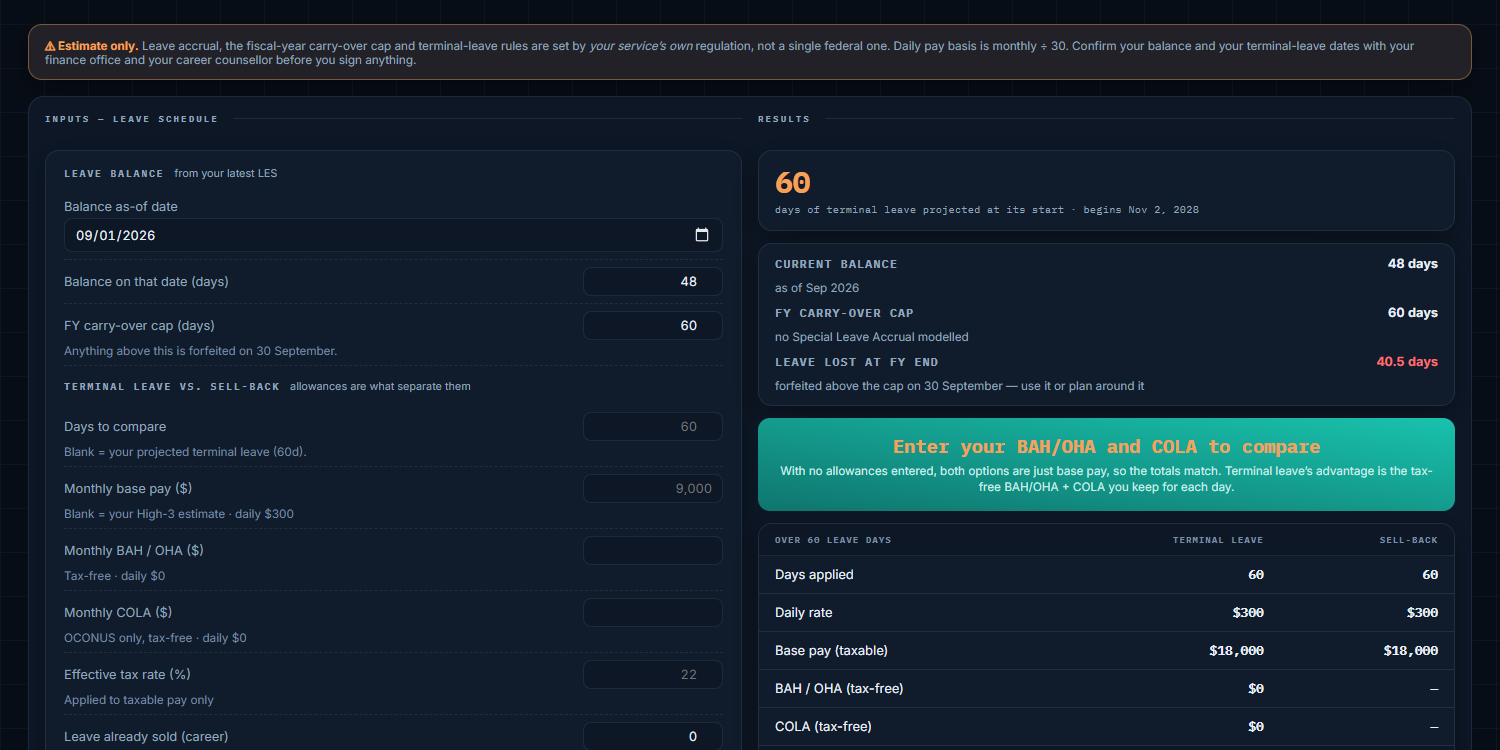
The Leave Calculator is a Pro tool. It shows a fiscal-year forfeiture only when you are still serving at the fiscal-year rollover, because a balance you hold at discharge is paid under §501, up to the 60-day career cap, rather than forfeited at the rollover; it subtracts the days you tell it you have already sold from the 60-day career cap; and it lays PTDY, SkillBridge and terminal leave on the same dates the timeline uses.
The short checklist
- Check your leave and earnings statement for an SLA balance and its expiration date, and confirm both with finance.
- Find your service's current rule — the statute says 30 excess days and the second fiscal year; older printed regulations say more.
- Air Force and Space Force members holding SLA from before 2023: check whether any of it expires on 30 September 2026.
- Keep your balance above 60 if you are relying on protection that ends when you drop to 60.
- Count your career sell-back — any mid-career SLA sell-back reduces what you can sell at separation.
- Schedule protected days into leave or terminal leave before they expire.
Sources
- 10 U.S.C. §701 — (a) 2½ days per month of active service and the exclusions; (b) the 60-day accumulation limit; (d) leave before discharge is active service; (e)(1)–(4) retention of not more than 30 days of excess leave, the qualifying duty, the written authorization and the second-fiscal-year forfeiture; the amendment credits
- 37 U.S.C. §501 — (b)(1) payment at discharge on the basis of basic pay; (b)(3) and (f) the sixty-day career limit after February 9, 1976; (b)(6) the one-time enlisted election for up to 30 days; (c) paid leave is not service
- DAFI 36-3003, Military Leave Program (26 February 2026) — paras 2.4–2.4.3.1; chapter 6, paras 6.1–6.10 (eligibility, the 90-day retention and second-fiscal-year rule, the December 2022 transition, disqualifiers, carry-forward calculation, O-7 approval, exceptions to policy, BCMR route, last-in-first-out accounting)
- AR 600-8-10, Leaves and Passes (3 June 2020) — paras 2-3, 2-4, 3-1 to 3-5, and para 4-9, terminal leave (terminal leave normally granted; limit to leave accrued; the three cash-in options)
- MILPERSMAN 1050-010 (CH-42, 29 March 2013) — the ordinary and special accrual limits and the third-fiscal-year rule as printed · MILPERSMAN 1050-120 (22 August 2002), para 5 — separation leave to the date of separation, including more than 60 days; the 60-day career payment limit
Spot an error? Tell us — citations are the product here.
Extra days only help if you use them in time. WheelsUp's Pro Leave Calculator projects your leave month by month to your date, next to every other transition deadline, with the regulation behind each one.