Which law it actually is
Federal hiring preference lives in Title 5. Two sections do the work: 5 U.S.C. §2108 decides who is a preference eligible, and §3309 says how many points that person gets.
The catch is a statute people cite instead. 38 U.S.C. §4212, headed Veterans’ employment emphasis under Federal contracts, is about something else entirely: it requires federal contracts of $100,000 or more to contain a provision requiring the contractor to “take affirmative action to employ and advance in employment qualified covered veterans.” That is an obligation on contractors. It awards no points in a federal job competition.
So when someone tells you what your preference is worth, ask which section they are reading. If the answer is not §2108 and §3309, keep asking.
Who counts as a veteran for preference
§2108(1) is narrower than the everyday word. You are a veteran for this purpose only if your service fits one of four descriptions:
| §2108(1) | Service that qualifies |
|---|---|
| (A) | Active duty during a war, in a campaign or expedition for which a campaign badge has been authorized, or between April 28, 1952 and July 1, 1955. |
| (B) | More than 180 consecutive days of active duty, any part of which fell after January 31, 1955 and before October 15, 1976 (certain reserve-enlistment service excluded). |
| (C) | Active duty between August 2, 1990 and January 2, 1992. |
| (D) | More than 180 consecutive days of active duty, any part of which fell from September 11, 2001 through the date set by presidential proclamation or by law as the last date of Operation Iraqi Freedom. |
(B), (C) and (D) use the definition of active duty in 38 U.S.C. §101(21). And all four carry the same condition: you must have been discharged or released from active duty under honorable conditions, except as provided in §2108a.
A disabled veteran, under §2108(2), is someone who served on active duty, was separated under honorable conditions (again, except as §2108a provides), and “has established the present existence of a service-connected disability or is receiving compensation, disability retirement benefits, or pension because of a public statute administered by the Department of Veterans Affairs or a military department”. Note that this definition has no wartime or 180-day test of its own.
5 points or 10 points
§2108(3) lists the preference-eligible categories, and §3309 assigns points by paragraph letter:
| Points (§3309) | §2108(3) | Who |
|---|---|---|
| 5 | (A) | A veteran under §2108(1)(A) |
| 5 | (B) | A veteran under §2108(1)(B), (C) or (D) |
| 10 | (C) | A disabled veteran |
| 10 | (D) | The unmarried widow or widower of a veteran under §2108(1)(A) |
| 10 | (E) | The wife or husband of a service-connected disabled veteran, if the veteran has been unable to qualify for any appointment in the civil service or in the government of the District of Columbia |
| 10 | (F) | The parent of an individual who lost his or her life under honorable conditions while serving during a §2108(1)(A) period — if the parent's spouse is totally and permanently disabled, or the parent is unmarried or legally separated when preference is claimed |
| 10 | (G) | The parent of a service-connected permanently and totally disabled veteran — on the same two spouse conditions |
| — | (H) | A veteran discharged or released from a period of active duty by reason of a sole survivorship discharge (as defined in 10 U.S.C. §1174(i)) |
Read (H) carefully. A sole-survivorship veteran is a preference eligible under §2108(3)(H), but §3309's two point clauses name paragraphs (A)–(B) and (C)–(G); neither names (H). Ask the hiring agency how it applies preference in that case rather than assuming a number.
Three limits apply to the whole list. §2108(3) does not cover applicants for, or members of, the Senior Executive Service, the Defense Intelligence Senior Executive Service, the Senior Cryptologic Executive Service, or the FBI and DEA Senior Executive Service. And the whole definition is subject to paragraph (4) — the retiree rule — and to §2108a(c).
The retiree rule: who it shuts out
Retirees should read this provision first. §2108(4) says that, except for the purposes of chapters 43 and 75 of title 5, preference eligible does not include a retired member of the armed forces unless:
- (A) the individual is a disabled veteran; or
- (B) the individual “retired below the rank of major or its equivalent”.
A retired member of the armed forces is defined in §2108(5) as a member or former member who is “entitled, under statute, to retired, retirement, or retainer pay on account of service as a member.”
What that means in practice:
- A retiree at the rank of major or above, or its equivalent, with no qualifying disability is not a preference eligible for §3309's points — however many campaigns they served in.
- The same retiree with an established service-connected disability meets exception (A), because a disabled veteran under §2108(2) is excepted.
- The test turns on entitlement to retired, retirement or retainer pay, so read §2108(5) against your own situation, and ask the agency how it applies the rank test to your retired grade.
If you are planning a federal second career after retirement, settle this question early. A VA rating decision can change which side of paragraph (4) you are on.
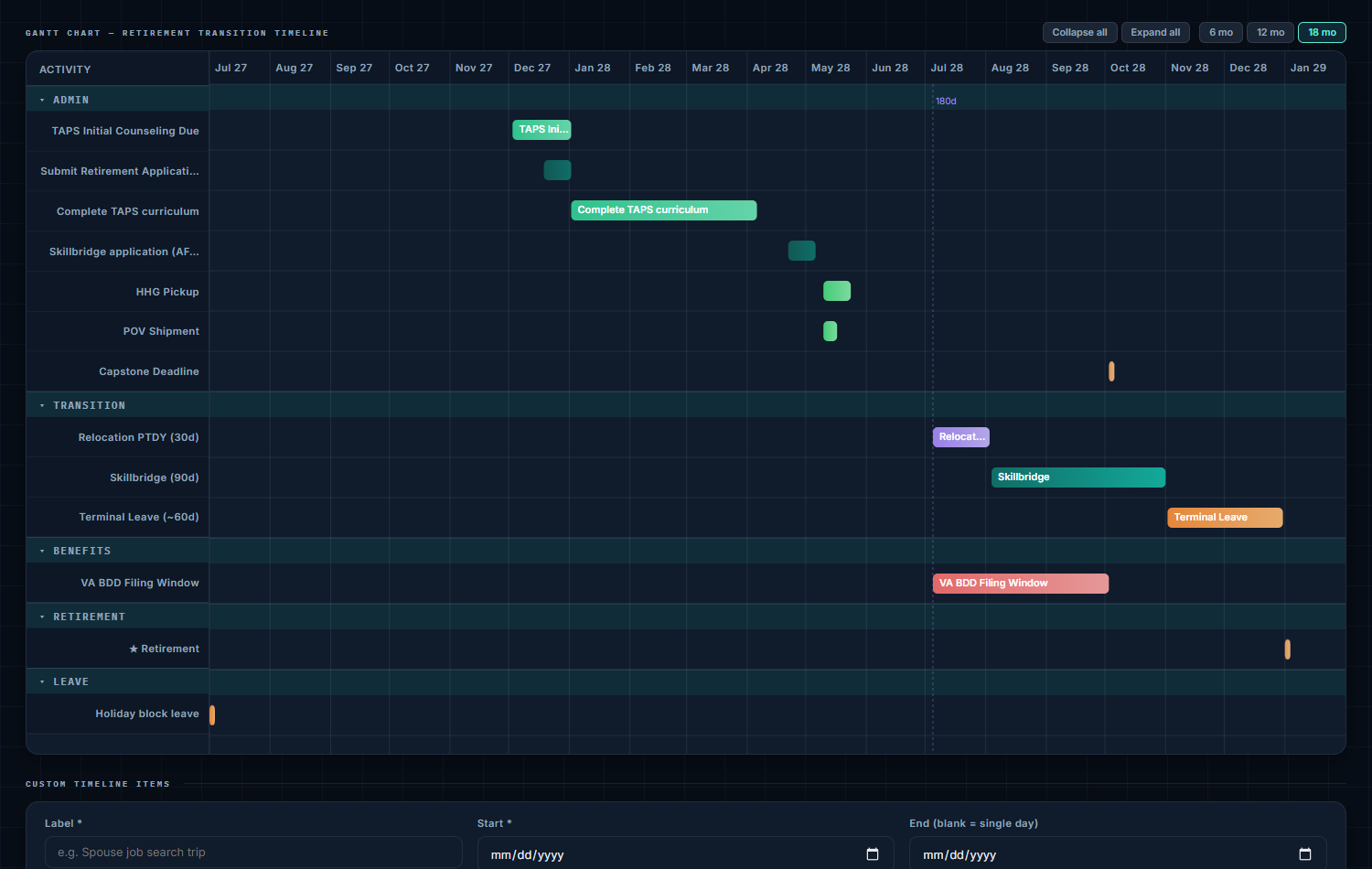
WheelsUp's timeline back-plans your transition from your actual date — SkillBridge, relocation PTDY, terminal leave and the VA filing window on one chart — so a federal job search starts while the dates can still move.
How the points actually apply
§3309 is one sentence and two clauses, and its condition matters: “A preference eligible who receives a passing grade in an examination for entrance into the competitive service is entitled to additional points above his earned rating”.
Three things follow from the text:
- Points come after a passing grade. They are added above your earned rating; they do not turn a failing result into a passing one.
- They attach to an entrance examination for the competitive service. The statute does not describe every hiring route an agency uses. How preference is applied under the assessment method a particular announcement uses is not in this statute — read the announcement and ask HR.
- The number is fixed by category, not by degree. §3309 gives 10 points to every (C)–(G) category and 5 to (A)–(B). Nothing in §3309 scales the points to a disability percentage.
WheelsUp's milestone checklist carries a card on exactly this, placed 90 days before your date, with the §2108 and §3309 citations and the §4212 warning attached.
Access is not preference: §3304(l)
There is a second, separate door. §3304(l)(1) says preference eligibles, or veterans separated under honorable conditions after 3 years or more of active service, “may not be denied the opportunity to compete for vacant positions for which the agency making the announcement will accept applications from individuals outside its own workforce under merit promotion procedures.”
What the subsection adds:
- (2) — if selected, you receive a career or career-conditional appointment, as appropriate.
- (3) — “This subsection shall not be construed to confer an entitlement to veterans' preference that is not otherwise required by law.” It opens the announcement; it adds no points.
- (4) — merit promotion announcements that include consideration of people from the federal workforce must say that these preference eligibles and veterans are eligible to apply.
- (5) — OPM's regulations must not exclude someone who completed an initial tour of active duty and was honorably released shortly before completing 3 years.
For a retiree whom paragraph (4) keeps out of preference, (l)(1) is worth reading closely: it names veterans separated under honorable conditions after 3 or more years of active service alongside preference eligibles. §2108 opens with for the purpose of this title, so veteran here carries the §2108(1) meaning — whether (l)(1) reaches your case is a question to put to the agency.
The short checklist
- Match your service to §2108(1)(A)–(D) — dates and the 180-day rules — and confirm the honorable-conditions requirement is met.
- Find your §2108(3) category, and from it your §3309 points.
- If you are retiring, apply §2108(4): disabled veteran, or retired below the rank of major or its equivalent. If neither, §3309 gives you no points — ask the agency whether §3304(l) access reaches your case.
- Get your disability documentation settled if a 10-point category or the retiree exception depends on it.
- Read each announcement's area of consideration for the §3304(l)(4) statement.
- Ask the agency's HR office what proof it wants for your category before you apply.
Sources
- 5 U.S.C. §2108 — (1)(A)–(D) veteran and the honorable-conditions requirement; (2) disabled veteran; (3)(A)–(H) preference eligible and the Senior Executive Service exclusions; (4) retired members, with the disabled-veteran and below-major exceptions; (5) retired member of the armed forces
- 5 U.S.C. §3309 — additional points for a preference eligible with a passing grade in a competitive-service entrance examination: 10 points under §2108(3)(C)–(G), 5 points under §2108(3)(A)–(B)
- 5 U.S.C. §3304(l)(1)–(5) — merit-promotion access for preference eligibles and 3-year veterans; career or career-conditional appointment; no new preference entitlement; area-of-consideration statement; the initial-tour rule
- 38 U.S.C. §4212(a)(1) — the federal-contractor affirmative-action provision, cited only to distinguish it from hiring preference
Spot an error? Tell us — citations are the product here.
Know your category before you apply. WheelsUp back-plans your transition from your real date, with the citation behind every card — including the one on federal hiring preference.